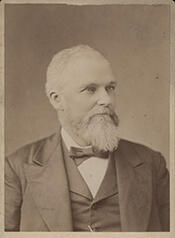
Joseph Ripley Chandler (August 22, 1792 – July 10, 1880) was a Whig member of the U.S. House of Representatives from Pennsylvania who served as a Representative in the United States Congress from 1849 to 1855. Over the course of three terms in office, he contributed to the legislative process during a significant period in American history, participating in the democratic process and representing the interests of his constituents as a member of the House of Representatives.
Born on August 22, 1792, Chandler came of age in the early years of the American republic, a context that shaped his later political alignment with the Whig Party. Details of his early life and family background are sparse in the surviving record, but his subsequent public career suggests that he received a level of education sufficient to support work in writing, public affairs, and politics. His formative years coincided with the nation’s first experiments in party politics and the development of a broader civic culture, influences that would later be reflected in his own public service.
Chandler’s education, while not extensively documented, prepared him for a career that combined intellectual pursuits with public engagement. Like many nineteenth-century public men, he likely pursued a course of study that emphasized reading, rhetoric, and familiarity with law and government, equipping him to participate effectively in political debate and legislative work. His later authorship and public roles indicate that he was regarded as a capable writer and commentator on civic matters.
Before and alongside his congressional service, Chandler was associated with the Whig Party, which advocated for congressional supremacy over the presidency, economic modernization, and internal improvements. His political alignment placed him among those who favored a strong legislative branch and a program of national development. This affiliation provided the platform from which he would seek and win election to the U.S. House of Representatives from Pennsylvania, representing an urbanizing and economically significant state during a period of rapid national change.
Chandler entered the national legislature as a Whig Representative from Pennsylvania in 1849. Serving three consecutive terms, he remained in the House of Representatives until 1855. His tenure in Congress spanned the administrations of Presidents Zachary Taylor, Millard Fillmore, and the early years of Franklin Pierce, a time marked by intensifying sectional tensions over slavery, debates over territorial expansion, and disputes about the balance of power between free and slave states. Within this environment, Chandler contributed to the legislative process, participating in deliberations and votes that shaped federal policy in the years leading up to the Civil War. As a member of the House, he represented the interests of his Pennsylvania constituents, engaging in the democratic process at a moment when questions of union, commerce, and national identity were increasingly contested.
During his years in Congress from 1849 to 1855, Chandler’s work reflected both the priorities of the Whig Party and the concerns of his district. Although the detailed record of his committee assignments and specific bills is limited in surviving summaries, his service coincided with major legislative struggles, including debates over the Compromise of 1850 and related measures that sought to manage sectional conflict. His repeated reelection over three terms indicates that his constituents regarded his representation as effective during a turbulent political era.
After leaving Congress in 1855, Chandler remained a figure of public note, associated with the generation of Whig leaders whose careers bridged the antebellum and Civil War eras. In later life, he continued to be recognized for his contributions as a legislator and as a public man formed in the political culture of the early nineteenth century. He lived to witness the Civil War, Reconstruction, and the nation’s transition into the later industrial age, outliving many of his contemporaries in public service.
Joseph Ripley Chandler died on July 10, 1880, closing a long life that had spanned from the early national period through the post–Civil War era. Remembered primarily as a Whig member of the U.S. House of Representatives from Pennsylvania who served three terms between 1849 and 1855, he occupies a place in congressional history as a participant in the legislative struggles of a formative period in the United States.
Congressional Record