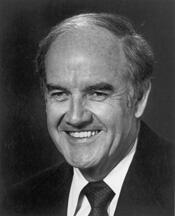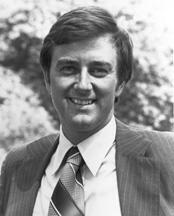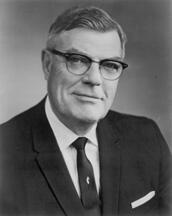
Joseph Henry Bottum (August 7, 1903 – July 4, 1984) was an American politician and jurist who served as the 27th Lieutenant Governor of South Dakota and as a United States Senator from South Dakota. A member of the Republican Party, he represented his state in the U.S. Senate from 1962 to 1963, contributing to the legislative process during one term in office and participating in the democratic governance of the nation during a significant period in American history.
Bottum was born in Faulkton, Faulk County, South Dakota, and was educated in the public schools of his hometown. He came from a family deeply rooted in public service and politics. His paternal grandfather, Henry C. Bottum, had been a member of the Wisconsin State Assembly, while his maternal grandfather, Darius S. Smith, served in the South Dakota Senate. His father, Joseph H. Bottum Sr. (1853–1946), was also a member of the South Dakota Senate and later served as a circuit judge in Faulkton from 1911 to 1942. This multigenerational tradition of public office strongly influenced Bottum’s own career in law and politics.
After completing his early education, Bottum attended Yankton College and then the University of South Dakota from 1920 to 1921. He went on to study law at the University of South Dakota School of Law in Vermillion, from which he graduated in 1927. That same year he was admitted to the bar and began the practice of law, first in St. Paul, Minnesota, and later returning to his native South Dakota to establish a practice in Faulkton. His early legal work laid the foundation for a long career that would span prosecution, state administration, elective office, and the judiciary.
Shortly after beginning his legal practice in Faulkton, Bottum entered public service at the county level. He was elected Faulk County State’s Attorney in 1932 and was re-elected in 1934, gaining experience as a prosecutor during the challenging years of the Great Depression. In 1937 he was appointed State Director of Taxation for South Dakota, a position that placed him at the center of state fiscal administration. In 1942 he sought higher office, running for governor in the Republican primary, but was unsuccessful, losing to Merrell Q. Sharpe. The following year, in 1943, Bottum resigned from state government to accept a federal position with the Board of Economic Warfare in Washington, D.C., reflecting the broader mobilization of governmental resources during World War II.
In 1944 Bottum resigned from the Board of Economic Warfare and returned to South Dakota, where he successfully ran for Pennington County State’s Attorney. He was re-elected to that post in 1946, continuing his career as a county prosecutor in the rapidly growing western part of the state. His prominence within the Republican Party increased, and in 1948 he was elected Chairman of the Republican Party of South Dakota, giving him a major role in shaping the party’s organization and electoral strategy. In 1950 he sought national office, running in the Republican primary for the U.S. House of Representatives from South Dakota’s 2nd congressional district, but he was defeated by Ellis Berry.
Bottum returned to statewide office a decade later. He was elected Lieutenant Governor of South Dakota in 1960 and served in that capacity from 1961 to 1962 in the administration of Governor Archie M. Gubbrud. In this role he presided over the state Senate and was a key figure in the executive branch during a period of postwar growth and political realignment. His tenure as lieutenant governor positioned him for elevation to the federal legislative branch when a vacancy arose in the state’s representation in the United States Senate.
In 1962, following the death of U.S. Senator Francis H. Case, Governor Gubbrud appointed Bottum to the United States Senate to fill the vacancy for the remainder of Case’s term. Bottum thus served as a Senator from South Dakota in the United States Congress from 1962 to 1963. During this single term in office, he participated in the legislative process at a time marked by Cold War tensions and the early stages of the civil rights movement, representing the interests of his South Dakota constituents in the upper chamber of Congress. Separately from his appointment, the state Republican Party selected him as the replacement for Case on the ballot in the 1962 general election. In that contest he faced former U.S. Representative George McGovern and narrowly lost, falling short by just 597 votes, or 0.23 percent of the vote, one of the closest Senate races in South Dakota history.
After leaving the Senate in 1963, Bottum continued his public service in the judicial branch. Following in the footsteps of his father, who had long served as a circuit judge, Bottum became a South Dakota circuit judge in 1965. He held that position until 1980, presiding over a wide range of civil and criminal matters during a period of significant social and political change. Among the notable cases over which he presided was the controversial prosecution of Native American activist Russell Means, brought by then–Attorney General Bill Janklow, reflecting the tensions surrounding Native American rights and activism in the 1970s.
In his later years, Bottum resided in Rapid City, South Dakota, where he remained a respected figure in legal and political circles. He died there on July 4, 1984. Joseph Henry Bottum is interred at Pine Lawn Cemetery in Rapid City, closing a life that encompassed service as a county and state prosecutor, state tax administrator, party leader, lieutenant governor, United States senator, and state circuit judge, and that reflected the longstanding civic engagement of his family in Midwestern and South Dakota public life.
Congressional Record