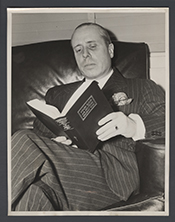
Joseph Clark Baldwin (January 11, 1897 – October 27, 1957) was an American politician, United States Army officer, journalist, and a Republican member of the United States House of Representatives from New York. Born Joseph Clark Baldwin III in New York City, New York, he was the son of Joseph Clark Baldwin Jr. and Fanny Taylor Baldwin. He attended private schools and graduated from St. Paul’s School in Concord, New Hampshire, in 1916. Following the death of his father in 1937, he dropped the “III” from his name and was thereafter known simply as Joseph Clark Baldwin. On December 5, 1923, he married Marthe Guillon-Verne; the couple had two sons and two daughters. Known socially in New York, Baldwin and his wife regularly hosted “At Homes” on alternate Thursday evenings that drew much of New York society as well as visiting celebrities, and his friends recalled his wit and sociability in these gatherings.
During World War I, Baldwin enlisted in the United States Navy in 1917. After six months of persistent seasickness, he transferred in 1918 to the United States Army. He first served overseas as a private in the Machine Gun Company of the 305th Infantry. He later received a commission and, as a captain, commanded the First Platoon, Machine Gun Company, 39th Infantry. For his service in France, he was made an officer of the French Legion of Honor, reflecting distinguished conduct in the field. After the war, he pursued higher education and graduated from Harvard University in 1920, preparing for a career that would combine journalism, public relations, and public service.
Following his graduation from Harvard, Baldwin worked as a political reporter for the New York Tribune, gaining experience in political affairs and public communication. From 1922 to 1930 he served as associate editor of the North Westchester Times, further establishing his reputation in journalism. In 1930 he founded his own public relations firm, drawing on his reporting background and growing political connections. His early professional life thus intertwined with his emerging role in Republican politics in New York City and Westchester County.
Baldwin’s formal political career began in municipal government. From 1929 to 1934 he served as a member of the New York City Board of Aldermen. In that body, he was the only Republican among ninety-four Tammany Hall Democrats, and colleagues joked that he held his party caucuses in a phone booth. He became well known for leading the effort to secure a New York State investigation into the administration of Mayor Jimmy Walker, contributing to what became the Seabury Investigation into municipal corruption. That investigation helped pave the way for the election of Fusion Mayor Fiorello La Guardia and the adoption of a new New York City charter, and Baldwin received considerable public attention for his role. He also served as president of the New York Young Republican Club from 1930 to 1931, further solidifying his standing within the party.
Baldwin advanced to state-level office as a member of the New York State Senate, representing the 17th District in 1935 and 1936. He then served on the New York City Council from 1937 to 1941, participating in the city’s reformed legislative structure following the charter changes. In 1938 he was a delegate to the New York State Constitutional Convention, taking part in deliberations over revisions to the state’s fundamental law. These roles reflected his growing influence in Republican politics and his experience in both municipal and state governance.
Baldwin entered national office during a critical period in American and world history. A member of the Republican Party, he was elected as a Republican to the Seventy-seventh Congress to fill the vacancy caused by the death of Representative Kenneth F. Simpson. He took his seat in the U.S. House of Representatives on March 11, 1941, representing a New York district, and was re-elected to the Seventy-eighth and Seventy-ninth Congresses, serving until January 3, 1947. His three terms in Congress coincided with the United States’ involvement in World War II and the immediate postwar transition. As a member of the House of Representatives, Joseph Clark Baldwin participated in the legislative process, contributed to national policymaking during wartime and reconstruction, and represented the interests of his New York constituents. In 1946 he was an unsuccessful candidate for renomination to the Eightieth Congress, bringing his congressional service to a close in early 1947.
After leaving Congress, Baldwin returned to private life and business, drawing on his experience in public relations and government. He became a representative for the United Dye and Chemical Corporation and for William Recht Company, Incorporated, continuing to work in roles that connected industry and public affairs. He remained a figure associated with Republican politics and civic life in New York, remembered by associates for his independence, humor, and reform-minded approach, including the anecdote in which, after being introduced as “Alderman Joseph Clark Baldwin the ‘Toid,’” he quipped that since his father had died he had “dropped the ‘Toid.’”
Joseph Clark Baldwin died at the Veterans Administration Hospital in Manhattan, New York County, New York, on October 27, 1957, at the age of 60. He was interred at Woodlawn Cemetery in the Bronx, New York. His career spanned military service in World War I, journalism, municipal and state office, and three terms in the United States Congress, marking him as a notable Republican figure in New York politics in the first half of the twentieth century.
Congressional Record