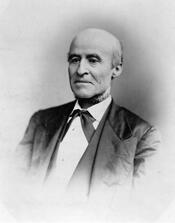
José Manuel Gallegos (October 30, 1815 – April 21, 1875) was a Democratic delegate to the United States Congress from the Territory of New Mexico and one of the earliest Hispanic representatives in the national legislature. He was born in Abiquiú, in what is now Rio Arriba County, New Mexico, then part of the Mexican province of Santa Fe de Nuevo México. Raised in a predominantly Spanish-speaking, Catholic frontier community, he attended local parochial schools, receiving a traditional religious and classical education that prepared him for both the priesthood and public life.
Gallegos pursued advanced religious studies in Mexico, enrolling at the Jesuit-run College of Durango (Colegio de Durango) in the Republic of Mexico. He studied theology there and graduated in 1840, after which he was ordained a Roman Catholic priest. His early adult years thus combined clerical duties with growing involvement in civic affairs. As a priest, he served communities in New Mexico at a time when the region was still under Mexican sovereignty, and his status as a clergyman gave him prominence and influence among local residents.
Gallegos entered politics under Mexican rule, serving as a member of the legislative assembly of the territory of Santa Fe de Nuevo México, Republic of Mexico, from 1843 to 1846. This period coincided with mounting tensions between Mexico and the United States and preceded the U.S. conquest of New Mexico during the Mexican–American War. After the region came under U.S. control and was organized as the Territory of New Mexico, he continued his political career in the new territorial framework. In 1851 he served as a member of the first territorial council of the Territory of New Mexico, participating in the initial efforts to establish American-style civil government in the region.
As a member of the Democratic Party, Gallegos advanced to national office when he was elected as a delegate to the Thirty-third U.S. Congress, serving from March 4, 1853, to March 3, 1855. Although territorial delegates did not have full voting rights on the House floor, they played an important role in representing local interests, and Gallegos contributed to the legislative process during this significant period in American history. He was elected to a second term and began service in the Thirty-fourth Congress on March 4, 1855, but his tenure was cut short on July 23, 1856, when Miguel Antonio Otero (I) successfully contested his election and was seated in his place. Despite this setback, Gallegos remained an important political figure in New Mexico and continued to participate actively in the democratic process on behalf of his constituents.
After leaving Congress in 1856, Gallegos focused on territorial politics. He served as a member of the territorial house of representatives from 1860 to 1862 and was chosen as speaker of that body, underscoring the respect he commanded among his colleagues. During the Civil War, New Mexico became a contested region, and in 1862 Gallegos was captured and made a prisoner of war by Texas Confederate troops when they passed through Santa Fe as part of the Confederate campaign in the Southwest. Following his release and the restoration of Union control, he resumed public service in the territorial administration.
In the mid-1860s Gallegos held key executive positions in the Territory of New Mexico. He served as Treasurer of the New Mexico Territory in 1865 and 1866, overseeing the territory’s fiscal affairs during the difficult postwar period. In 1868 he was appointed Superintendent of Indian Affairs in New Mexico, a post that placed him at the center of federal–tribal relations in the region. In this capacity he was involved in administering federal policies affecting Native American communities at a time of ongoing conflict, negotiation, and resettlement across the Southwest.
Gallegos returned to national office when he was elected as a Democrat to the Forty-second U.S. Congress, serving as New Mexico’s territorial delegate from March 4, 1871, to March 3, 1873. This service, combined with his earlier terms, meant that he served in Congress during three separate terms in office between 1853 and 1873. At the time of his final congressional service he did not speak English and formally requested permission to use a translator on the floor of the House of Representatives; this request was denied, highlighting both the linguistic and cultural barriers faced by Hispanic representatives in the 19th-century Congress. He was an unsuccessful candidate for reelection in 1872 to the Forty-third Congress, bringing his congressional career to a close.
In his later years, Gallegos remained a prominent figure in Santa Fe, where he lived in a residence that would later become historically notable and eventually house the Santacafé restaurant. He died in Santa Fe, New Mexico, on April 21, 1875, and was interred there in the Catholic Cemetery. His life and career, spanning Mexican and American rule, the Mexican–American War, and the Civil War era, have drawn scholarly attention, including a biographical study titled “Très macho – he said: Padre Gallegos of Albuquerque, New Mexico’s first congressman,” which underscores his dual identity as priest and politician and his role as one of the earliest Hispanic Americans to serve in the United States Congress.
Congressional Record