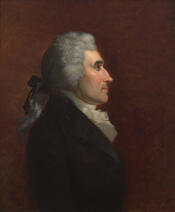
Jonathan Dayton (October 16, 1760 – October 9, 1824) was an American Founding Father, lawyer, soldier, and Federalist politician from New Jersey who served in both houses of the United States Congress. At age twenty-six, he was the youngest person to sign the Constitution of the United States. He was elected to the United States House of Representatives in 1791 and later served from 1795 to 1799 as its third Speaker. He left the House in 1799 after being elected to the United States Senate, where he served one term. A member of the Federalist Party, he contributed to the legislative process during his service in Congress, which occurred during a significant period in American history. His national political career was later damaged by his 1807 arrest for alleged treason in connection with Aaron Burr’s conspiracy, although he was ultimately exonerated.
Dayton was born in Elizabethtown (now Elizabeth), New Jersey, the son of Elias Dayton, a merchant prominent in local politics who had served as a militia officer in the French and Indian War, and his wife, the former Hannah Rolfe. He attended the local academy in Elizabethtown, run by Tapping Reeve and Francis Barber, where he was a classmate of Alexander Hamilton. He then enrolled at the College of New Jersey (now Princeton University). With the outbreak of the American Revolutionary War, he left college in 1775 to join the Continental Army and was later awarded an honorary degree in 1776 in recognition of his service.
Dayton’s military career began when he was fifteen years old. At the outbreak of the war in 1775, he served under his father in the 3rd New Jersey Regiment as an ensign. On January 1, 1777, he was commissioned a lieutenant and served as paymaster. He saw active service under General George Washington, fighting in the battles of Brandywine and Germantown, and he remained with Washington at Valley Forge during the harsh winter encampment. He helped push British forces from their positions in New Jersey into the safety of New York City. Revolutionary War pension records indicate that he served as aide-de-camp to General John Sullivan on his expedition against Native American nations from May 1 to November 30, 1779. On March 30, 1780, at age nineteen, he was promoted to captain and transferred to the 2nd New Jersey Regiment, in which capacity he took part in the Battle of Yorktown. In October 1780, Dayton and an uncle were captured by Loyalists and held captive over the winter, being released the following year, after which he again served under his father in the New Jersey Brigade. At the close of the war, he was admitted as an original member of The Society of the Cincinnati in the state of New Jersey. On July 19, 1799, he was offered a commission as major general in the Provisional United States Army, but he declined.
After the Revolutionary War, Dayton studied law and opened a legal practice, dividing his time between law, land speculation, and politics. He became a New Jersey delegate to the Continental Congress and later to the Constitutional Convention of 1787, where, at age twenty-six, he was the youngest member and signed the Constitution. He entered state politics as a member of the New Jersey General Assembly in 1786–1787 and again in 1790, and he served in the New Jersey Legislative Council (now the New Jersey Senate) in 1789. These roles established him as a prominent Federalist legislator in the early years of the republic.
Dayton was elected to the United States House of Representatives in 1789 but did not take his seat in the First Congress; he entered the House when he was re-elected in 1791. He served in the House through successive terms and became Speaker for the Fourth and Fifth Congresses, from 1795 to 1799, making him the third Speaker of the House of Representatives. As Speaker and as a leading Federalist, he supported the fiscal policies of Alexander Hamilton and helped organize the federal response to the Whiskey Rebellion. He also supported the Louisiana Purchase and opposed the repeal of the Judiciary Act of 1801, aligning himself with Federalist efforts to maintain a strong national judiciary. He left the House in 1799 after being elected to the United States Senate.
In the Senate, Dayton represented New Jersey from 1799 to 1805. Although one source describes his service as a single term, he is also recorded as having served as a Senator from New Jersey from 1791 to 1805, and he remained an active Federalist voice in Congress during this formative period of the early republic. As a member of the Senate, he participated in the legislative process and represented the interests of his New Jersey constituents during a time marked by partisan conflict between Federalists and Democratic-Republicans and by the nation’s efforts to define its institutions and policies under the new Constitution.
Dayton became wealthy through heavy investments in western lands, particularly in the Ohio country. At the time the city of Dayton, Ohio, was established in 1796, he owned, in partnership with Arthur St. Clair, James Wilkinson, and Israel Ludlow, approximately 250,000 acres in the Great Miami River basin. Although he never visited the area, the city of Dayton was named in his honor. His land dealings later intersected with national politics when he lent money to former Vice President Aaron Burr. In 1807, Dayton was arrested for alleged treason in connection with Burr’s purported conspiracy to establish an independent country in the Southwestern United States and parts of Mexico. He was exonerated by a grand jury and never brought to trial, but the association with Burr effectively ended his national political career.
In his private life, Dayton married Susan Williamson in 1779, and the couple had two daughters. He continued to reside in his native Elizabethtown (Elizabeth), New Jersey, where he remained a respected figure despite the decline of his national influence. He died there on October 9, 1824. Dayton was interred in an unmarked grave that now lies beneath St. John’s Episcopal Church in Elizabeth, which replaced an earlier church on the site in 1860. Shortly before his death, he was visited by the Marquis de Lafayette during Lafayette’s celebrated tour of the United States. An obituary in the Columbian Centinel of October 20, 1824, reported that when “the Nation’s Guest” passed through New Jersey, he spent the night with Dayton, and that Dayton’s exertions to honor Lafayette and accommodate the wishes of his fellow citizens to see him contributed to the decline in his health from which he did not recover.
Jonathan Dayton’s legacy is reflected in the places that bear his name. In addition to the city of Dayton, Ohio, Jonathan Dayton High School in Springfield Township, Union County, New Jersey, the Dayton neighborhood of Newark, New Jersey, Dayton Street in Madison, Wisconsin, and Dayton, New Jersey, are named in his honor. His service as a Revolutionary War officer, a signer of the Constitution, Speaker of the House, and United States Senator from New Jersey secured his place among the notable Federalist leaders of the early United States.
Congressional Record