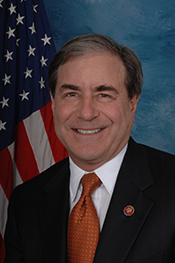
John Allan Yarmuth (YAR-mith; born November 4, 1947) is a retired American politician, newspaper editor, and publisher who served as the U.S. representative for Kentucky’s 3rd congressional district from January 3, 2007, to January 3, 2023. A member of the Democratic Party, he represented a district that encompassed the vast majority of Louisville, Kentucky, which has shared borders with Jefferson County since the 2003 city-county merger. Over eight consecutive terms in office, he became a prominent liberal voice in the House of Representatives and, from 2013 onward, the sole Democratic member of Kentucky’s congressional delegation. Yarmuth chaired the House Budget Committee from 2019 to 2023 and introduced the American Rescue Plan Act of 2021, President Joe Biden’s first major piece of legislation. On October 12, 2021, he announced that he would not seek reelection in 2022 and would retire from Congress at the end of his term in 2023.
Yarmuth was born in Louisville, Kentucky, the son of Edna E. (née Klein) and Stanley R. Yarmuth. He is descended from Jewish immigrants from Russia and Austria, and he grew up in Louisville’s public schools, graduating from Atherton High School. He went on to attend Yale University, where he majored in American studies, an academic background that later informed both his political commentary and his legislative interests. His early exposure to public affairs, combined with his family’s immigrant heritage and Louisville roots, helped shape his views on civic responsibility, civil rights, and the role of government.
After graduating from Yale, Yarmuth began his career in national politics as a legislative aide to Republican U.S. Senator Marlow Cook of Kentucky, serving in that capacity from 1971 to 1974. During this period, he described himself as a Rockefeller Republican, aligned with the party’s moderate, pro–civil rights, and pro–good-government wing. While working for Senator Cook in 1971, he briefly gained attention on Capitol Hill when he posed as a pin-up model for an April Fool’s edition of the newspaper Roll Call. Over time, however, Yarmuth became disillusioned with the Republican Party, particularly during the presidency of Ronald Reagan. He later explained that he left the party because he perceived “an unmistakable move away from moderation” as Reagan courted religious conservative leaders such as Jerry Falwell and Pat Robertson and increasingly catered to the religious right.
Returning to Louisville after his service in Washington, Yarmuth launched a career in publishing and higher education administration that would make him a well-known figure in his hometown. In 1976 he founded Louisville Today, a city magazine that operated until 1982, marking his first major venture as a publisher. From 1983 to 1986 he served as vice president of university relations at the University of Louisville, working on institutional advancement and public outreach. His contributions to the university were later recognized in 2014, when he was inducted into Omicron Delta Kappa as an honoris causa initiate. In 1990, he founded the Louisville Eccentric Observer (LEO), an alternative weekly newspaper. At LEO he wrote a generally liberal political column, often appearing on the front page, that established him as a prominent local commentator and critic of conservative policies. In 2003 he sold LEO to a company owned by Times Publishing Company of Pennsylvania, the owner of the Erie Times-News, but he remained with the paper as a columnist and consultant until January 2006, when he placed his column on hiatus in order to run for Congress.
On January 31, 2006, Yarmuth filed candidacy papers to represent Kentucky’s 3rd congressional district in the U.S. House of Representatives. He won the Democratic primary on May 16, 2006, defeating Andrew Horne, Burrell Charles Farnsley, and James W. Moore. His general election campaign against incumbent Republican Representative Anne Northup quickly drew national attention. In early August 2006, The Courier-Journal reported that The Hill had revealed the Democratic Congressional Campaign Committee had earmarked $51.5 million for television advertising in 32 congressional districts nationwide, but none for Yarmuth’s race, underscoring the perception that his challenge was an uphill battle. As the campaign progressed, polling showed a tightening contest: a WHAS11/SurveyUSA poll reported by The Courier-Journal on October 20, 2006, showed Yarmuth leading Northup 48 percent to 47 percent, after an earlier poll had Northup ahead by six points. Another WHAS11/SurveyUSA poll released on November 2 showed Yarmuth expanding his lead to 52 percent to 44 percent. During the campaign, Yarmuth pledged to donate his congressional salary—set at $168,500 in 2007—to local charities if elected. Because Kentucky’s polls close relatively early, many analysts viewed the race as an early indicator of national trends in the 2006 midterm elections, and it became one of the most closely watched House contests in the country. In the November general election, Yarmuth defeated Northup with 122,139 votes (51 percent) to her 116,157 (48 percent), while independent candidates received 2,896 votes (1 percent). He took office on January 3, 2007.
During his first year in Congress, Yarmuth followed through on his campaign pledge and donated his post-tax congressional salary—just over $120,000—to various Louisville charities, reinforcing his image as a reform-minded and community-focused legislator. In 2008 he endorsed Barack Obama for the Democratic nomination for President of the United States and faced Northup again in a rematch for the 3rd district seat. That year he ran unopposed in the Democratic primary and defeated Northup in the general election with 59 percent of the vote, solidifying his hold on the district. Following his 2008 reelection, the Democratic Steering and Policy Committee rewarded him with a seat on the influential House Ways and Means Committee. On that committee he worked on Social Security, pension, Medicare, and Medicaid issues, areas that had been central to his campaign and remained central to his legislative agenda.
Yarmuth continued to secure reelection by substantial margins throughout the next decade. In 2010 he was challenged by Republican Todd Lally and Independent Michael D. Hansen and was reelected with 55 percent of the vote. In 2012 he faced Republican Brooks Wicker and Independent candidate Robert L. Devore Jr., winning 206,385 votes (63.96 percent) to Wicker’s 111,452 (23.32 percent) and Devore’s 4,819 (1.49 percent). In the 2014 general election he was opposed by Republican Michael McFarlane and Independent Gregory Puccetti; a debate hosted by Kentucky Educational Television and moderated by Bill Goodman was broadcast live on Louisville’s KET on October 6, 2014. Yarmuth was reelected that year with 63.5 percent of the vote. In 2016 he defeated Republican Harold Bratcher and Independent Everett Corley, receiving 212,388 votes (63 percent) to Bratcher’s 122,085 (37 percent), while Corley received no recorded votes. In 2018 he announced on April 17 that he would seek reelection and campaigned in part on his desire to chair the House Budget Committee, promising to hold hearings on proposals such as Medicare for All. He was reelected with more than 62 percent of the vote against Republican Vickie Yates Glisson, Kentucky’s former Secretary of Health and Family Services. In 2020 he won an eighth and final term with 62 percent of the vote against Republican Rhonda Palazzo.
Throughout his congressional service, Yarmuth was an active participant in major legislative debates and a consistent advocate for progressive policies. In September 2008 he voted against the initial version of the Emergency Economic Stabilization Act, commonly known as the TARP bailout plan, which had been negotiated by House Speaker Nancy Pelosi, Senate Majority Leader Harry Reid, President George W. Bush, House Minority Leader John Boehner, and Senate Minority Leader Mitch McConnell; he later voted for the revised version of the bailout bill. In June 2009 he drew attention for leaving the House chamber during a moment of silence for entertainer Michael Jackson, later stating that he was “nauseated” by the gesture and calling it “outrageous,” noting that in his two and a half years in Congress such honors had been reserved for former members. At a contentious town hall meeting in September 2009, he defended his support for the Patient Protection and Affordable Care Act, remaining calm in the face of boos and catcalls from some constituents and warning, according to an Associated Press report, that the existing health care system was an unsustainable drain on businesses and the national economy.
Yarmuth’s legislative priorities frequently centered on campaign finance reform, voting rights, and democratic accountability. In 2011 he joined Republican Representative Walter Jones in introducing a bill to overturn key elements of the Supreme Court’s decision in Citizens United v. FEC, seeking to give Congress authority to enact mandatory public financing for congressional candidates and to establish a national holiday for voting. That same year he voted against the National Defense Authorization Act for Fiscal Year 2012, citing concerns over a controversial provision that allowed the government and the military to detain American citizens and others indefinitely without trial. In 2013 he introduced the Fair Elections Now Act, which proposed a public financing system for congressional campaigns, and in 2015 he sponsored H.R. 2125, the Keeping Our Campaigns Honest Act of 2015, another effort to curb “dark money” in politics. In 2018 he signed onto a “Medicare for All” bill along with more than 120 other House Democrats, endorsing a single-payer health care system. Over the course of his tenure, he became the first Kentuckian to join the Congressional Progressive Caucus, aligning himself with the party’s left-leaning bloc on issues such as health care, economic inequality, and campaign finance reform.
When Democrats regained control of the House of Representatives following the 2018 elections, Yarmuth achieved his long-sought goal of chairing the House Budget Committee in the 116th Congress, a position he held from 2019 to 2023. As chair, he played a central role in shaping budgetary policy and oversight, including requesting documents related to the withholding of congressionally appropriated defense funds to Ukraine during the Trump administration. His leadership on the committee earned him an “A” grade from the nonpartisan Lugar Center’s Congressional Oversight Hearing Index, reflecting his active role in conducting hearings and exercising legislative oversight. On December 18, 2019, he voted for both articles of impeachment against President Donald Trump, becoming the only House member from Kentucky to support impeachment. In 2021 he introduced the American Rescue Plan Act of 2021 in the House, the Biden administration’s first major legislative initiative, which provided extensive economic relief in response to the COVID-19 pandemic. On October 12, 2021, Yarmuth publicly announced that he would retire from Congress at the end of his term in January 2023, concluding a 16-year career in the House during a significant period in American political history, in which he consistently participated in the democratic process and represented the interests of his Louisville-area constituents.
Congressional Record