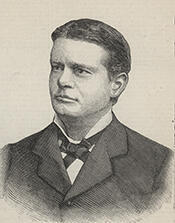
John Sergeant Wise (December 27, 1846 – May 12, 1913) was an American author, lawyer, and politician from Virginia who served one term as a Representative in the United States Congress from 1883 to 1885. He was born in Rio de Janeiro, Empire of Brazil, where his father, Henry A. Wise, was serving as U.S. Minister to Brazil, and his mother was Sarah Sergeant. Returning to the United States as a child, he grew up at Rolleston, the family plantation on the Elizabeth River outside Norfolk, Virginia. His father, a prominent Virginia politician, had served as a U.S. Congressman before being elected Governor of Virginia in 1856, and the younger Wise’s early life unfolded in the milieu of antebellum Virginia’s political and planter elite.
Wise was privately tutored in his youth before enrolling at the Virginia Military Institute (VMI) in Lexington, Virginia. When the American Civil War began in 1861, he was still a student at VMI. On May 15, 1864, he served with the VMI Corps of Cadets at the Battle of New Market in the Shenandoah Valley. Although ordered to remain behind to guard the cadets’ baggage train, he defied those orders and joined the cadets’ famous charge on the battlefield, an episode that later became central to his own recollections of the war. Following New Market, Wise accepted an officer’s commission in the Confederate States Army, thus interrupting his formal education in order to serve in the Confederate cause during the closing years of the conflict.
After the Civil War, Wise resumed his education in a more traditional academic setting. He studied law at the University of Virginia in Charlottesville, where he was initiated as a member of the Beta Theta Pi fraternity in 1867. That same year he completed his legal studies, graduated, and was admitted to the bar. Establishing himself in Richmond, Virginia, he began a long legal career, practicing law in the state capital for many years. His professional and family background, together with his war service and legal training, positioned him as a figure of some prominence in postwar Virginia society.
Wise’s political career developed alongside his legal practice. In 1880 he was an unsuccessful candidate for the United States House of Representatives. On May 1882 he was appointed United States Attorney for the Eastern District of Virginia, a post he held until March 1883. Later in 1882, he successfully ran for Congress and was elected as a member of the Readjuster Party to represent Virginia’s at-large seat. The Readjusters were a coalition of Republicans and dissident Virginia Democrats who sought to “readjust” the state’s prewar debt and pursued a reform agenda in the turbulent politics of the Reconstruction and post-Reconstruction era. Wise’s election reflected both the shifting political alignments in Virginia and his own appeal as a lawyer and public figure.
From March 4, 1883, to March 3, 1885, Wise served in the 48th United States Congress as a Representative from Virginia. During this single term in office, he participated in the legislative process at a time of significant transition in American political and social life, representing the interests of Virginians in the House of Representatives. As a member of the Readjuster Party, he contributed to debates shaped by the lingering effects of the Civil War, Reconstruction policies, and the evolving status of African Americans and poor whites in the South. His service in Congress occurred during a period when Virginia and the nation were redefining federal-state relations and grappling with questions of suffrage, public finance, and regional reconciliation. When Virginia’s congressional districts were redrawn before the 1884 elections, the statewide at-large seat he held was abolished. Wise chose not to seek re-election from a newly drawn district. Instead, in 1885 he ran for Governor of Virginia as a Republican, but he was defeated by Democrat Fitzhugh Lee.
Wise remained active in legal and political affairs after leaving Congress. On November 3, 1869, he had married Evelyn Byrd Beverly Douglas, daughter of Hugh Douglas and Nancy Hamilton, and together they had nine children: John Sergeant Wise (who died young), Hugh Douglas Wise, Henry Alexander Wise, a second son named John Sergeant Wise (in keeping with the custom of giving a later-born child the name of a deceased sibling to carry on the father’s name), Hamilton Wise, Eva Douglas Wise, Jennings Cropper Wise, Margaretta Watnough Wise, and Byrd Douglas Wise. One of his sons, Jennings Cropper Wise, later received the Distinguished Service Cross during the First World War and became Commandant of the Virginia Military Institute, while his grandson Henry A. Wise (1906–1982) served as a New York State Senator. Professionally, Wise continued to practice law in Virginia and took on significant constitutional litigation. In November 1902 he served as attorney of record in two federal lawsuits, Jones v. Montague and Selden v. Montague (both reported at 194 U.S. 147–153 (1904)), challenging the actions of the Virginia Constitutional Convention of 1902. Acting on behalf of voters in Virginia’s 3rd congressional district, he sought a writ of prohibition to prevent the counting of the November 1902 election returns and argued that the convention’s work—proclaimed in effect on July 10, 1902, without the promised popular ratification—was designed to disenfranchise Black voters and many poor whites. The federal courts, relying in part on the precedent of Mills v. Green, 159 U.S. 651 (1895), held that they lacked jurisdiction, and the U.S. Supreme Court noted that the “thing sought to be prohibited has been done and cannot be undone by order of court,” observing that the House of Representatives had already seated the congressmen elected under the new system. By the 1904 election, voter participation had fallen dramatically, with approximately fifty percent fewer white men and ninety percent fewer Black men voting in Virginia.
In addition to his legal and political work, Wise gained recognition as an author. He wrote several books, including Diomed: The Life, Travels, and Observations of a Dog (1897); The End of an Era (1899); The Lion’s Skin: A Historical Novel and a Novel History (1905); and Recollections of Thirteen Presidents (1906). The End of an Era, his best-known work, is a memoir of his boyhood on the Rolleston plantation in Virginia, his close relationship with an enslaved childhood companion, and his experiences during the Civil War, including his father’s role and the collapse of the antebellum world. The book has been reprinted in numerous editions and is available in full text through the University of North Carolina’s “Documenting the American South” project. In his later years, Wise moved to New York City, where he continued to practice law until his retirement. He died on May 12, 1913, near Princess Anne, Maryland. His life and wartime service have continued to attract historical interest; he was portrayed by actor Luke Benward in the 2014 film Field of Lost Shoes, which dramatizes the Battle of New Market.
Congressional Record