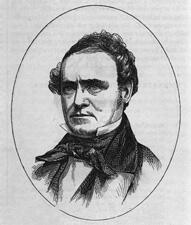
John B. Weller (February 22, 1812 – August 17, 1875) was an American lawyer, soldier, and Democratic politician who served as a congressman from Ohio, a United States senator from California, the fifth governor of California, and later minister to Mexico. Over the course of a long public career, he held office at both the state and federal levels during a period of profound territorial expansion and sectional conflict in the United States.
Weller was born in Hamilton County, Ohio, and attended the public schools before enrolling at Miami University in Oxford, Ohio. After his studies he read law, was admitted to the bar, and began practicing in Butler County, Ohio. He quickly entered public life, serving as prosecuting attorney of Butler County from 1833 until 1836. His early legal and prosecutorial work established his reputation within the Democratic Party in Ohio and laid the groundwork for his subsequent election to national office.
In 1838 Weller was elected as a Democrat from Ohio to the Twenty-sixth Congress. He was reelected to the Twenty-seventh and Twenty-eighth Congresses, serving in the U.S. House of Representatives from March 4, 1839, until March 3, 1845. During these three consecutive terms he participated in the legislative process at a time of rapid national growth, representing the interests of his Ohio constituents in debates over economic policy, territorial issues, and the evolving party conflicts of the era. His service in Congress occurred during a significant period in American history, and he contributed to the democratic process over what was effectively four terms in federal office when his later Senate service is also considered.
After leaving the House, Weller served in the Mexican–American War. From 1846 until 1847 he was lieutenant colonel of the 1st Regiment of Ohio Volunteers, seeing active duty in the conflict that resulted in large territorial gains for the United States. Returning to politics, he became the Democratic candidate for governor of Ohio in 1848. The campaign was bitterly contested and produced the only disputed election for Ohio governor in the nineteenth century. A select joint committee of the Ohio General Assembly ultimately determined on January 22, 1849, that Weller had lost the election to Whig candidate Seabury Ford by 311 votes.
Weller’s involvement with the newly acquired western territories began soon thereafter. In 1849 and 1850 he served as a member of the federal commission charged with establishing the boundary line between California and Mexico. President Zachary Taylor, a Whig, later replaced him on the commission, first naming John C. Frémont. After Frémont resigned without beginning his duties, Taylor appointed John Russell Bartlett to the post. Weller then settled permanently in California, where he resumed the practice of law and became active in the state’s Democratic politics.
When Frémont’s term as U.S. senator from California expired on March 3, 1851, the California legislature initially failed to elect a successor, leaving the seat vacant beginning March 4. In 1852 the legislature chose Weller to fill the position. He served as a United States senator from California from January 30, 1852, to March 3, 1857. A member of the Democratic Party, he contributed to the legislative process during his term in the Senate and represented the interests of his California constituents. During the Thirty-fourth Congress he was chairman of the Senate Committee on Military Affairs, a role that placed him at the center of deliberations over military organization and frontier security in the tense years preceding the Civil War. After running unsuccessfully for reelection to the Senate, he turned his attention back to state office.
In 1857 Weller was elected governor of California, and he served as the state’s fifth governor from January 8, 1858, to January 9, 1860. His governorship coincided with intensifying national disputes over slavery and sectionalism. Weller indicated that he intended to make California an independent republic if the North and South divided over slavery, reflecting the volatility of political sentiment on the Pacific coast. He also personally led an assault on San Quentin Prison to take possession of the facility from a commercial contractor, asserting direct state control over the institution. His administration was marked by grave violence against Indigenous peoples. Weller sanctioned the genocide of the Yuki Tribe by granting a state commission to Walter S. Jarboe after U.S. Army generals refused to participate in a campaign against the Yuki. Jarboe’s band, known as the “Eel River Rangers,” massacred at least 283 men—Jarboe did not record the women and children killed—and later presented the State of California with a bill for $11,143. Historian Benjamin Madley has written that Weller “officially sanctioned genocide” through these actions.
After leaving the governorship, Weller was appointed minister (often styled ambassador) to Mexico near the end of 1860 by the lame-duck administration of President James Buchanan. He presented his credentials in 1861, but his mission was short-lived; the incoming Lincoln administration soon recalled him as federal policy shifted with the onset of the Civil War. In 1867 Weller moved to New Orleans, Louisiana, where he continued to practice law and served as a United States commissioner, remaining professionally active in legal affairs during his later years.
Weller married four times. His first wife, Ann E. Ryan, died in 1836. In 1840 he married Cornelia A. Bryan, who died in 1842. He married Susan McDowell Taylor in 1845; she died in 1848. Susan Taylor was the daughter of William Taylor, the niece of Senator Thomas Hart Benton, and a cousin of Jessie Benton Frémont, linking Weller by marriage to several prominent political families. In 1854 he married Elizabeth Winona Brockelbank, who had previously been married to Stephen Stanton and had a son, Josiah, from that earlier marriage. Weller’s father-in-law John A. Bryan was a U.S. diplomat, and his brother-in-law Charles Henry Bryan served as a California state senator, further extending Weller’s connections within Democratic political circles.
John B. Weller died in New Orleans on August 17, 1875. His original interment was at Girod Street Cemetery in that city. When the cemetery was destroyed in 1959, unclaimed remains, including Weller’s, were commingled with those of approximately 15,000 others and deposited beneath Hope Mausoleum in St. John’s Cemetery, New Orleans, where his remains now rest.
Congressional Record