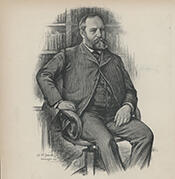
John DeWitt Warner (October 30, 1851 – May 27, 1925) was an American lawyer, civic leader, and Democratic politician who served as a U.S. Representative from New York from 1891 to 1895. During his two terms in the House of Representatives, he represented parts of Manhattan, including Midtown, Hell’s Kitchen, and Chelsea, and contributed to the legislative process during a significant period in American history. As a member of the Democratic Party, he participated actively in the democratic process and represented the interests of his urban constituents in New York City.
Warner was born on a farm near Reading, New York, and in his childhood moved with his parents first to Big Stream (later known as Glenora), New York, and later to Rock Stream, New York. He completed his preparatory education in the district schools and at Starkey Seminary in Eddytown, New York. Demonstrating early academic promise, he pursued further studies at Cornell University, from which he graduated in 1872. While at Cornell, he was a charter member of the university’s chapter of the Delta Kappa Epsilon fraternity and a member of the Irving Literary Society, and he wrote the lyrics for the Cornell song “1875,” reflecting his early interest in literature and the arts.
Before entering the legal profession, Warner taught for four years at the Ithaca and Albany Academies, gaining experience in education that complemented his later public service. He subsequently enrolled at Albany Law School, where he completed his legal studies and graduated in 1876. After admission to the bar, he moved to New York City and began practicing law, establishing himself professionally in the state’s principal commercial and political center. His continuing connection to Cornell University was recognized when he was elected an Alumni Trustee in June 1882, underscoring his prominence among the institution’s graduates.
Warner’s political career reached its height with his election to the United States House of Representatives as a Democrat. He served in Congress from 1891 to 1895, holding office for two consecutive terms during an era marked by intense national debates over tariffs, taxation, and economic policy. In the House of Representatives, he was identified with reformist and free-trade currents within the Democratic Party. In 1894, during consideration of the Wilson–Gorman Tariff Act, he was one of only six congressmen to vote in favor of a single tax amendment proposed by Georgist Democrat James G. Maguire of California. The amendment, intended as a substitute for the bill’s proposed income tax, would have levied a direct tax of $31,311,125 on land values nationwide. After the single tax proposal was rejected, Warner voted in favor of the original version of the Wilson–Gorman Tariff bill but opposed the final version returned by the Senate several months later, reflecting his principled stance on tariff and tax policy.
Following his congressional service, Warner remained active in public affairs, law, and civic life in New York. He became president of the American Free Trade League from 1905 to 1909, a role that aligned with his long-standing advocacy of freer trade and his earlier positions in Congress. In 1911 and 1912 he served as special counsel for the New York City dock department, advising on terminal work at a time when the city’s harbor and port facilities were of critical economic importance. In 1913 he was appointed to a commission to revise the New York banking laws, contributing his legal expertise to efforts to modernize and strengthen the state’s financial regulatory framework.
Beyond politics and law, Warner was deeply involved in the arts and cultural institutions. He was one of the founders of the National Sculpture Society, reflecting his interest in public art and artistic patronage. In New York City he served as president of the Art Commission of the City of New York, a body responsible for overseeing the artistic quality of public monuments and works, thereby influencing the visual and cultural landscape of the city. His leadership in these organizations underscored his reputation as a cultivated public figure who linked legal, political, and artistic concerns.
Warner’s personal life was closely tied to the academic and social circles in which he had long moved. He married Lillian Hudson, a native of New York who descended from an old New York family; her paternal grandfather had served with distinction in the War of 1812. Like her husband, she was educated at Ithaca Academy and then attended Cornell University, reflecting a shared commitment to higher education. The couple had two children, a son and a daughter, Charlot Lillian Warner. John DeWitt Warner continued to be remembered for his combined roles as educator, lawyer, legislator, free-trade advocate, and patron of the arts until his death on May 27, 1925.
Congressional Record