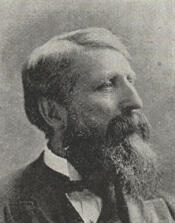
John Van Voorhis (October 22, 1826 – October 20, 1905) was an American lawyer and Republican politician from New York who served as a Representative in the United States Congress during a significant period in American history. He was born in Decatur, New York, in 1826. His family moved several times during his youth before settling in the town of Mendon, New York, where he spent much of his early life. These early experiences in upstate New York helped shape his familiarity with the region and the communities he would later represent in public office.
Van Voorhis pursued a legal education and studied law in New York State. He was admitted to the bar in December 1851, formally entering the legal profession. In the spring of 1853, he commenced the practice of law in Elmira, New York, but soon chose to relocate to Rochester, New York, where he opened his own law practice on July 4, 1854. Over time, his practice became a family enterprise, as he was eventually joined by his brother Quincy and his sons Eugene and Charles, establishing a multigenerational legal presence in Rochester.
In addition to his legal work, Van Voorhis quickly became active in local public affairs. He served as a member of the Board of Education in 1857, reflecting an early commitment to civic responsibility and public education. In 1859 he was appointed City Attorney of Rochester, further solidifying his role in municipal governance. During the Civil War era, he was appointed Collector of Internal Revenue for the 28th District of New York, a post he held from September 1, 1862, to March 31, 1863. He also participated in national party politics as a delegate to the 1864 Republican National Convention, aligning himself with the Republican Party at a formative moment in its history.
Van Voorhis’s legal career included representation of several prominent and historically significant clients. In 1873, he joined the legal defense of women’s suffrage leader Susan B. Anthony during her trial for voting in the 1872 elections, working alongside attorney Henry Selden. He also represented Martha Matilda Harper, assisting her in opening her first salon in 1888, and he served as counsel for abolitionist and statesman Frederick Douglass. His relationship with Douglass extended beyond the courtroom: Van Voorhis was an honorary pallbearer at Douglass’s funeral in 1895 and later contributed to a monument erected in Douglass’s honor in 1899.
Van Voorhis entered national office as a member of the United States House of Representatives from New York. A Republican, he was elected to the 46th and 47th Congresses and served from March 4, 1879, to March 3, 1883. His service in Congress occurred during a significant period in American history, and as a member of the House of Representatives he participated in the democratic process and represented the interests of his constituents. During this initial period in Congress, he served as Chairman of the Committee on Mines and Mining in the 47th Congress, where he contributed to the legislative process on issues related to mineral resources and industrial development. Among his notable efforts was his advocacy for the construction of a federal building in Rochester; his work in Congress helped secure this project, and the resulting federal building—now serving as Rochester’s city hall—stands as a tangible legacy of his tenure.
After his first two terms concluded in 1883, Van Voorhis returned to Rochester and resumed the practice of law, continuing his longstanding professional engagement with the city and its residents. He remained active in public and legal affairs and later returned to national office when he was again elected as a Republican to the 53rd United States Congress, serving from March 4, 1893, to March 3, 1895. Over the course of his three terms in Congress—two consecutive terms from 1879 to 1883 and a later term from 1893 to 1895—he contributed to the legislative process and continued to represent New York constituents in the House of Representatives.
During his final term in Congress, Van Voorhis played a prominent role in defending the rights of the Seneca Nation. In 1895, he made a strong defense against a claim that the defunct Ogden Land Company held title to the Allegany and Cattaraugus Reservations. He opposed a provision in pending legislation that would have authorized Congress to pay the company’s shareholders $300,000 for the land, a measure that would have undermined Seneca land rights. The version of the bill containing this provision was defeated in the House of Representatives, and the Seneca Nation ultimately prevailed in retaining its land, marking one of the most consequential legislative interventions of his career.
After leaving Congress in 1895, Van Voorhis again resumed the practice of law in Rochester, maintaining his professional activities into his later years. In his personal life, he married Frances Artistine Galusha, a native of Rochester, in 1854. Through their son Eugene, who practiced law in Rochester, Van Voorhis was the grandfather of Judge John Van Voorhis of the New York Court of Appeals, and the great-grandfather of Eugene Van Voorhis (Hotchkiss School, class of 1951; Yale College, class of 1955; Yale Law School, class of 1958), extending the family’s legal and public service tradition across multiple generations. John Van Voorhis died on October 20, 1905, and was buried at Mount Hope Cemetery in Rochester, New York, closing a life marked by legal advocacy, civic engagement, and service in the United States Congress.
Congressional Record