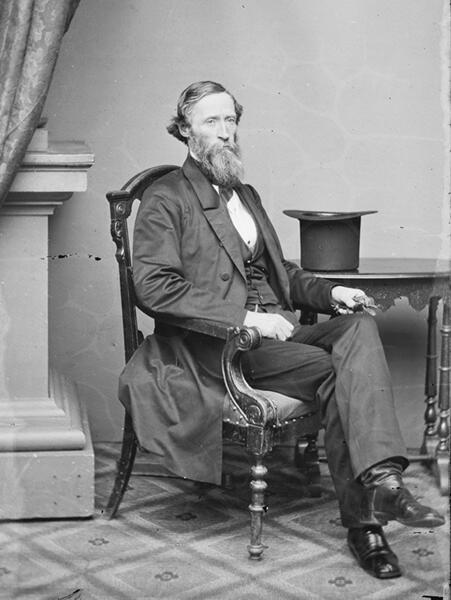
John Blair Smith Todd (April 4, 1814 – January 5, 1872) was a Delegate from Dakota Territory to the United States House of Representatives and a general in the Union Army during the American Civil War. He served as a Representative from Dakota Territory in the United States Congress from 1861 to 1865. A member of the Democratic Party, he contributed to the legislative process during two terms in office, representing the interests of his constituents during a significant period in American history.
Todd was born in Lexington, Kentucky, on April 4, 1814, to John and Elizabeth (Smith) Todd. In 1827 he moved with his parents to Illinois. Through his family, he was closely connected to several prominent political and military figures of the era. His first cousin was Mary Todd Lincoln, the wife of Abraham Lincoln, making him a cousin-in-law of the President. Another cousin-in-law was Confederate General Benjamin Hardin Helm, whose father, John Helm, served as governor of Kentucky. Through these relationships, Todd was linked by blood or marriage to several members of Congress from Kentucky and to Colonel John Hardin, illustrating the deep political and military roots of his extended family.
Todd pursued a military education and entered the United States Military Academy at West Point, New York, graduating in 1837. Upon graduation he was commissioned into the 6th U.S. Infantry and promoted to first lieutenant on December 25 of that year. He saw early active service in the Seminole War in Florida from 1837 until 1840. In 1841 he returned home for a period of recruiting duty, then resumed active service in the Florida war during the remainder of that year and part of 1842, gaining experience in frontier and irregular warfare that would shape his subsequent military career.
Advancing through the ranks, Todd was promoted to captain in 1843 and assigned to frontier duty in Indian Territory and Arkansas, where he served until 1846. During the Mexican–American War in 1847, he took part in several major engagements, including the Siege of Veracruz and the battles of Cerro Gordo and Amazoque. After the war he continued on garrison and frontier duty until 1855, when he participated in the action of Blue Water against the Sioux Indians, an episode later documented in his own journal. On September 16, 1856, he resigned from the United States Army and entered civilian life as an Indian trader, settling at Fort Randall in what would become Dakota Territory. By 1861 he had relocated to Yankton, where he was admitted to the bar and commenced the practice of law.
With the outbreak of the Civil War, Todd returned to military service. On September 19, 1861, he was appointed a brigadier general of Volunteers in the Union Army. He was placed in command of the North Missouri district, a strategically important region troubled by divided loyalties and guerrilla activity, and he held this command from October 15 until December 1, 1861. His tenure as a general was relatively brief; he resigned from the Army on July 17, 1862, and turned his attention fully to territorial politics and representation in Washington.
Todd’s congressional service coincided with the formative years of Dakota Territory and the height of the Civil War. When the Dakota Territory was organized, he was elected as a Democrat to serve as its first Delegate to the United States House of Representatives. He took his seat in the 37th Congress on December 9, 1861, and served until March 3, 1863. After a brief lapse in service, he was reelected and returned to the House as Delegate to the 38th Congress, serving from June 17, 1864, to March 3, 1865. During these two terms, from 1861 to 1865, he participated in the legislative process on behalf of the territory, advocating for its development and representing the interests of its settlers at a time when national attention was focused on the Civil War. He was an unsuccessful candidate for reelection in 1864 and subsequently returned to Yankton.
Following his service in Congress, Todd remained active in Dakota territorial politics. He served in the territorial legislature and was chosen speaker of the territorial House of Representatives in 1866 and 1867, continuing to influence the region’s political and institutional development. In 1868 he again sought a nomination for a congressional seat but was unsuccessful in securing it. Despite these setbacks, his earlier work had already helped establish the political framework of the territory and laid groundwork for its eventual statehood.
John Blair Smith Todd died in Yankton County, Dakota Territory, on January 5, 1872, at the age of 57. He was interred in Yankton Cemetery. His legacy in the Upper Midwest is reflected in the naming of Todd County, South Dakota, and Todd County, Minnesota, in his honor, commemorating his role as a military officer, early territorial leader, and the first Delegate to Congress from Dakota Territory.
Congressional Record