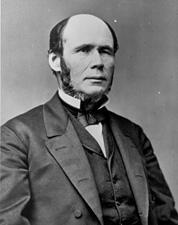
John Conover Ten Eyck (March 12, 1814 – August 24, 1879) was a United States Senator from New Jersey from 1859 to 1865, serving one term during the American Civil War. A member of the Republican Party, he represented New Jersey in the Senate during a significant period in American history, contributing to the legislative process and participating in the democratic governance of the nation at a time of sectional crisis and war.
Ten Eyck was born on March 12, 1814, in Freehold Township, New Jersey, the son of William Ten Eyck and Leah (Conover) Ten Eyck. He was a member of the Dutch American Ten Eyck family (pronounced “Ten Ike”), which had long been prominent in law, business, and politics, particularly in New York and New Jersey. He completed preparatory studies under private tutors before turning to the study of law. Under the mentorship of Joseph Fitz Randolph, a noted New Jersey lawyer and later a member of Congress, Ten Eyck read law and was admitted to the bar in 1835.
After his admission to the bar, Ten Eyck established a successful law practice in Burlington, New Jersey. He initially practiced in partnership with Garret D. Wall, a former United States Senator from New Jersey, and later became the sole member of his own firm. Originally affiliated with the Whig Party, he quickly became a recognized figure in state legal and political circles. From 1839 to 1849 he served as prosecuting attorney of Burlington County, a position that underscored his growing reputation in the legal profession. In 1844 he was a delegate to the New Jersey constitutional convention, participating in the revision of the state’s fundamental law. As the Whig Party collapsed in the 1850s, Ten Eyck joined the newly formed Republican Party and supported John C. Frémont, the party’s first presidential nominee, in the 1856 election.
Ten Eyck was elected to the United States Senate in a joint session of the New Jersey State Legislature that met in January 1859. He formally took his seat on March 4, 1859, and served until March 3, 1865. His election arose from a complex struggle within the legislature between Democrats and an anti-slavery Opposition coalition composed of Republicans, former Whigs, Free Soilers, and members of the American Party. None of the Opposition factions was strong enough to elect its own candidate, but all were determined to prevent the re-election of Democrat William Wright or the choice of another Democrat. Ten Eyck, who was not an active candidate and had not been politically prominent in recent years, was selected as a compromise figure acceptable to the various Opposition elements, having been both a Whig and more recently a Republican without strong ties to any one faction. Although members of the American Party were disappointed that they could not secure the election of John F. Randolph or another of their own, they ultimately accepted Ten Eyck to ensure that a Democrat did not win the seat.
During his Senate career, Ten Eyck served on the Judiciary Committee and the Commerce Committee, and his term coincided entirely with the secession crisis and the Civil War. He entered the Senate regarded as a moderate on the slavery question. He opposed the expansion of slavery into new territories but believed that the Constitution protected the institution where it already existed. On constitutional grounds, he supported enforcement of the Fugitive Slave Act of 1850, despite his personal opposition to slavery. Over time, however, his anti-slavery views grew more pronounced. In early 1861, when the New Jersey Legislature adopted resolutions endorsing the Crittenden Compromise in an effort to avert secession, Ten Eyck complied with the legislature’s instructions to present the resolutions to the Senate but publicly stated his belief that they were unconstitutional. As the war progressed, he supported key measures against slavery, including voting to abolish slavery in the District of Columbia and voting in favor of the Thirteenth Amendment to the Constitution, which abolished slavery throughout the United States.
Ten Eyck’s commitment to the Union cause extended beyond the Senate chamber. In the summer of 1863, when Confederate forces invaded Pennsylvania during the Gettysburg Campaign, he advocated the immediate formation of a Burlington County militia unit to assist in the state’s defense. To set a personal example, he enlisted as a private in the company that was formed, which the volunteers named the “Ten Eyck Guards” in his honor. He marched with the unit into Pennsylvania; after the Confederate retreat and the completion of the emergency service, he returned with the company to Burlington County and concluded his brief military service.
At the end of his Senate term in March 1865, Ten Eyck did not return to national office but resumed the practice of law in New Jersey. He remained active in public affairs and in 1866 served as a delegate to the National Union Convention, which sought, unsuccessfully, to build support for President Andrew Johnson’s Reconstruction policies and to promote post–Civil War reconciliation. In 1873 he was appointed to the commission charged with revising the Constitution of New Jersey. Following the death of the commission’s original presiding officer, Ten Eyck became its president. The commission’s proposed constitutional changes were submitted to the state legislature and then to the voters, who approved them in an 1875 election; the revisions went into effect soon thereafter.
On June 10, 1845, Ten Eyck married Julia Gadsby, the daughter of John Gadsby and Providence (Norris) Gadsby. The couple had six children: Augusta (1846–1876), Julia (1847–1941), Jane (1849–1918), May (1850–1951), Virginia, and John (1855–1935). John Conover Ten Eyck died at his home in Mount Holly Township, New Jersey, on August 24, 1879. He was interred in St. Andrew’s Cemetery in Mount Holly, closing the life of a lawyer, state constitutional reformer, and Civil War–era senator who represented New Jersey in the United States Congress during one of the most consequential periods in the nation’s history.
Congressional Record