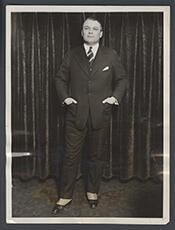
John Bartholomew Sosnowski (December 8, 1883 – July 16, 1968) was a Republican politician from Michigan who served one term as a United States Representative from 1925 to 1927. A lifelong resident of Detroit, he emerged from the city’s Polish American community and combined a career in military service, municipal administration, real estate, and partisan politics with repeated efforts to return to Congress over more than two decades.
Sosnowski was born in Detroit, Michigan, to a Polish family and was raised in the city’s growing immigrant community. He attended parochial schools, reflecting the strong Catholic and ethnic institutions that shaped many Polish American families at the turn of the twentieth century, and also received training in Army schools. This early exposure to both religious education and military discipline helped prepare him for a lengthy period of uniformed service that began while he was still a young man.
During the Spanish–American War, Sosnowski enlisted as a private in the Seventh Regiment, United States Cavalry, serving in Cuba and the Philippines as the United States expanded its overseas presence. After the close of the war, he remained in the Regular Army and was assigned to detached duty at the United States Military Academy at West Point, New York, where he continued to serve until his honorable discharge on December 26, 1906. Following his discharge, he returned to Detroit and entered the real estate and brokerage business, beginning a civilian career that he would resume at several points throughout his life.
In addition to his earlier federal service, Sosnowski continued his military involvement through the Michigan Army National Guard. From 1909 to 1916 he rose to the rank of captain and adjutant in the Thirty-first Regiment, Infantry, Michigan Army National Guard. His service included duty on the Mexican border in 1916, during the period of heightened tensions and mobilization associated with the Mexican Revolution and the Punitive Expedition. Parallel to his military responsibilities, he became increasingly active in local affairs and was appointed to the board of water commissioners of the city of Detroit, serving as both a member and chairman from 1918 to 1924, a period of rapid urban growth and infrastructure expansion in the city.
Sosnowski’s prominence in Detroit and his Republican affiliation led to his election to Congress from Michigan’s 1st congressional district. He was elected as a Republican to the Sixty-ninth Congress and served as a Representative from Michigan in the United States Congress from March 4, 1925, to March 3, 1927. His single term in office coincided with a significant period in American history marked by post–World War I economic growth, rising nativism, and increasing concern over radical ideologies. As a member of the House of Representatives, Sosnowski participated in the legislative process, represented the interests of his Detroit constituents, and took part in the broader democratic deliberations of the era.
During his congressional service, Sosnowski became known as an early anticommunist. He shared considerable findings from anticommunist investigations in public congressional hearings, reflecting the growing anxiety in the 1920s about Bolshevism and radical labor movements. In 1927, in the course of presenting a long list of findings during a public congressional hearing, he urged his colleagues to study contemporary anticommunist literature, stating, “I would suggest you gentlemen read a book published by Blair Coan, entitled The Red Web.” His advocacy placed him among those legislators who sought to frame communism as a pressing domestic and international threat during the interwar period.
Sosnowski’s congressional career was brief. He was an unsuccessful candidate for renomination in 1926, when his 1924 Democratic rival, Robert H. Clancy, switched parties to become a Republican and defeated him in the Republican primary. Undeterred, Sosnowski repeatedly sought to regain his seat. He again ran for the 1st district and lost in 1928, 1930, 1932, 1934, 1936, 1938, 1942, 1944, and 1946. In 1952, he shifted his efforts to Michigan’s 16th congressional district, entering the Republican primary but again failing to secure the nomination. These persistent campaigns underscored both his continued engagement with public life and the changing political dynamics of Detroit and Michigan over the interwar and postwar decades.
Between and after his congressional campaigns, Sosnowski resumed his real estate and brokerage business in Detroit, maintaining his professional base in the city. He remained active in Republican Party affairs at the state and national levels, serving as a delegate to the Republican National Conventions in 1932, 1936, and 1944, and as an alternate delegate in 1940. He was also listed as an unsuccessful candidate for election in 1942 to the Seventy-eighth Congress, in 1944 to the Seventy-ninth Congress, and in 1946 to the Eightieth Congress, reflecting his ongoing ambition to return to the House of Representatives. From 1947 to 1951, he held a state administrative post as a hearing examiner for the Michigan Liquor Control Commission, adding regulatory and quasi-judicial responsibilities to his long record of public service.
John Bartholomew Sosnowski died in Detroit on July 16, 1968. He was interred in Sweetest Heart of Mary Cemetery in Detroit, a burial place closely associated with the city’s Polish Catholic community, thus closing a life that had been rooted in the civic, political, and ethnic institutions of his native city.
Congressional Record