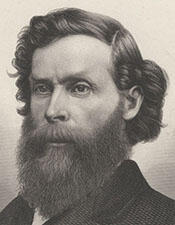
John Peter Cleaver Shanks (June 17, 1826 – January 23, 1901) was a U.S. Representative from Indiana, a Republican legislator during and after the Civil War, and an officer in the Union Army. He served in the United States House of Representatives from 1861 to 1863 and again from 1867 to 1875, participating in the legislative process during five terms in office and representing Indiana through a period of profound national conflict and reconstruction.
Shanks was born in Martinsburg, Virginia (now Martinsburg, West Virginia), on June 17, 1826. He pursued an academic course in his youth and subsequently studied law. After completing his legal studies, he was admitted to the bar in 1848. The following year, in 1849, he moved to Indiana and commenced the practice of law in Portland, Jay County, where he would remain closely associated for the rest of his life.
Early in his career, Shanks quickly entered public service in his adopted state. He served as prosecuting attorney of Jay County in 1850 and 1851, gaining experience in local legal affairs and public administration. He was elected to the Indiana House of Representatives in 1855, marking his first tenure as a state legislator and establishing his standing within the emerging Republican Party in Indiana.
Shanks’s national political career began on the eve of the Civil War. A member of the Republican Party, he was elected as a Republican to the Thirty-seventh Congress, serving from March 4, 1861, to March 3, 1863. In this initial term in the U.S. House of Representatives, he participated in the democratic process at a time when the Union was fracturing and war had begun. He was an unsuccessful candidate for reelection in 1862 to the Thirty-eighth Congress, temporarily interrupting his congressional service even as the war intensified.
During the Civil War, Shanks served in the Union Army and combined military duty with his political commitments. He entered service as a colonel and aide-de-camp to Major General John C. Frémont on September 20, 1861, and served in that capacity until June 1862. He was appointed a colonel in the regular army and continued as an aide-de-camp from March 31, 1862, to October 9, 1863. On that date he assumed command of the 7th Indiana Cavalry Regiment as its colonel, leading the regiment from October 9, 1863, to December 8, 1864. In recognition of his service, President Abraham Lincoln nominated him on December 12, 1864, for appointment as a brevet brigadier general of volunteers, to rank from December 8, 1864; the United States Senate confirmed this appointment on February 14, 1865. Shanks then commanded Brigade 1 of the Cavalry Division of the Department of Mississippi from December 8, 1864, until September 19, 1865, when he was mustered out of the volunteer service. Subsequently, on December 3, 1867, President Andrew Johnson nominated him for appointment as a brevet major general of volunteers, to rank from March 13, 1865, and the Senate confirmed this higher brevet rank on February 14, 1868.
After the war, Shanks returned to Congress and played a significant role in the legislative debates of the Reconstruction era. He was elected to the Fortieth and to the three succeeding Congresses, serving from March 4, 1867, to March 3, 1875, thus completing four consecutive postwar terms and five terms in total. During this period, he represented the interests of his Indiana constituents while addressing national issues arising from the restoration of the Union and the integration of formerly enslaved people into American civic life. He served as chairman of the Committee on Militia in the Forty-first Congress, reflecting his military background, and as chairman of the Committee on Indian Affairs in the Forty-second Congress, where he helped shape federal policy toward Native American nations during a time of westward expansion and conflict. He was an unsuccessful candidate for renomination in 1874, which ended his continuous service in the House.
Following his departure from Congress, Shanks resumed the practice of law in Portland, Indiana, returning to the profession that had launched his public career. He remained active in state politics and public life and was again elected to the Indiana House of Representatives in 1879, adding a second period of service in the state legislature to his long record of public office. His later years were spent in Indiana, where he continued to be regarded as a prominent figure in both the legal and political communities.
John Peter Cleaver Shanks died in Portland, Indiana, on January 23, 1901. He was interred in Green Park Cemetery in Portland, closing a life that had encompassed service as a local prosecutor, state legislator, Civil War officer, and five-term member of the United States House of Representatives during one of the most consequential eras in American history.
Congressional Record