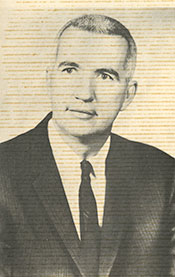
John Scott was an American politician who served as a member of the Adams Party representing Missouri in the United States Congress, where he contributed to the legislative process during six terms in office. His service in Congress occurred during a significant period in American history, as the young republic was consolidating its institutions, expanding westward, and defining the balance of power between the federal government and the states. As a representative of Missouri, he participated in the democratic process and worked to represent the interests of his constituents in this evolving national context.
Details of John Scott’s early life, including his exact date and place of birth, family background, and formative influences, are not fully documented in the surviving record. However, his later prominence as a legislator from Missouri indicates that he came of age during the early decades of the nineteenth century, a time when the trans-Appalachian West was being settled and organized into new states. Like many political figures of that era, he likely developed his understanding of public affairs amid debates over territorial governance, statehood, and the extension of federal authority into the frontier regions.
Information about Scott’s formal education is similarly limited, but his eventual election to Congress and his ability to navigate the complex issues of national policy suggest that he attained a level of learning and professional competence consistent with public service in the early republic. Many contemporaries who entered politics in the western states had backgrounds in law, local administration, or business, and Scott’s later legislative career implies that he was conversant with legal and constitutional questions, as well as with the economic concerns of a developing state.
John Scott’s rise to public office in Missouri coincided with the state’s early years in the Union, following the Missouri Compromise and the intense national debate over the expansion of slavery and the balance between free and slave states. As a member of the Adams Party, he aligned himself with the political movement associated with John Quincy Adams, which emphasized a strong but constitutionally bounded national government, support for internal improvements, and a program of economic development designed to integrate the western states more fully into the national economy. In Missouri, this would have included attention to transportation, land policy, and the legal framework needed to support settlement and commerce.
Scott’s congressional service, spanning six terms, placed him at the center of legislative deliberations during a transformative era. Serving in the House of Representatives as Missouri’s voice in Washington, he participated in debates over federal infrastructure projects, tariffs, banking and currency issues, and the ongoing questions of territorial expansion and relations with Native American nations. His role as an Adams Party representative suggests that he generally favored measures to strengthen the nation’s economic foundations and to promote orderly development, while also addressing the specific needs and priorities of a frontier state whose population and institutions were still taking shape.
Within Congress, Scott’s repeated reelection indicates that he maintained the confidence of his constituents over an extended period. This continuity allowed him to develop experience in legislative procedure and to build working relationships with colleagues from other regions and parties during a time of shifting political alignments, including the decline of the old Democratic-Republican consensus and the emergence of new party formations. His tenure thus bridged an important phase in the evolution of American party politics, as the Adams coalition contended with rival factions over the direction of national policy.
After completing his six terms in Congress, John Scott’s public profile diminished, and the historical record provides fewer details about his later life. It is likely that he returned to private pursuits in Missouri, possibly resuming professional or business activities and remaining engaged in local or regional affairs, as was common for former members of Congress in the nineteenth century. The date and circumstances of his death are not clearly preserved in the available sources, but his congressional career stands as a record of sustained service during a formative period in both Missouri’s development and the broader history of the United States.
Congressional Record