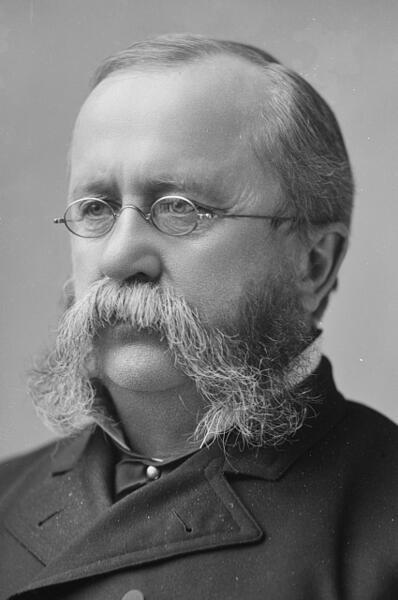
John Gilbert Sawyer (June 5, 1825 – September 5, 1898) was a U.S. Representative from New York and a member of the Republican Party who served three consecutive terms in Congress from 1885 to 1891. He was born in Brandon, Vermont, on June 5, 1825, the eldest of seven children of John F. and Mary J. Sawyer. In 1831 his father relocated the family to Knowlesville in Orleans County, New York. Sawyer attended the common schools in Shelby, New York, and later continued his education at Millville Academy in New York, laying the foundation for a career that combined law, public service, and politics.
Seeking further education, Sawyer traveled to Kentucky and later to Arkansas, where he taught in local one-room schoolhouses in order to earn money for his collegiate studies. In 1846 he returned to Knowlesville, and in 1847 he moved to Albion, New York. There he began the study of law, first in the office of Curtis & Stone and later under Benjamin L. Bessac. Even before completing his legal studies, Sawyer entered public life: in 1848 he was elected superintendent of public schools for Orleans County, New York, an early indication of his long-standing interest in education and local governance.
Sawyer’s early legal and judicial career developed steadily in Albion. In 1851 he was elected a justice of the peace, a position in which he served for nearly five years. In 1855 he formed a law partnership with Sanford E. Church, who would later become lieutenant governor of New York and chief judge of the New York Court of Appeals. Originally aligned with the Whig Party, Sawyer became a staunch Republican as the political landscape shifted in the 1850s and assisted in organizing the Republican Party in Orleans County, helping to establish its local foundations during a period of national realignment.
During the Civil War era and afterward, Sawyer held a series of important county offices. In 1862 he was elected district attorney of Orleans County, New York, and in 1863 he was elected county judge, positions that placed him at the center of local legal affairs. His commitment to education continued alongside his legal work. In 1876 he was appointed to the original Board of Education for the Albion Union Free School, reflecting his sustained advocacy for public schooling and his influence in shaping local educational institutions.
Sawyer was elected to the United States House of Representatives as a Republican in 1884 and served three consecutive terms in the Forty-ninth, Fiftieth, and Fifty-first Congresses, from March 4, 1885, to March 3, 1891. As a member of the House of Representatives from New York, he participated in the legislative process during a significant period in American history, representing the interests of his constituents and contributing to national debates during the late nineteenth century. His service in Congress occurred at a time of industrial expansion, post–Civil War adjustment, and evolving federal policy, and he took part in the democratic process as one of the Republican Party’s established figures from western New York.
After concluding his congressional service in 1891, Sawyer returned to Albion, New York, where he resumed the practice of law. He remained a respected figure in the community he had served in various capacities for decades. John Gilbert Sawyer died in Albion on September 5, 1898, and was interred in Mount Albion Cemetery. His local legacy was commemorated in Orleans County, where the hamlet of Sawyer was named in his honor, reflecting the enduring impact of his legal, educational, and congressional service on the region.
Congressional Record