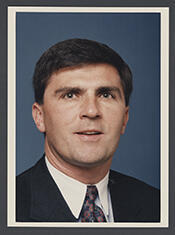
John Peter Spyros Sarbanes (born May 22, 1962) is an American lawyer and politician who served as the U.S. representative for Maryland’s 3rd congressional district from January 3, 2007, to January 3, 2025. A member of the Democratic Party, he served nine consecutive terms in the United States House of Representatives. Over the course of his tenure, he contributed to the legislative process during a significant period in American history, representing the interests of his constituents in a district that, at the time of his retirement, included Annapolis, the entirety of Howard County, and parts of Anne Arundel and Carroll counties.
Sarbanes is the son of Paul S. Sarbanes, a prominent Maryland Democrat who represented Maryland’s 3rd congressional district in the U.S. House of Representatives from 1971 to 1977 and later served in the U.S. Senate. Growing up in a politically engaged family, John Sarbanes was exposed early to public service and the workings of government, experiences that helped shape his later career in law and politics. His family background and his father’s long record in Congress and the Senate provided him with both name recognition and familiarity with Maryland’s political landscape.
Sarbanes pursued higher education and legal training before entering public life, becoming an attorney and building a professional career in law. As a lawyer, he developed expertise that he would later bring to his legislative work in Congress, particularly in areas related to governance, ethics, and public accountability. His legal background informed his approach to complex policy questions and helped position him as a key architect of major reform legislation once he entered national office.
Sarbanes sought the Democratic nomination for Maryland’s 3rd congressional district in 2006 after 10-term incumbent Ben Cardin vacated the seat to run for the U.S. Senate seat held by John Sarbanes’s father, Paul Sarbanes. The Democratic primary was competitive and included state senator Paula Hollinger, former Baltimore City health commissioner Peter Beilenson, and former Maryland Democratic Party treasurer Oz Bengur. On September 12, 2006, Sarbanes won the nomination with 31.9% of the vote. In the general election, his Republican opponent was Annapolis marketing executive John White, with Libertarian Charles Curtis McPeek also on the ballot. The 3rd district, a heavily Democratic seat that had been in Democratic hands since 1927, was widely expected to remain in the party’s control. Sarbanes benefited from the district’s partisan alignment as well as from the recognition associated with his family name; his father had represented the same district decades earlier. On November 7, 2006, he won the general election with 64% of the vote to White’s 34%, with McPeek receiving 2%. He was subsequently reelected eight times with no substantive opposition.
During his first eight terms in Congress, Sarbanes represented a district that spilled across portions of Anne Arundel, Baltimore, Howard, and Montgomery counties, as well as much of downtown Baltimore City. Following the 2020 Census, redistricting made the 3rd district significantly more compact. In the new configuration, Sarbanes lost his shares of Baltimore City and Baltimore County—areas that had been part of the 3rd district and its predecessors for decades—and instead picked up a large portion of Carroll County, all of Howard County, and additional areas of Anne Arundel County. This redrawing of boundaries left his home in Towson outside the district he represented, though members of the House are constitutionally required only to reside in the state, not necessarily within the specific district, that they represent.
In Congress, Sarbanes became particularly known for his work on environmental education and democratic reforms. He introduced H.R. 2054, the No Child Left Inside Act (NCLI), which sought to improve education in the nation’s public schools while advancing environmental protection. The legislation proposed creating a new environmental education grant program, providing teacher training for environmental education, and including environmental education as an authorized activity under the Fund for the Improvement of Education. It further required participating states to develop plans to ensure that high school graduates are environmentally literate. The No Child Left Inside Act was supported by a broad coalition of more than 1,200 local, regional, and national organizations representing millions of citizens advocating for a renewed commitment to environmental education.
Sarbanes also emerged as a principal architect of major electoral and ethics reform efforts in the House of Representatives. Following the Democratic Party’s victory in the 2018 midterm elections, House Democrats introduced their first bill for the 116th Congress, the For the People Act, which was primarily authored by Sarbanes. The bill passed the House in 2019 but did not advance in the Republican-controlled Senate. It was reintroduced in the 117th Congress and again passed the House. The For the People Act was a comprehensive package of Democratic electoral and governance goals. It proposed small-dollar public financing of congressional elections, automatic national voter registration, expansion of early and online voter registration, and increased federal support for state voting systems. The legislation also sought to ban members of Congress from serving on corporate boards, require political advocacy groups to disclose donors, mandate that presidents disclose their tax returns, and establish a Supreme Court ethics code. It included provisions aimed at reducing partisan gerrymandering by creating independent redistricting commissions, a reform of particular note given that Sarbanes’s own district had been widely regarded as one of the most heavily gerrymandered in the United States.
Throughout his nine terms, Sarbanes participated actively in the democratic process and legislative deliberations, representing his Maryland constituents during a period marked by intense national debate over voting rights, campaign finance, ethics in government, and environmental policy. On October 26, 2023, he announced that he would not seek reelection in 2024, bringing to a close his service in the U.S. House of Representatives at the end of his ninth term in January 2025.
Congressional Record