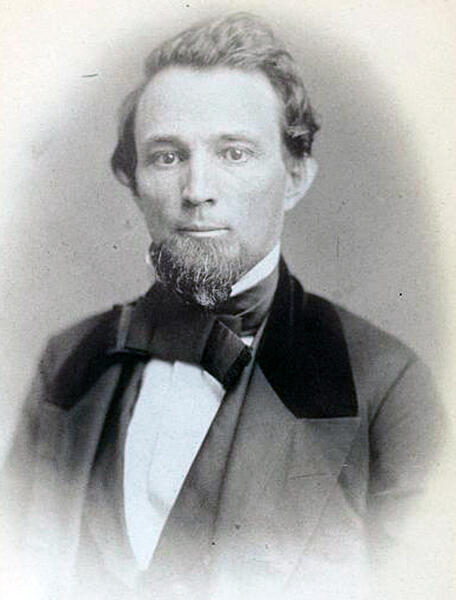
John Milton Sandidge (January 7, 1817 – March 30, 1898) was a U.S. Representative from Louisiana and a prominent nineteenth-century planter, state legislator, and Confederate officer. He was born near Carnesville, Franklin County, Georgia, on January 7, 1817. Little is recorded about his early childhood, but as a young man he left Georgia and settled in Louisiana, where he established himself as a planter, entering into the agricultural and slaveholding economy that dominated the region in the antebellum period.
After moving to Louisiana, Sandidge’s growing prominence as a planter and local figure led him into public life. By the mid-1840s he had become active in state politics, aligning with the Democratic Party. His early public service coincided with the Mexican War, during which he served as a colonel, reflecting both his local standing and his willingness to take on military responsibility in support of national policy. This combination of military and civic engagement helped lay the groundwork for his subsequent political career in Louisiana.
Sandidge served as a member of the Louisiana House of Representatives from 1846 to 1855, a period in which the state was grappling with questions of internal improvements, the expansion of slavery, and the broader sectional tensions affecting the United States. During his tenure in the state legislature he rose to a position of particular influence, serving two years as speaker of the Louisiana House of Representatives. In 1852 he further extended his role in shaping state governance by serving as a delegate to the Louisiana constitutional convention, participating in the revision of the state’s fundamental law at a time of significant political and economic change.
Building on his state-level prominence, Sandidge was elected as a Democrat to the Thirty-fourth and Thirty-fifth Congresses, serving in the U.S. House of Representatives from March 4, 1855, to March 3, 1859. As a member of the Democratic Party representing Louisiana, he contributed to the legislative process during two terms in office, participating in the democratic process and representing the interests of his constituents in a period marked by intensifying national debate over slavery, territorial expansion, and states’ rights. During the Thirty-fifth Congress he served as chairman of the Committee on Private Land Claims, a position that placed him at the center of disputes over land titles and property rights, issues of particular importance in a rapidly developing nation and in a state where landholding and plantation agriculture were central to the economy.
With the outbreak of the Civil War, Sandidge returned to military service on behalf of the Confederacy. He served throughout the conflict as colonel of the Bossier Cavalry, a unit raised from the region of Louisiana where he resided and held property. His military responsibilities expanded when Brigadier General Henry Watkins Allen became Governor of Louisiana. Governor Allen called Colonel Sandidge to his staff as Chief of Ordnance, a position Sandidge held until the close of hostilities. In this capacity he was responsible for overseeing the procurement, management, and distribution of arms and munitions for the state’s Confederate forces. At the end of the war, Sandidge, acting at the special request of Governor Allen, formally surrendered the archives of the State of Louisiana, marking a symbolic and administrative conclusion to Confederate state authority. His family was also directly involved in the conflict, as his sons James and George Sandidge served in the Confederate Army.
In the decades following the Civil War, Sandidge returned to civilian life in Louisiana. Although detailed records of his later activities are limited, his earlier prominence as a planter, legislator, congressman, and Confederate officer ensured that he remained a notable figure in his community during Reconstruction and the postwar era. He spent his final years in Bastrop, Morehouse Parish, Louisiana, where he continued to be associated with the agricultural and social life of the region.
John Milton Sandidge died in Bastrop, Louisiana, on March 30, 1898. He was interred in Christ Church Cemetery, leaving behind a legacy intertwined with the political, military, and social history of Louisiana and the United States in the mid-nineteenth century.
Congressional Record