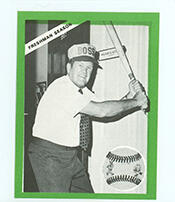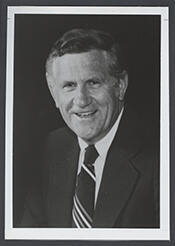
John Harbin Rousselot (November 1, 1927 – May 11, 2003) was a Republican U.S. Representative from southern California who served eight terms in the United States Congress between 1961 and 1983. Although the territory he represented in eastern Los Angeles County remained generally the same, the congressional district was renumbered several times during his career. Over more than two decades in public life, he participated actively in the legislative process and represented the interests of his constituents during a significant period in American political history.
Rousselot was born on November 1, 1927, in Los Angeles, California. He attended public schools in San Marino and South Pasadena, reflecting the suburban growth of the region that would later form the core of his political base. After completing his secondary education, he enrolled at Principia College in Elsah, Illinois, a small liberal arts institution, where he received a Bachelor of Arts degree in 1949. His early professional life was rooted in the private sector, and these experiences in business and communications would shape his later political and ideological activities.
Following his graduation, Rousselot began work as an insurance agent and, during the 1950s, expanded his career into writing and public relations consulting. From 1954 to 1955 he served as assistant to the public relations director of Pacific Finance Corporation in Los Angeles, gaining experience in corporate communications and public messaging. In 1956 he entered state government service as deputy to the chairman of the California Board of Equalization, the state agency responsible for tax administration and fee collection. Two years later, in 1958, he moved to the federal level as director of public information for the Federal Housing Administration (FHA) in Washington, D.C., a position he held until 1960. His work at the FHA coincided with a period of rapid suburban expansion and federal involvement in housing policy. Rousselot resigned from the FHA in 1960 to return to southern California and run for Congress. His first notable political involvement had come earlier as a delegate to the 1956 Republican National Convention, and he served on the executive committee of the California Republican State Central Committee in 1956–1957, signaling his emergence as a figure in state and national Republican politics.
Rousselot was first elected to Congress as a Republican to the Eighty-seventh Congress from California’s 25th congressional district, serving from January 3, 1961, to January 3, 1963. In that 1960 election he defeated Democratic incumbent George A. Kasem, marking his entry into national office. His initial term placed him in the House of Representatives at the dawn of the Kennedy administration, during a period of Cold War tensions and domestic policy change. However, he was an unsuccessful candidate for reelection to the Eighty-eighth Congress in 1962, losing his seat to Democrat Ronald B. Cameron. After leaving Congress, he worked as a management consultant and became Western regional director for the ultraconservative John Birch Society, deepening an association that had already drawn attention during his first term. He also served as the Society’s national public relations director. His close ties to the organization, and his alliances with figures such as resigned General Edwin Walker and segregationist Reverend Billy James Hargis, both prominent members of the John Birch Society, made him a controversial figure in national politics. Rousselot sat on the “Co-ordination of Conservative Efforts” committee of Hargis’ Anti-Communist Liaison organization, underscoring his role in the broader anti-communist conservative movement of the era.
Rousselot returned to Congress at the start of the 1970s. He was elected to the Ninety-first Congress by special election on June 30, 1970, to fill the vacancy caused by the death of Representative Glenard P. Lipscomb in California’s 24th congressional district. In the Republican primary for that special election, he narrowly defeated former congressman Patrick Hillings and former football star and physician Bill McColl, demonstrating his continued strength within the conservative wing of the party. In the special general election he won decisively over Democrat Myrlie Evers, the widow of assassinated civil rights activist Medgar Evers. Rousselot was subsequently reelected to the Ninety-second through Ninety-seventh Congresses, serving continuously from June 30, 1970, to January 3, 1983. During this period, he represented a district in eastern Los Angeles County that, while geographically consistent, underwent renumbering. The district remained the 24th for his full terms won in 1970 and 1972, but a 1973 redistricting ordered by the California Supreme Court renumbered it as the 26th. His congressional service thus spanned the Nixon, Ford, Carter, and early Reagan administrations, a time marked by the Vietnam War’s conclusion, the Watergate scandal, economic turbulence, and the rise of the modern conservative movement. In 1982, following a partisan redistricting that divided his old congressional district, Rousselot ran in the newly drawn 30th District against Democratic Representative Matthew Martinez. He was an unsuccessful candidate for reelection, losing the general election by a margin of 54 percent to 46 percent.
After leaving Congress in 1983, Rousselot continued to play a role in national policy and Republican politics. That same year he served as special assistant to President Ronald Reagan for business matters, reflecting both his longstanding ideological alignment with the conservative wing of the party and his background in finance and public relations. From 1985 to 1988 he was president of the National Council of Savings Institutions, a Washington-based lobbying group representing savings and loan associations and other thrift institutions during a period of significant regulatory and financial change in the industry. He remained politically active into the 1990s and sought a return to Congress in 1992. That year he was an unsuccessful candidate for the Republican nomination to the One Hundred Third Congress from California’s newly redrawn 25th congressional district, a seat ultimately won in the general election by Republican Howard “Buck” McKeon.
John Harbin Rousselot died of heart failure in Irvine, California, on May 11, 2003. His career reflected the trajectory of postwar conservatism in California and the United States, from grassroots anti-communist activism and controversial affiliations to long service in the House of Representatives and later involvement in the Reagan administration and financial industry advocacy.
Congressional Record