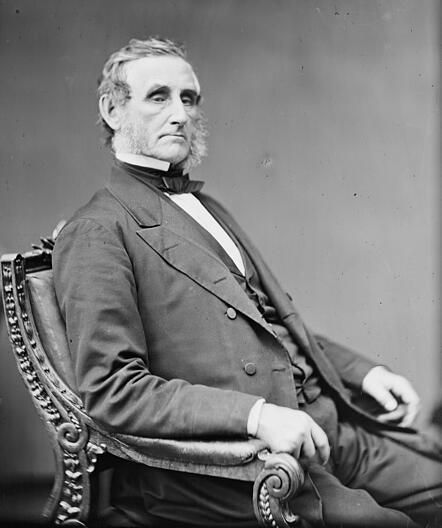
John Robbins (congressman) (1808–1880) was an American congressman from Pennsylvania who served as a Representative in the United States Congress from 1849 to 1877. A member of the Democratic Party, he represented the interests of his Pennsylvania constituents in the House of Representatives during a period of profound political, social, and economic change in the United States. His congressional career, spanning 4 terms in office, placed him at the center of national debates in the decades surrounding the Civil War and Reconstruction.
Born in 1808, Robbins came of age in the early nineteenth century as Pennsylvania was evolving into a key industrial and political center of the young republic. Details of his early life and family background are not extensively documented in the surviving public record, but his later prominence in national politics suggests that he benefited from the expanding educational and professional opportunities available in the state during this period. Like many future members of Congress of his generation, he likely pursued studies that prepared him for public service and participation in civic affairs.
By the mid-nineteenth century, Robbins had established himself sufficiently in Pennsylvania public life to be elected to the United States House of Representatives. As a Democrat, he was aligned with a party that, in this era, was deeply engaged in questions of federal versus state authority, territorial expansion, and the growing sectional conflict over slavery. His first election to Congress in 1849 placed him in the national legislature at a time when the country was grappling with the aftermath of the Mexican-American War and the legislative compromises that attempted to balance free and slave interests in the new territories.
Robbins’s service in Congress from 1849 to 1877 encompassed some of the most consequential years in American history, including the secession crisis, the Civil War, and the Reconstruction era. During his 4 terms in office, he contributed to the legislative process, participated in debates over the direction of national policy, and took part in the democratic process on behalf of his Pennsylvania district. As a member of the House of Representatives, he was responsible for considering and voting on measures related to war powers, finance, internal improvements, and the redefinition of the relationship between the federal government and the former Confederate states.
Throughout his tenure, Robbins’s role as a Democratic representative from Pennsylvania required him to balance the interests of a diverse constituency in a state that was both a major industrial center and a crucial political battleground. His participation in Congress during Reconstruction coincided with the contentious national effort to restore the Union, redefine citizenship, and determine the political status of formerly enslaved people. In this context, Robbins’s votes and positions would have contributed to the evolving legislative framework that shaped the postwar nation, even though specific committee assignments and individual legislative initiatives associated with him are not extensively recorded in the surviving summary sources.
After leaving Congress in 1877, Robbins retired from national legislative service as the country entered the Gilded Age, a period marked by rapid industrialization, urbanization, and political realignment. He lived out his later years in the aftermath of the transformative events he had witnessed and helped to legislate through as a member of the House. John Robbins died in 1880, closing a life that had intersected with nearly the entire antebellum, Civil War, and early Reconstruction eras of the United States. His career stands alongside that of other individuals named John Robbins noted in historical and biographical references—including John Robbins (author) (1947–2025), an American author known for his books on vegetarianism, food, and health; John Robbins (illustrator) (1938–2016), host of the public television program “Cover to Cover”; John B. Robbins (1932–2019), an American medical researcher known for the development of the vaccine against bacterial meningitis; John Everett Robbins (1903–1995), a Canadian educator, encyclopedia editor, and diplomat; Jack Robbins (1916–1983), an American football player; Jack W. Robbins (1919–2005), an American prosecutor at the Nuremberg trials; and John Robins (comedian) (born 1982), a British comedian—underscoring the need to distinguish the Pennsylvania congressman’s long period of service in the U.S. House of Representatives from the varied accomplishments of others who share his name.
Congressional Record