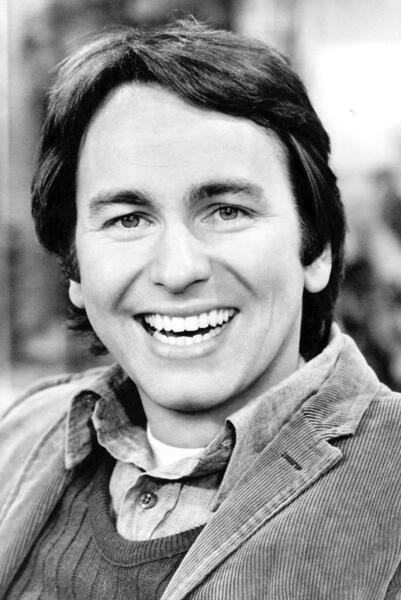
Johnathan Southworth Ritter (September 17, 1948 – September 11, 2003) was an American actor who became one of television’s most recognizable comic performers in the late twentieth century. Born at Providence Saint Joseph Medical Center in Burbank, California, he was the younger son of country music and film star Woodward Maurice “Tex” Ritter, a famed “singing cowboy,” and actress Dorothy Fay (née Southworth). Growing up in a show-business family, Ritter was exposed early to the entertainment industry, occasionally visiting film and television sets with his parents. Despite this background, he was initially shy and did not immediately envision a career as an actor.
Ritter attended Hollywood High School, where he was student body president and first began to explore performing through school activities. He went on to the University of Southern California (USC), initially majoring in psychology with an interest in politics and even contemplating a career in social service or diplomacy. While at USC he joined the drama department, discovering a talent for and commitment to acting that redirected his ambitions. He studied theater arts and performed in stage productions, eventually traveling to the United Kingdom to study at the London Academy of Music and Dramatic Art. This formal training, combined with his natural flair for physical comedy, helped shape the musical and character-based comedic style that would define his later work.
Ritter began his professional career in the early 1970s with guest appearances on a variety of television series, including roles on Dan August and Hawaii Five-O, and he gained early visibility with a recurring part as Reverend Matthew Fordwick on the CBS family drama The Waltons. He also appeared in stage productions and began building a film résumé. His breakthrough came when he was cast as Jack Tripper on the ABC sitcom Three’s Company, which premiered in 1977. Playing a struggling culinary student sharing an apartment with two female roommates, Ritter co-starred opposite Joyce DeWitt and Suzanne Somers, and later Jenilee Harrison and Priscilla Barnes. Much of the series’ comedy centered on Jack’s pretending to be gay to placate the conservative landlords about the co-ed living arrangement. The show quickly became a ratings powerhouse, spending several seasons near the top of the U.S. television ratings and making Ritter a household name.
During the run of Three’s Company (1977–1984), Ritter’s performance as Jack Tripper earned him widespread critical acclaim. In 1984 he received both a Primetime Emmy Award and a Golden Globe Award for the role. He also appeared in several feature films during this period, including Hero at Large (1980), Americathon (1979), and Peter Bogdanovich’s They All Laughed (1981). After Three’s Company ended in 1984, Ritter briefly reprised his signature role in the spin-off Three’s a Crowd, which followed Jack Tripper as a bistro owner living with his girlfriend. The series aired for one season, producing 22 episodes before its cancellation in 1985, but the original Three’s Company continued in syndication and on home video, maintaining Ritter’s visibility with new generations of viewers. In 1983, he received a star on the Hollywood Walk of Fame at 6627 Hollywood Boulevard; he and his father Tex Ritter became the first father-and-son pair to be so honored in different categories.
Ritter’s first regular television role after Three’s Company was the ABC dramedy Hooperman (1987–1989), in which he played San Francisco police detective Harry Hooperman, who inherits a run-down apartment building and hires Susan Smith (Debrah Farentino) to manage it, leading to a complicated romantic relationship. The series showcased Ritter’s ability to blend comedy with more serious material. In 1988 he was nominated for both an Emmy Award and a Golden Globe Award for his work on Hooperman and won a People’s Choice Award for the role. He continued to work steadily in television, film, and theater. From 1992 to 1995 he starred in the CBS sitcom Hearts Afire as John Hartman, an aide to a U.S. Senator, opposite Markie Post as Georgie Anne Lahti and Billy Bob Thornton as Billy Bob Davis. On stage, he played Garry Lejeune/Roger Tramplemain in the 1992 production of Michael Frayn’s farce Noises Off, further demonstrating his skill in physically demanding comedy.
Alongside his television work, Ritter built an extensive film career. He appeared in over 100 films and television series combined and performed on Broadway. In the late 1980s he co-starred with Jim Belushi in the 1987 comedy Real Men and played the lead in Blake Edwards’ 1989 film Skin Deep. He gained further recognition with roles in the comedy Problem Child (1990) and its sequel Problem Child 2 (1991), playing the well-meaning but beleaguered adoptive father of a mischievous boy. He took a dramatic turn as the adult Ben Hanscom in the 1990 television miniseries adaptation of Stephen King’s It. Ritter later reunited with Billy Bob Thornton in the critically acclaimed film Sling Blade (1996), portraying a kindhearted, gay discount-store manager, and appeared in the 1996 action film Mercenary opposite Olivier Gruner. His final live-action feature film role was in the dark comedy Bad Santa (2003), which was dedicated to his memory.
Ritter was also prolific in television films and guest appearances. His television movies included Gramps (1995), co-starring Andy Griffith; Rob Hedden’s The Colony (1995) with Hal Linden; Danielle Steel’s Heartbeat, opposite Polly Draper; and It Came from the Sky (1999) with Yasmine Bleeth. He made guest appearances on a wide range of popular series, including Felicity, Ally McBeal, Scrubs, Buffy the Vampire Slayer, and Law & Order: Special Victims Unit, often playing against type in more dramatic or eccentric roles. In animation, he provided the voice of the title character in the PBS children’s program Clifford the Big Red Dog (2000–2003), a role that brought him four Daytime Emmy Award nominations, and he voiced Clifford in the animated feature Clifford’s Really Big Movie (released in 2004). His final film work was the animated direct-to-DVD feature Stanley’s Dinosaur Round-Up (2006), based on the Disney Channel series, which was dedicated to his memory.
In the early 2000s, Ritter returned to a weekly network starring role with the ABC sitcom 8 Simple Rules (originally titled 8 Simple Rules… for Dating My Teenage Daughter), which premiered in 2002. He played Paul Hennessy, a newspaper columnist and overprotective father navigating the challenges of raising three teenagers. The series allowed Ritter to update his everyman persona for a new era, combining broad physical comedy with more grounded family humor. At the time of his death in 2003, he was actively starring in the show, and his performance was widely praised by colleagues and critics. In 2002, his longtime friend and former Three’s Company co-star Don Knotts described Ritter as the “greatest physical comedian on the planet,” underscoring the esteem in which he was held within the industry.
On September 11, 2003, while rehearsing for 8 Simple Rules on the Walt Disney Studios lot in Burbank, California, Ritter suddenly became ill, experiencing profuse sweating, vomiting, and chest pain. He was transported across the street to Providence Saint Joseph Medical Center—the same hospital where he had been born—at approximately 6:00 p.m. Initially treated for a suspected heart attack, his condition deteriorated rapidly. Physicians then diagnosed an aortic dissection, a tear in the wall of the aorta, and he was taken into surgery. Despite efforts to save him, Ritter was pronounced dead at 10:48 p.m. on September 11, 2003, at the age of 54. A private funeral was held in Los Angeles on September 15, 2003, after which he was interred at Forest Lawn Memorial Park in Hollywood Hills.
In the years following his death, Ritter’s family became involved in legal and advocacy efforts related to aortic disease. In 2008, his widow, actress Amy Yasbeck, on behalf of herself and Ritter’s children, filed lawsuits against several physicians involved in his treatment and against Providence Saint Joseph Medical Center. Some of these actions were settled out of court for a total of $14 million, including a $9.4 million settlement with Providence Saint Joseph. A separate $67 million wrongful-death lawsuit was brought against two of the doctors who treated Ritter on the day of his death, alleging misdiagnosis of his condition as a heart attack and failure to detect an enlarged aorta on a full-body scan two years earlier. A jury ultimately found that the physicians were not negligent and were not responsible for his death. Parallel to these legal proceedings, Yasbeck and the family helped establish the John Ritter Foundation and supported the John Ritter Research Program in Aortic and Vascular Diseases, promoting public awareness and research into the detection and treatment of aortic dissections.
Congressional Record