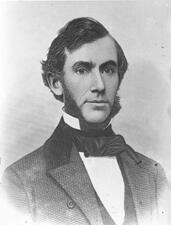
John Pettit (June 24, 1807 – January 17, 1877) was an American lawyer, jurist, and Democratic politician who served as both a United States Representative and Senator from Indiana and later as a judge in the court systems of Indiana and the Kansas Territory. He was born in Sackets Harbor, Jefferson County, New York, where he completed preparatory studies before reading law. He was admitted to the bar in 1831 and subsequently moved west, joining the wave of migration into the Old Northwest.
After his admission to the bar, Pettit established his legal career in Indiana. He settled in Lafayette, Tippecanoe County, where he commenced the practice of law in 1838. Almost immediately he entered public life, winning election to the Indiana House of Representatives and serving in the state legislature in 1838–1839. He was appointed United States district attorney for Indiana in 1839, a position he held until 1843, during which time he built a reputation as a capable advocate and a committed Democrat in a rapidly developing frontier state.
Pettit was elected as a Democrat to the Twenty-eighth, Twenty-ninth, and Thirtieth Congresses, serving in the U.S. House of Representatives from March 4, 1843, to March 3, 1849. Representing Indiana during a period marked by debates over territorial expansion, the Mexican-American War, and the extension of slavery, he aligned with the Democratic Party’s national program. He was an unsuccessful candidate for renomination in 1848. In 1850 he participated in the reshaping of Indiana’s fundamental law as a delegate to the Indiana state constitutional convention, and in 1852 he further demonstrated his standing within the party by serving as a presidential elector on the Democratic ticket.
Pettit returned to national office when he was appointed to the United States Senate to fill the vacancy caused by the death of Senator James Whitcomb. He served in the Senate from January 18, 1853, to March 4, 1855, and was an unsuccessful candidate for reelection in 1854. During the Thirty-third Congress he was chairman of the Committee on Private Land Claims, a post that placed him at the center of disputes over property and settlement in the expanding West. In the Senate he became particularly noted for his annual objections to the appointment of congressional chaplains on constitutional grounds. Arguing that Congress had no power to legislate in matters of religion and therefore could not pay for preaching, he maintained that chaplains, if desired, should be hired and compensated through voluntary contributions from members. His objections were routinely overridden by his colleagues.
Pettit’s Senate career coincided with the intensifying national conflict over slavery. During the debates on the Kansas-Nebraska Act of 1854, he spoke in favor of allowing the expansion of slavery into Kansas under the principle of popular sovereignty. In the course of those debates he became widely known for repudiating Thomas Jefferson’s assertion in the Declaration of Independence that “all men are created equal,” declaring that this supposed “self-evident truth” was, to him, “nothing more… than a self-evident lie.” The controversy surrounding Pettit’s remarks resonated far beyond the Senate chamber and is credited by contemporaries and later historians with helping to revive Abraham Lincoln’s interest in national politics, contributing to Lincoln’s reemergence as a leading voice against the extension of slavery.
After leaving Congress, Pettit continued his public service in the judiciary. He was appointed chief justice of the United States courts in the Territory of Kansas, serving from 1859 to 1861, a period marked by violent conflict over slavery and governance in “Bleeding Kansas.” His tenure placed him at the judicial center of one of the nation’s most contentious territorial struggles on the eve of the Civil War. Returning to Indiana, he resumed legal practice and later ascended to the state’s highest court. From 1870 until his death in 1877, he served as a judge of the Indiana Supreme Court, contributing to the development of Indiana jurisprudence during Reconstruction.
John Pettit died in Lafayette, Indiana, on January 17, 1877, at the age of 69. He was interred in Greenbush Cemetery in Lafayette, closing a career that had spanned state and national legislatures, territorial and state judiciaries, and some of the most divisive constitutional and political controversies of the mid-nineteenth century.
Congressional Record