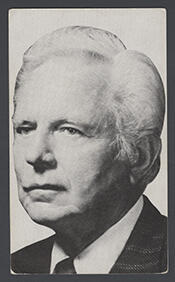
John M. Pattison (June 13, 1847 – June 18, 1906) was an American Democratic politician from Ohio who served one term in the United States House of Representatives and, for five months, as the 43rd governor of Ohio, serving for a shorter period than any other person elected to the office before his death. A member of the Democratic Party representing Ohio, he contributed to the legislative process during one term in Congress, participating in the democratic process and representing the interests of his constituents during a significant period in American history.
Pattison was born near Owensville, Clermont County, Ohio, on June 13, 1847. In 1864, during the later years of the American Civil War, he joined the Union Army, entering military service as a young man while the conflict was still ongoing. After the war ended, he returned to civilian life in Ohio and pursued higher education, reflecting the postwar generation’s emphasis on professional training and public service.
He attended Ohio Wesleyan University in Delaware, Ohio, and graduated in 1869. Determined to enter the legal profession, Pattison then studied law at the Cincinnati Law School, from which he graduated in 1872. That same year he was admitted to the bar, beginning a legal career that would underpin his later work in both business and politics. His legal training and early practice provided him with the skills and public profile that facilitated his entry into elective office.
Pattison’s political career in Ohio began soon after his admission to the bar. He briefly served in the Ohio House of Representatives in 1873, marking his first formal role in public office. After this initial legislative experience, he moved into the private sector, working as an executive at an insurance company, a position that gave him administrative and managerial experience. He later returned to state politics and, after a period of renewed involvement, briefly served in the Ohio State Senate, further establishing his reputation within the Democratic Party and among Ohio voters.
Building on his state-level experience, Pattison was elected as a Democrat to the United States House of Representatives in 1890. He represented Ohio in the Fifty-second Congress, serving one term from March 4, 1891, to March 3, 1893. During this time he contributed to the legislative process at the national level, participating in debates and votes during a period marked by economic and political realignments in the post-Reconstruction era. He sought reelection in 1892 but was unsuccessful in his bid for a second term, and he returned to private life and continued his involvement in state affairs and the Democratic Party.
Pattison reemerged on the statewide political stage in the early twentieth century. In 1905 he was elected governor of Ohio as the Democratic nominee, defeating the Republican incumbent in a closely watched contest. He entered office in January 1906 and thus became the 43rd governor of Ohio. However, his tenure was immediately overshadowed by serious illness. Although he attended his inauguration, he returned home ill that same day and never again returned to the executive office in Columbus. From his residence, Promont, near Milford, Ohio, he directed the affairs of the state government from his bed, attempting to fulfill his gubernatorial responsibilities despite his declining health.
Pattison’s condition, diagnosed as Bright’s disease, a chronic kidney ailment, worsened over the ensuing months. His governorship, already historically brief, was cut short when he died at his home, Promont, on June 18, 1906, only five months after taking office. His service thus became the shortest of any person elected governor of Ohio up to that time. He was buried in Greenlawn Cemetery in Milford, Ohio, where his grave marks the resting place of a figure who bridged military service, law, business, and politics in late nineteenth- and early twentieth-century Ohio.
In his personal life, Pattison was married twice. His first marriage was to Aletheia Williams, with whom he had several children; three of their children survived her, while another daughter predeceased her mother. After Aletheia’s death, Pattison married her sister, Anna Williams, thereby maintaining close family ties that linked his private and public worlds. He was also active in fraternal circles and was a thirty-second degree Scottish Rite Mason, reflecting his engagement in civic and social organizations beyond formal politics.
Pattison’s legacy in Ohio has been preserved in several ways. His home, Promont, near Milford, later became a historic site associated with the Greater Milford Area Historical Society. In 2004, Pattison Elementary School was built in Milford as his namesake; the school educates students in kindergarten through sixth grade, commemorating his role in state history for new generations. Pattison Park, located on U.S. Highway 50 west of Owensville, is also named in his honor, further linking his memory to the region in which he was born, lived, and rose to prominence.
Congressional Record