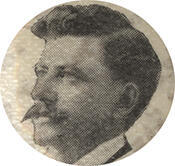
John Eugene Osborne (June 19, 1858 – April 24, 1943) was an American physician, farmer, banker, and Democratic politician who served as the third governor of Wyoming and as a United States Representative from Wyoming. He held a variety of public offices at the territorial, state, and national levels and was active in Democratic Party politics for several decades.
Osborne was born on June 19, 1858, in Westport, New York, to John C. Osborne and Mary E. Rail, although his passport later stated his birth date as June 19, 1860. In 1874 he moved to Burlington, Vermont, where he worked in a drug store while studying medicine at the University of Vermont College of Medicine. He graduated from the medical school in 1880. Later that year he moved west to the Wyoming Territory, settling in Rawlins, where he established a drug store and began practicing as a physician and chemist. In 1881 he was hired as a surgeon by the Union Pacific Railroad, serving the medical needs of railroad workers in the region.
Osborne quickly became a prominent figure in Rawlins and in territorial Wyoming. During the 1880s he combined his medical practice with business and agricultural pursuits, operating a farm and at one point becoming the largest individual sheep owner in Wyoming. He also became involved in one of the territory’s most notorious criminal episodes. After the botched hanging and subsequent lynching of the outlaw George Parrott, known as Big Nose George, in 1881, Osborne helped conduct the autopsy. He had Parrott’s skin tanned and fashioned into a pair of shoes that he later allegedly wore at his gubernatorial inauguration in 1893, and he gave part of Parrott’s skull to medical assistant Lillian Heath, who, at age sixteen, received the skull cap and later became the first female physician in Wyoming. In 1883 Osborne was elected to the Wyoming House of the Territorial Assembly, but he resigned in 1885 when he left the territory for a brief period. Returning to Rawlins, he continued to expand his civic role; in 1888 he was appointed chairman of the Penitentiary Building Commission and was also elected mayor of Rawlins.
Osborne’s rise within the Democratic Party coincided with Wyoming’s transition from territory to statehood. He served as an alternate delegate to the Democratic National Convention in 1892. That same year, at the Wyoming Democratic state convention, he was nominated for governor on the thirty-seventh ballot. Although he had withdrawn his name from consideration at one point, he was persuaded to allow it to be resubmitted and ultimately secured the nomination. In the general election he defeated Republican candidate Edward Ivinson by a vote of 9,290 to 7,509. Osborne attempted to assume the governorship early, on December 2, 1892, but the Wyoming Supreme Court ruled on January 17 that this effort was invalid and premature. He was formally inaugurated on January 2, 1893, reportedly wearing the shoes made from Big Nose George’s skin. During his term as the third governor of Wyoming, he contended with a sharply divided legislature composed of 22 Republicans, 21 Democrats, and 5 Populists, which made governance contentious. Concerned that Secretary of State Amos W. Barber, a Republican, might use his absence to appoint a Republican governor, Osborne declined to leave the state to attend President Grover Cleveland’s 1893 inauguration. He completed his gubernatorial term on January 7, 1895, and declined renomination.
Osborne’s service in the United States Congress occurred during a significant period in American history. A member of the Democratic Party, he was elected as Wyoming’s at-large Representative to the Fifty-fifth Congress and served from March 4, 1897, to March 3, 1899. During this single term in the House of Representatives, he participated in the legislative process and represented the interests of his Wyoming constituents at the national level. He declined renomination at the end of his term, choosing instead to focus on party leadership and other public roles rather than a continued congressional career.
Beyond elective office, Osborne became a leading Democratic strategist and organizer in the Mountain West. A strong supporter of free silver, he backed William Jennings Bryan in the presidential elections of 1896, 1900, and 1908. In 1896 he served as chairman of the Wyoming delegation to the Democratic National Convention. In 1898 he was chosen vice chairman of the Democratic National Committee, was made a member of the national committee in 1900, and served as vice chairman of the committee’s finance committee in 1908. During the 1904 presidential election, Bryan suggested that a western Democrat such as Osborne should seek the party’s presidential nomination, but Osborne declined to run. In Wyoming, he continued to play a central role in party affairs and served as chairman of the Wyoming Democratic Party in 1910.
Osborne also remained active in state electoral politics. On April 28, 1903, Governor DeForest Richards died in office shortly after winning reelection in 1902, prompting a special election. Osborne received the Democratic nomination for governor by acclamation, but he was defeated by Republican Bryant Butler Brooks in a landslide. He continued his business interests as chairman of the board of the Rawlins National Bank and engaged extensively in stock raising, maintaining his position as a significant agricultural and financial figure in Wyoming.
Osborne’s national public service resumed under President Woodrow Wilson. On April 21, 1913, Wilson appointed him Assistant Secretary of State, a position in which Osborne served until December 14, 1916. During his tenure at the State Department he participated in the administration’s foreign policy during the years leading up to the United States’ entry into World War I. In 1913 he proposed that the remains of Christopher Columbus be placed on a battleship and carried through the Panama Canal as part of the canal’s opening ceremonies, reflecting his interest in symbolic national events. He remained an influential Democrat into the New Deal era; during the 1936 presidential election he was chosen as one of Wyoming’s three Democratic presidential electors and cast his electoral vote for Franklin D. Roosevelt and John Nance Garner when the Electoral College convened.
In his personal life, Osborne married Selina Smith of Princeton, Kentucky, on November 2, 1907. They had met on the island of Madeira while she, then known as Jean Curtis Smith, was traveling around the world with her sister Kate and brother-in-law. They became engaged upon returning to the United States two months later. Their honeymoon was interrupted when Osborne’s efforts to secure the 1908 Democratic National Convention for a western city succeeded and they hastened to Denver, Colorado, where the convention was held; Mrs. Osborne became known as the “official hostess” of the convention. Osborne was a Freemason and a member of the York Rite, reflecting his participation in fraternal as well as political organizations. On March 2, 1942, his wife died in Louisville, Kentucky. Osborne himself died in Rawlins, Wyoming, on April 24, 1943, at the age of 84, after suffering a heart attack earlier in the week. He was interred in the Smith family plot at Cedar Hill Cemetery in Princeton, Kentucky.
Congressional Record