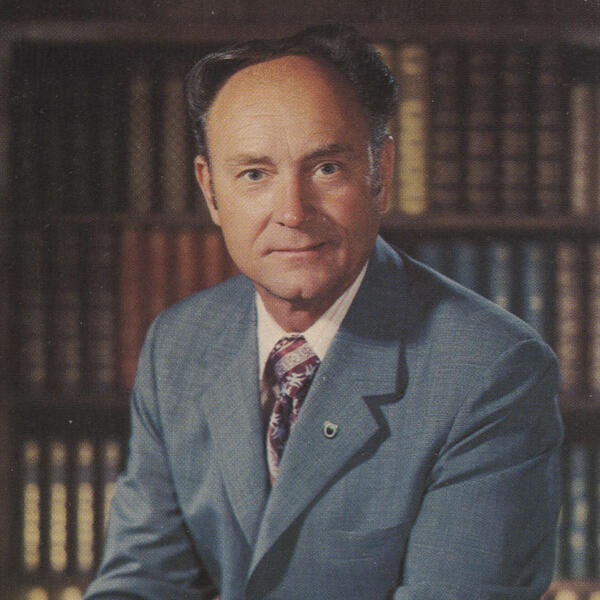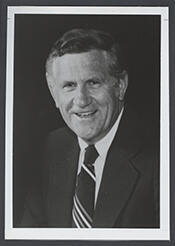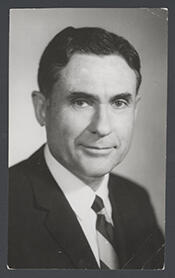
John Joseph McFall (February 20, 1918 – March 7, 2006) was an American attorney and Democratic politician who served as a member of the United States House of Representatives from California from 1957 to 1979, rising to the position of House Majority Whip. Over eleven consecutive terms in Congress, he contributed to the legislative process during a significant period in American history, representing the interests of his California constituents and participating actively in the workings of the House of Representatives.
McFall was born on February 20, 1918, in Buffalo, New York. During his childhood, his family moved to Manteca, California, where he attended local schools and graduated from Manteca High School. He continued his education at Modesto Junior College, from which he graduated in 1936. He then enrolled at the University of California, Berkeley, earning his undergraduate degree in 1938, and proceeded to the UC Berkeley School of Law, where he obtained his law degree in 1941. These academic achievements laid the foundation for his subsequent legal and political career in California.
After completing his legal education, McFall began practicing law, but his early career was interrupted by World War II. From 1942 to 1946, he served in the United States Army Security Intelligence Corps, where he was stationed within the United States and rose to the rank of sergeant. Following his military service, he returned to California and resumed his work as an attorney. His involvement in local civic affairs soon led him into elective office. In 1948, he was elected a councilman in Manteca, California, marking his formal entry into public service and local government.
McFall’s political career advanced to the state level when he was elected to the California State Assembly in 1951. He served in the Assembly until his election to the United States Congress in 1956. Taking office in the House of Representatives in January 1957, he embarked on a congressional career that would span more than two decades. As a Democratic member of the House, he served during a transformative era that encompassed the civil rights movement, the Vietnam War, and major shifts in domestic and foreign policy, and he participated in the democratic process as a representative of his district in California.
During his time in Congress, McFall served eleven terms, holding office from 1957 until his resignation on December 31, 1978. Over the course of these terms, he rose within the Democratic leadership to become House Majority Whip, one of the key leadership positions responsible for party discipline and vote counting on major legislation. His tenure in leadership reflected the confidence placed in him by his colleagues and his influence within the House. However, his congressional career was also marked by controversy. He was reprimanded by the House of Representatives for his role in the influence-peddling scandal commonly known as Koreagate, in which several members of Congress were investigated for improper relationships with South Korean interests. In the wake of this scandal, he lost his bid for re-election to a twelfth term in 1978 and subsequently resigned at the end of that year.
In his personal life, McFall married Evelyn A. M. Anklam in 1950, and the couple had four children. Following his departure from Congress, he retired in 1978 to Alexandria, Virginia. Drawing on his legislative experience, he continued to be involved in public affairs as a lobbyist, working on behalf of railroad interests and maintaining a presence in the policy and regulatory arenas connected to transportation and commerce.
John Joseph McFall died on March 7, 2006, in Virginia from complications of a broken hip and Parkinson’s disease. His long career in public service, spanning local government, the California State Assembly, and more than two decades in the U.S. House of Representatives, reflected both the opportunities and challenges of congressional life in the mid-twentieth century, including his rise to House Majority Whip and his involvement in one of the notable political scandals of his era.
Congressional Record