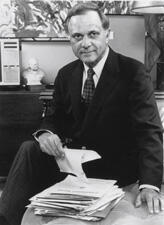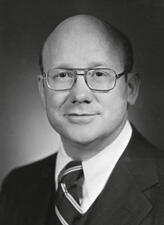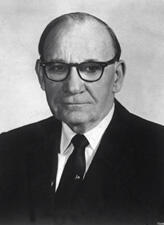
John Little McClellan (February 25, 1896 – November 28, 1977) was an American lawyer and segregationist politician who represented Arkansas in the United States Congress for more than four decades. A member of the Democratic Party, he served as a U.S. Representative from 1935 to 1939 and as a U.S. Senator from 1943 until his death in 1977. At the time of his death, he was the second most senior member of the Senate, chairman of the Senate Appropriations Committee, and the longest-serving United States Senator in Arkansas history. Over eight Senate terms, he played a central role in appropriations, government operations, and high-profile investigations into labor corruption and organized crime.
McClellan was born on a farm near Sheridan, Grant County, Arkansas, to Isaac Scott McClellan and Belle (née Suddeth) McClellan. His parents, both strong Democrats, named him after John Sebastian Little, an Arkansas Democrat who served as a U.S. Representative from 1894 to 1907 and briefly as Governor of Arkansas in 1907. His mother died only months after his birth, and he was educated in local public schools. Exceptionally precocious, he graduated from Sheridan High School at age 12 and immediately began reading law in his father’s office. In 1913, when he was 17, the Arkansas General Assembly enacted a special law waiving the normal age requirement so that he could be admitted to the state bar. He was then reputed to be the youngest practicing attorney in the United States and entered into practice with his father in Sheridan. That same year, in 1913, he married Eula Hicks; the couple had two children before divorcing in 1921.
During World War I, McClellan served in the United States Army from 1917 to 1919 as a first lieutenant in the aviation section of the Signal Corps. After his military service, he moved to Malvern, Arkansas, where he opened a law office and served as city attorney from 1920 to 1926. In 1922 he married his second wife, Lucille Smith, with whom he had three children; they remained married until her death from spinal meningitis in 1935. McClellan’s legal career advanced as he became prosecuting attorney for the seventh judicial district of Arkansas, serving from 1927 to 1930. Following his term as prosecutor, he continued in private practice and built a reputation as a capable trial lawyer and committed Democrat.
In 1934, McClellan was elected as a Democrat to the U.S. House of Representatives from Arkansas’s 6th congressional district and took his seat in 1935. He was re-elected in 1936. During his tenure in the House, he took a generally conservative stance within the New Deal coalition. In March 1936 he publicly condemned the Columbia Broadcasting System (CBS) for airing a speech by Communist Party leader Earl Browder, calling the broadcast “nothing less than treason.” He voted against President Franklin D. Roosevelt’s 1937 court-packing plan, opposed the Gavagan anti-lynching bill, and voted against the Reorganization Act of 1937. In 1937, after the death of his second wife, he married his third and final wife, Norma Myers Cheatham. In 1938 he gave up his House seat to challenge first-term incumbent Senator Hattie Caraway for the Democratic nomination to the U.S. Senate. He criticized Caraway for supporting the 1937 Reorganization Act and accused her of exerting “improper influence” over federal employees in Arkansas, but he was defeated in the primary by roughly 8,000 votes. After this loss, he resumed the practice of law in Camden, joining the firm of Gaughan, McClellan and Gaughan. He remained active in national party affairs, serving as a delegate to the Democratic National Conventions of 1940 in Chicago, 1944 in Chicago, and 1948 in Philadelphia.
In 1942, after Senator G. Lloyd Spencer chose not to seek re-election, McClellan again sought a Senate seat and this time won. He entered the U.S. Senate in January 1943 and served continuously until his death in 1977. Over the course of his Senate career, he became one of the chamber’s most influential members. He served 22 years as chairman of the Committee on Government Operations and ultimately rose to chair the powerful Senate Appropriations Committee, a position he held at the time of his death. During the later part of his Senate service, Arkansas was noted for having one of the most powerful congressional delegations in the nation: McClellan chaired the Senate Appropriations Committee; J. William Fulbright chaired the Senate Foreign Relations Committee; Wilbur Mills chaired the House Ways and Means Committee; Oren Harris chaired the House Commerce Committee; Ezekiel C. “Took” Gathings chaired the House Agriculture Committee; and James William Trimble served on the House Rules Committee. McClellan’s legislative interests extended to infrastructure as well; together with Senator Robert S. Kerr of Oklahoma, he co-sponsored the legislation authorizing construction of the McClellan–Kerr Arkansas River Navigation System, maintained by the U.S. Army Corps of Engineers, which transformed the often shallow and sometimes dry Arkansas River into a major transportation route and water resource.
McClellan became nationally prominent through his long service on, and leadership of, investigative committees. He chaired the Senate Permanent Subcommittee on Investigations for eighteen years, from 1955 to 1973, and played a key role in continuing inquiries into alleged subversive activities at the U.S. Army Signal Corps facilities at Fort Monmouth, New Jersey, where Soviet spies Julius Rosenberg, Al Sarant, and Joel Barr had worked in the 1940s. He was a participant in the widely watched Army–McCarthy hearings of 1954 and led a Democratic walkout from the subcommittee in protest of Senator Joseph McCarthy’s conduct. Archival footage of McClellan from these hearings later appeared in the 2005 film “Good Night, and Good Luck.” Under the auspices of the United States Senate Select Committee on Improper Activities in Labor and Management—commonly known as the McClellan Committee—he directed a major televised investigation into corruption in labor unions and management from January 1957 to March 1960, with particular focus on Teamsters leader Jimmy Hoffa. During this period he hired Robert F. Kennedy as chief counsel, helping to propel Kennedy into the national spotlight. In April 1961, during a subcommittee hearing, contractor Henry Gable testified that Communists could not inflict as much damage on the American missile program as labor practices at Cape Canaveral; McClellan responded that such remarks bordered on accusations of subversion and pressed for further testimony from union representatives.
McClellan also led a second major televised inquiry in 1964, known as the Valachi hearings, which investigated the structure and operations of organized crime in the United States. These hearings featured the testimony of Joseph Valachi, the first American Mafia insider to publicly describe the organization’s criminal activities. McClellan continued his efforts against organized crime for the remainder of the 1960s, including support for anti–organized crime legislation that contributed to the development of the Racketeer Influenced and Corrupt Organizations (RICO) statute. Although his Select Committee on Improper Activities in Labor and Management had been dissolved by 1960, he initiated a related three-year investigation in 1963 through the Permanent Subcommittee on Investigations into the union benefit plans controlled by labor leader George Barasch, alleging misuse and diversion of $4,000,000 in benefit funds. His inability to establish criminal wrongdoing in that case led him to propose new federal standards for the management of employee benefit plans. On October 12, 1965, he introduced his own bill setting fiduciary standards for plan trustees. Senator Jacob K. Javits of New York introduced related bills in 1965 and 1967 to increase regulation of welfare and pension funds and limit the discretion of trustees and administrators. Provisions from all three initiatives ultimately contributed to the framework enacted in the Employee Retirement Income Security Act of 1974 (ERISA). In 1977, near the end of his Senate career, McClellan was one of five Democrats to vote against the nomination of F. Ray Marshall as United States Secretary of Labor.
On civil rights and racial issues, McClellan was a staunch segregationist. In 1957 he opposed President Dwight D. Eisenhower’s decision to send federal troops to Little Rock, Arkansas, to enforce the desegregation of Central High School. Before the deployment of troops under Major General Edwin A. Walker, McClellan publicly expressed his “regret [regarding] the … use of force by the federal government to enforce integration,” declaring that he believed the action to be “without authority of law” and warning that it might “precipitate more trouble than it will prevent.” His stance placed him among the Southern Democrats who resisted federal civil rights enforcement during the mid-twentieth century, even as he simultaneously wielded considerable influence over national spending and investigative policy.
McClellan’s personal life was marked by repeated family tragedies. His second wife, Lucille, died of spinal meningitis in 1935. His son Max died of the same disease in 1943 while serving in Africa during World War II. Another son, John L. McClellan Jr., was killed in an automobile accident in 1949, and his son James H. McClellan died in a plane crash in 1958. Both John Jr. and James H. had been members of the Xi chapter of the Kappa Sigma fraternity at the University of Arkansas. In 1965, to honor their two deceased brothers, the Xi chapter initiated Senator McClellan into Kappa Sigma. McClellan died in his sleep on November 28, 1977, in Little Rock, Arkansas, following surgery to implant a pacemaker. He was buried at Roselawn Memorial Park in Little Rock. A Department of Veterans Affairs hospital in Little Rock bears his name, as does a chapter of the Delta Theta Phi law fraternity at the University of Arkansas at Little Rock William H. Bowen School of Law. Ouachita Baptist University serves as the repository for his official papers, preserving the record of his long and consequential congressional career.
Congressional Record