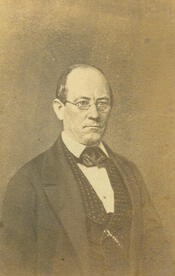
John Letcher (March 29, 1813 – January 26, 1884) was an American lawyer, journalist, and Democratic politician who served as a Representative from Virginia in the United States Congress from 1851 to 1859, was the 34th Governor of Virginia during the American Civil War, and later served in the Virginia General Assembly. Over the course of his public life he was also active on the Board of Visitors of the Virginia Military Institute, and was widely known in his own day by the sobriquet “Honest John” for his opposition to government extravagance.
Letcher was born on March 29, 1813, in the town of Lexington in Rockbridge County, Virginia. He attended private rural schools before pursuing higher education at Randolph-Macon College in Boydton, Virginia (later relocated to Ashland, Virginia). In 1833 he graduated from Washington Academy in Lexington, an institution that would later become Washington and Lee University. After completing his formal education, he studied law, was admitted to the Virginia bar, and opened a legal practice in Lexington in 1839, establishing the professional base from which he would enter journalism and politics.
In addition to his legal work, Letcher became a prominent figure in Virginia’s Democratic press. From 1840 to 1850 he served as editor of the (Shenandoah) Valley Star newspaper, using its pages to advocate Democratic principles and to participate actively in state and national political debates. He was involved in the presidential campaigns of 1840, 1844, and 1848, and served as a Democratic presidential elector in 1848. Although never a committed abolitionist, he briefly aligned himself with limited antislavery reform when he signed the Ruffner Pamphlet of 1847, which proposed the abolition of slavery in that part of Virginia west of the Blue Ridge Mountains; he soon repudiated this antislavery position and later, as his views hardened, publicly affirmed his support for slavery. Letcher’s growing prominence led to his selection as a delegate to the Virginia Constitutional Convention of 1850, where he participated in debates over representation, suffrage, and the structure of state government.
Letcher was elected as a Democratic candidate to the United States House of Representatives and served four consecutive terms from 1851 to 1859, representing Virginia during a period of mounting sectional tension in the decade before the Civil War. As a member of the House of Representatives, he participated in the legislative process and represented the interests of his constituents, contributing to national debates over economic policy and the expansion of slavery. His reputation for integrity and fiscal caution earned him the nickname “Honest John,” reflecting his opposition to what he regarded as unnecessary or excessive government spending. His eight years in Congress placed him among the more visible Virginia Democrats in Washington during the 1850s.
In 1859 Letcher was elected Governor of Virginia, defeating Whig (and American Party) candidate William Leftwich Goggin, and he served as the Commonwealth’s chief executive from 1860 to 1864. In accepting the Democratic nomination for governor, he declared “in language distinct and emphatic” that he regarded the institution of slavery, as it existed in Virginia and other slave states, as “morally, socially and politically right,” a stance that marked a sharp contrast with his earlier, more tentative views and led some contemporaries to charge that he had once been an abolitionist. As governor, Letcher confronted the secession crisis. He was prominent in organizing the Peace Conference of 1861, which met in Washington, D.C., on February 8, 1861, in an effort to devise means to prevent the impending American Civil War. Although he initially discouraged secession, once the Virginia Secession Convention passed the ordinance of secession on April 17, 1861, he actively sustained and supported that decision. A popular referendum on the Articles of Secession was held on May 23, 1861, and Virginia voters overwhelmingly approved secession, by which time the actions of the convention and the state government, including Letcher’s, had effectively committed Virginia to leaving the Union.
As wartime governor, Letcher played a central role in organizing Virginia’s military forces. On April 22, 1861, he appointed Robert E. Lee, who had just resigned as a colonel in the United States Army, as commander in chief of Virginia’s army and navy forces with the rank of major general. Two days later, on April 24, 1861, Virginia and the Confederate States agreed that Virginia’s forces would be placed under the overall direction of Confederate President Jefferson Davis, pending completion of the process by which Virginia formally joined the Confederacy. Letcher’s administration thus oversaw Virginia’s transition from a member of the Union to a leading Confederate state. During the war he also sought election to the Second Confederate Congress, but in May 1863 he was defeated by Colonel John Brown Baldwin. In 1864, amid the devastation of the conflict, his home in Lexington was burned by Union troops during General David Hunter’s raid through the Shenandoah Valley.
After the Civil War, Letcher returned to Lexington and resumed the practice of law. He remained active in public affairs and higher education. From 1866 to 1880 he served on the Board of Visitors of the Virginia Military Institute (VMI), one of the state’s principal military and educational institutions, and for ten of those years he was president of the Board, helping guide the school’s recovery and development in the Reconstruction era. He also reentered elective office at the state level, winning election to the Virginia House of Delegates, where he served from 1875 to 1877 as a member of the Virginia General Assembly. In these later roles he continued to influence Virginia’s legal, educational, and political life long after his tenure as governor and congressman had ended.
Letcher’s family was likewise prominent in public and academic life. Among his sons was Samuel Houston Letcher, who became a state senator and judge; John Davidson Letcher, who served as a professor at Oregon State University and was acting president of that institution from January 1892 to June 1892; and Greenlee D. Letcher, who served two terms as a member of the Virginia House of Delegates. His daughter Lizzie married James Harrison, a language professor at Washington and Lee and later head of the Department of Romance and Teutonic Languages at the University of Virginia after 1895, further extending the family’s influence in higher education.
John Letcher died on January 26, 1884, at the age of 70, in Lexington, Virginia. He was interred in the Presbyterian Cemetery, now known as Oak Grove Cemetery, in Lexington, closing a career that had spanned journalism, law, state and national politics, and educational leadership during one of the most turbulent periods in Virginia and American history.
Congressional Record