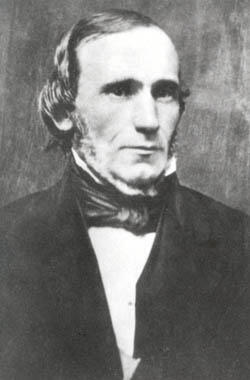
John Scott Harrison (October 4, 1804 – May 25, 1878) was an American politician and Ohio farmer who served as a member of the United States House of Representatives from 1853 to 1857. A native of North Bend, Ohio, he was born into one of the most prominent political families in early United States history as the son of U.S. President William Henry Harrison and First Lady Anna Tuthill Symmes Harrison. He later became the father of Benjamin Harrison, who served as a U.S. Senator and as the 23rd President of the United States. He is the only person in American history to have been both the son and the father of a U.S. president.
Harrison spent his early life in North Bend, in the then-frontier region of the Ohio River valley, where his father was a military officer, territorial leader, and later a national political figure. Growing up in a large family, he was exposed from an early age to public affairs and the responsibilities of landholding and agriculture on the family estate. His upbringing in this politically engaged household, combined with the developing civic life of Ohio in the early nineteenth century, helped shape his later interest in public service, although he did not initially pursue a national political career.
On August 12, 1831, in Cincinnati, Ohio, Harrison married Elizabeth Ramsey Irwin (1810–1850), the daughter of Archibald Irwin and Mary (née Ramsey) Irwin, a family of standing in the region. The couple established their home in North Bend and had ten children. Their children included Lt.-Col. Archibald Harrison (1832–1870), who served as commander of the 27th Indiana Infantry Regiment during the Civil War and later died of tuberculosis; Benjamin Harrison (1833–1901), who became a U.S. Senator in 1881 and the 23rd President of the United States in 1889; Mary Jane Harrison (1835–1867), who married Samuel Vance Morris, later a member of the Minnesota House of Representatives, in 1859; Carter Bassett Harrison (1840–1905), who served as a captain in the 51st Ohio Infantry Regiment and married Sophia Ridgely Dashiell in 1863; Anna Symmes Harrison (1842–1926), who in 1869 married her sister’s widower, Samuel Vance Morris; John Scott Harrison Jr. (1844–1926), who married Sophia Elizabeth Lytle; and several children who died young, including Elizabeth Short Harrison (1825–1904), who married George Coleman Eaton; William Henry Harrison (1827–1829); Sarah Lucretia Harrison (1829–1917), who married Thomas Jefferson Devin; Anna Symmes Harrison (1837–1838); John Irwin Harrison (1839); James Findlay Harrison (1847–1848); and James Irwin Harrison (1849–1850). After the death of his father in 1841, his widowed mother, Anna Harrison, moved into his household in North Bend, where she assisted in raising the children and remained under his care.
Before entering Congress, Harrison devoted himself primarily to agriculture and the management of family lands along the Ohio River. Living in North Bend, he maintained the Harrison family’s local prominence and was active in community affairs. Although he did not initially seek high office, his family name and his own standing as a substantial farmer and citizen drew him into political life during a period of growing sectional tension and party realignment in the United States.
Harrison was elected to the United States House of Representatives from Ohio and served two terms, from 1853 to 1857. As a member of the Independent Party representing Ohio, he contributed to the legislative process during a significant period in American history, participating in the democratic process and representing the interests of his constituents. His service in Congress coincided with the debates over slavery, territorial expansion, and the political upheavals that preceded the Civil War. During his tenure, he aligned himself with the emerging currents of political realignment that were reshaping national parties, and he took part in deliberations on issues affecting both Ohio and the broader Union. After completing his second term, he did not seek further national office and returned to private life in Ohio.
In his later years, Harrison continued to reside in North Bend, where he oversaw his agricultural interests and remained a respected figure in the community and within his extended political family. He lived to see his son Benjamin rise in public life, including Benjamin’s early legal and political career that would eventually lead to the U.S. Senate and the presidency. Harrison’s long life thus spanned from the early republic through the tumultuous antebellum era and into the post–Civil War period, linking three generations of national political leadership.
John Scott Harrison died in North Bend, Ohio, on May 25, 1878, at the age of 73. At the time of his death, he was the last surviving child of President William Henry Harrison. He was interred in the family tomb in North Bend, now preserved as the William Henry Harrison Tomb State Memorial, alongside his parents and other family members. In a notorious episode that drew national attention to the practice of body snatching for medical dissection, Harrison’s body was stolen by grave robbers shortly after his burial. After an investigation, his remains were eventually recovered and returned to their final place of interment in the family tomb, where he rests as a central figure in one of America’s most historically significant political families.
Congressional Record