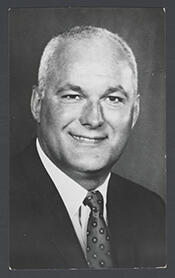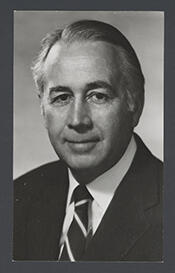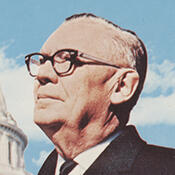
John Robert Hansen (August 24, 1901 – September 23, 1974) was an American businessman and Democratic politician who served one term as a U.S. Representative from Iowa from January 3, 1965, to January 3, 1967. A member of the Democratic Party, he represented a largely Republican, southwestern Iowa district during a significant period in American history. Until the election of Cindy Axne in 2018, he and Tom Harkin were the only two Democrats to have represented southwestern Iowa in the U.S. House of Representatives since the end of the Great Depression.
A native and lifelong resident of Manning, Iowa, Hansen attended the Manning public schools. He went on to study at the University of Iowa from 1919 to 1921, after which he returned to Manning and entered the business world. He married Mary Lou, and the couple had two children, Robert and Jack, maintaining strong family and community ties in western Iowa throughout his life.
Hansen built a long and successful career in manufacturing and sales before entering elective office. From 1921 to 1962 he served in a series of leadership roles with Dultmeier Manufacturing Co. of Manning, Iowa, working as a sales representative, general manager, and ultimately president. In addition, he served as president of Dultmeier Sales in Omaha, Nebraska, from 1934 to 1957, overseeing the company’s regional sales operations. His business experience and prominence in the community helped establish his reputation as a practical, locally focused leader.
Parallel to his business career, Hansen was deeply involved in Democratic Party politics for many years. He served as a member of the Carroll County Democratic Central Committee from 1932 to 1944 and as its chairman from 1944 to 1952, playing a key role in building the party’s organization at the county level. He advanced to statewide party responsibilities as district committeeman on the Democratic State Central Committee from 1952 to 1957 and as Sixth Congressional District Democratic chairman from 1953 to 1957. He was twice chosen as a delegate to the Democratic National Convention, first in 1948 and again in 1964, reflecting his growing influence within the party. In 1960 he was the Democratic nominee for Lieutenant Governor of Iowa, but he was defeated in the general election by Republican W. L. Mooty.
Hansen also held several appointive positions in Iowa state government, further broadening his public service experience. From 1957 to 1960 he served as a member of the Board of Control of State Institutions, which oversaw various state facilities and programs. During the same period, he was a member of the executive council of the Governor’s Alcoholism Commission and of the Commission on Interstate Cooperation, participating in efforts to address public health issues and to coordinate policies with other states. These roles, combined with his party leadership, positioned him as a trusted adviser and ally to leading Iowa Democrats.
In 1963, Hansen’s close friend Harold Hughes was elected Governor of Iowa, marking a high point for the state Democratic Party. The following year, Hansen sought the Democratic nomination for the U.S. House of Representatives from Iowa’s 7th congressional district. In the 1964 primary, none of the six Democratic candidates received more than 35 percent of the vote, forcing the nomination to be decided at a district convention. After a prolonged contest, Hansen secured the nomination on the ninth ballot, winning without a single vote to spare. In the general election of 1964, held in the context of President Lyndon B. Johnson’s landslide victory over Republican Barry Goldwater and a substantial expansion of the Democratic majority in the House, Hansen defeated longtime Republican incumbent Ben F. Jensen. He thus became one of a number of Midwestern Democrats elected from traditionally Republican districts in that year’s Democratic surge.
Hansen served in the U.S. House of Representatives from January 3, 1965, to January 3, 1967. During his single term in Congress, he participated in the legislative process and represented the interests of his southwestern Iowa constituents at a time of major national debates over civil rights, social welfare, and foreign policy. His tenure coincided with the Great Society era, and he contributed to the work of the House as part of the Democratic majority. However, like many Democrats elected from Republican-leaning districts in 1964, he faced a difficult reelection environment in the midterm elections of 1966. That year he was defeated by William Scherle, a conservative Republican member of the Iowa House of Representatives from Mills County, Iowa, and thus concluded his congressional service after one term.
After returning from Washington, Hansen continued his involvement in public affairs at the state level. He served as a member of the Iowa State Highway Commission from February 1967 until his retirement on July 1, 1969, helping to oversee the development and maintenance of Iowa’s transportation infrastructure during a period of highway expansion and modernization. He remained a respected figure in his community and within Iowa Democratic circles until his death.
John Robert Hansen died in Des Moines, Iowa, on September 23, 1974. He was interred in Manning Cemetery in Manning, Iowa, closing a life marked by long service to his hometown, his state, and his party, as a businessman, party leader, state official, and member of the United States House of Representatives.
Congressional Record