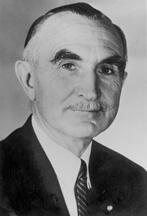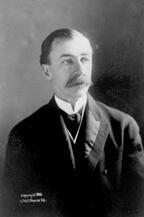
John McDermeid Gearin (August 15, 1851 – November 12, 1930) was an American politician and attorney from the state of Oregon. A member of the Democratic Party for most of his public career, he served as a United States Senator from Oregon from 1905 to 1907 and earlier represented Portland in the Oregon House of Representatives. Over several decades in public life he also held local and county offices, including service as Portland’s city attorney and as district attorney for Multnomah County, while maintaining a substantial private law practice.
Gearin was born on August 15, 1851, near Pendleton in eastern Oregon. His parents, John and Ellen Burns Gearin, were immigrants from Ireland, and he was raised in the then-remote eastern portion of the Oregon Country. He attended local public schools before leaving the region for further education. From 1863 to 1867 he studied at St. Mary’s College in San Francisco, California, receiving a classical education that prepared him for the legal profession. He then enrolled at the University of Notre Dame Law School in Indiana, from which he graduated in 1871 with a bachelor of laws degree.
After completing his legal studies, Gearin returned to Oregon and was admitted to the Oregon bar in 1873. He established a private law practice in Portland, joining a firm that would later become known as Miller Nash Graham & Dunn LLP. His legal work quickly brought him prominence in the city’s professional circles. On June 28, 1878, he married Matilda Raleigh, and the couple had three children. While building his practice, Gearin became increasingly active in civic affairs and local politics, initially aligning himself as an independent.
Gearin entered elective office in 1874 when he was chosen as an independent to represent District 43 in Multnomah County in the Oregon House of Representatives, serving in the 1874 legislative session. The following year he was selected as city attorney of Portland, an office in which he combined his legal training with growing experience in municipal government. By the late 1870s he had affiliated with the Democratic Party and in 1878 ran unsuccessfully as a Democrat for election to the Forty-sixth Congress, an early bid to enter the national legislature. From 1884 to 1886 he served as district attorney for Multnomah County, further solidifying his reputation as a capable public lawyer.
In addition to his elected and county roles, Gearin received federal appointment during the administration of President Grover Cleveland. In 1893 Cleveland named him special prosecutor for the federal government in cases involving opium fraud, a responsibility that reflected national concern over customs and narcotics violations in the Pacific Northwest. This assignment added to his experience with complex litigation and federal law enforcement matters and reinforced his standing within Democratic Party circles in Oregon.
Gearin’s long pursuit of national office culminated in his service in the United States Senate. Following the death of Senator John H. Mitchell, Oregon Governor George Earle Chamberlain appointed Gearin, a Democrat, to fill the resulting vacancy. He took his seat in the Senate on December 13, 1905, and served until January 23, 1907. During this single term in office, he participated in the legislative process at a time of significant change in American political and economic life, representing the interests of his Oregon constituents in debates over national policy. He did not stand as a candidate for election in 1907 to complete the full term, and his service in Congress concluded after this appointed tenure.
After leaving the Senate, Gearin returned to Portland and resumed his private law practice, remaining an influential figure in the city’s legal community. He continued to be identified with the Democratic Party and with the civic and professional organizations of which he was a member, including the Knights of Columbus. John McDermeid Gearin died in Portland on November 12, 1930, at the age of 79. He was buried in Mount Calvary Cemetery in Portland, closing a career that had spanned local, state, and national public service.
Congressional Record