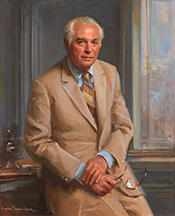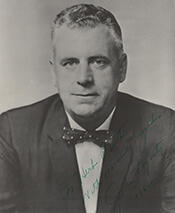
John Edward Fogarty (March 23, 1913 – January 10, 1967) was a Democratic Representative from Rhode Island who served in the United States House of Representatives from January 3, 1941, until his death, a span of 26 years encompassing 14 terms in Congress. Widely regarded as one of the most influential congressional advocates for public health, medical research, education, and services for people with disabilities, he became nationally known as the “Champion of Better Health for the Nation” and was often referred to as “Mr. Public Health.” Throughout his career he was influential in passing numerous pieces of legislation and acts, and for his service he received a wide range of awards, honors, and honorary degrees.
Fogarty was born in Providence, Rhode Island, on March 23, 1913. He attended La Salle Academy in Providence and later studied at Providence College. After his schooling he settled in Harmony, Rhode Island. Before entering public office, Fogarty was employed as a bricklayer and became active in organized labor. He was a member of Rhode Island’s Bricklayers Union Number 1, rising to serve as its president. His early experience in the building trades and union leadership helped shape his later legislative priorities, particularly his concern for working families, health, and education.
In 1940, Fogarty was elected as a Democrat to the United States House of Representatives from Rhode Island. He took office on January 3, 1941, and remained in the House until his death in 1967, representing his constituents during a significant period in American history that included World War II, the postwar era, and the Great Society. During World War II, from December 1944 to February 1945, he traveled and worked with a Seabee battalion in the Pacific Theater as a member of the House Naval Affairs Committee, gaining firsthand exposure to the needs of servicemembers and the demands of wartime logistics. Over the course of his 14 terms, he participated actively in the legislative process and became one of the House’s most prominent voices on health, education, and welfare issues.
Fogarty’s most consequential committee work began in January 1947, when he was assigned to the powerful House Appropriations Committee. He served on the subcommittee responsible for funding the Departments of Labor, Health, Education and Welfare longer than any other member in the history of Congress, and he chaired that subcommittee for 16 years. In this role he became the leading spokesman for medical research in Congress. Under his stewardship, appropriations for the National Institutes of Health (NIH) rose dramatically—from $3.5 million in 1946 to $1.5 billion for fiscal year 1967—enabling major advances in biomedical research. At his instigation, federal funds were first appropriated in 1955 for activities in the field of intellectual disability, beginning with $750,000 and increasing to $334 million by 1967. This expansion of federal support allowed NIH and related institutions to make significant strides in understanding and combating many of the era’s most serious diseases and in improving services for people with intellectual and developmental disabilities.
Fogarty was a principal architect and sponsor of a wide range of landmark health, education, and social welfare legislation. Working closely with Senator J. Lister Hill of Alabama, he co-sponsored the Hill–Fogarty “Health for Peace” bill, which expanded opportunities for international research and training to improve the health of the American people. He was responsible for the authorizing legislation and appropriations that led to the construction of the National Institute of Dental Research. He sponsored the “Fogarty bill” to expand teaching and research for mentally retarded citizens, and he authored legislation to authorize the wide distribution of books and special instructional materials for the blind, as well as measures to provide teachers and educational films for the deaf. His efforts led to the White House Conference on Aging and, in the 89th Congress, to the establishment of the U.S. Administration on Aging within the Department of Health, Education and Welfare. He was the original sponsor of the legislation that created the Older Americans Act of 1965, a cornerstone of federal policy on aging.
In addition to his work on aging and disability, Fogarty played a central role in strengthening public health infrastructure and educational services. He worked with Senator Hill to establish the Library Services Act of 1956, inspired in part by the pioneering work of Rhode Island state librarian Elizabeth Myer, and he became a leading champion of library development and the extension of library services nationwide. In the 89th Congress, he sponsored or helped enact legislation establishing the National Technical Institute for the Deaf, the Model Secondary School for the Deaf, and amendments to the Community Mental Health Centers Act and the Community Health Service Act. He supported the Health Research Facilities Amendments, the Water Pollution Control Act, and the creation of medical complex centers focused on heart disease, cancer, and stroke. He was instrumental in passing the Medical Library Assistance Act and amendments to the Library Services Act, and he was a key figure in the Vocational Rehabilitation Act. Fogarty was also the original sponsor of the legislation creating the National Foundation on the Arts and the Humanities and was instrumental in the passage of the Manpower Act of 1965 and the Economic Opportunity Amendments of 1965.
Fogarty introduced several additional measures that gained nationwide attention and support. Among them was PREVENTICARE, a proposal aimed at providing multiphasic health screening tests for all Americans age 50 and over to detect chronic diseases at an early stage. He advanced legislation to amend the Social Security Act to increase benefit payments by an average of 50 percent and to extend and improve child welfare services. He also sponsored bills to strengthen health education by providing for qualified health educators to be placed in schools to teach health as an academic subject. Through these and other initiatives, he became widely known throughout his Rhode Island district as “Everybody’s Congressman,” reflecting his reputation for accessibility, responsiveness, and broad concern for the welfare of his constituents.
Fogarty’s leadership and advocacy brought him extensive recognition from professional organizations, educational institutions, and foreign governments. He received distinguished service citations from numerous national health organizations, veterans’ groups, educational associations, and business chambers. He was appointed by the President of the United States as congressional advisor to the U.S. delegation to the World Health Assembly on seven occasions. The Italian government honored him with the title “Commedatore al Merito della Repubblica Italiana.” A leading national magazine named him one of the ten outstanding members of Congress who had done the most for the youth of the country, and Parents Magazine awarded him its National Distinguished Service Medal for his work on behalf of children. Medical World News referred to him as the “Health Spokesman in the House,” while Science magazine praised his “incredible ability … to get things moving” and his “deep, undiscriminating humanitarian impulse.” Newsweek called him “Mr. Public Health,” and Modern Medicine described him as “one of the most influential and knowledgeable men in the nation’s health affairs.” On July 10, 1966, he was awarded honorary membership by the American Library Association in recognition of his contributions to library services.
Academic institutions across the country conferred numerous honorary degrees on Fogarty. He received honorary Doctor of Laws degrees from the University of Rhode Island, Providence College (where he also received a Doctor of Political Science), Brown University, Bryant College (Doctor of Humane Letters), Salve Regina College, Brandeis University, St. Francis College in Loretto, Pennsylvania, Georgetown University, the University of Notre Dame, Manhattan College, Loyola University, Howard University, and Gallaudet College. He was awarded honorary Doctor of Science degrees by the Rhode Island School of Pharmacy, New York Medical College, the University of the Pacific in San Francisco, and the College of Osteopathic Medicine and Surgery in Des Moines, Iowa. Rhode Island College awarded him an honorary Doctor of Pedagogy. He was made an honorary member of the Rhode Island Medical Society and received honorary fellowships from the American College of Dentists, the American Psychiatric Association, and the American College of Osteopathic Internists. On February 3, 1966, President Lyndon B. Johnson presented him with the American Heart Association’s 1966 Heart of the Year Award.
Fogarty’s commitment to public health and services for people with disabilities was reflected in the way he used his personal honors. In 1959 he received the national Albert Lasker Award for championing the advancement of medical research and public health; he donated the accompanying $5,000 honorarium to the Rhode Island Parents Council for Mentally Retarded Children. When he was later selected for the Leadership Award of the Kennedy Foundation, given to a public official whose work had awakened public conscience or increased community effort on behalf of the mentally retarded, he donated the $8,000 honorarium to establish the John E. Fogarty Foundation, a charitable and educational organization dedicated to encouraging medical and educational research and fostering the rehabilitation of people with intellectual disabilities. Today, the John E. Fogarty Foundation for Persons with Intellectual and Developmental Disabilities, chaired by his daughter Mary Fogarty McAndrew, has raised millions of dollars and provides annual grants to organizations and institutions in Rhode Island that enhance the lives of individuals with intellectual and developmental disabilities.
Fogarty’s legacy is also reflected in the many facilities and structures named in his honor. In Rhode Island, five health and educational institutions have been dedicated to him: the John E. Fogarty Occupational Training Center for the Mentally Retarded; the John E. Fogarty Medical and Rehabilitation Unit at the Joseph H. Ladd School for the Mentally Retarded; the John E. Fogarty Health Science Building at the University of Rhode Island Colleges of Pharmacy and Nursing; the John E. Fogarty School in Glocester, Rhode Island; and the John E. Fogarty Memorial Hospital in North Smithfield. The John E. Fogarty Memorial Building in downtown Providence, designed in 1968 by architects Castellucci, Galli & Planka to house the state welfare office, was a three-story brutalist structure occupying an entire city block at 111 Fountain Street. Government offices moved out in 1999, and the building was used briefly as a middle school before being abandoned after 2003. Scheduled for demolition in 2016 to make way for a hotel, it was finally demolished in 2017.
In his personal life, Fogarty was married to Luise Rohland. The couple had one daughter, Mary Fogarty McAndrew, who, along with her husband Thomas, later became active in carrying forward his legacy through the Fogarty Foundation. Fogarty died of a heart attack in Washington, D.C., on January 10, 1967, shortly before he was to be sworn in for his fourteenth term in Congress. He was buried in St. Ann’s Cemetery in Cranston, Rhode Island. He was survived by his wife Luise (who died on October 21, 2011), his daughter Mary, and five grandchildren—John Maxwell, Mercedes, Hope, Marya, and Cornelia (Sally)—as well as seven great-grandchildren. Following his death, the Fogarty International Center was established at the National Institutes of Health in Bethesda, Maryland. The center sponsors training for more than 5,000 scientists and physicians, operates programs in more than 100 countries, represents NIH in international affairs, and uses its relatively modest budget to support research aimed first at combating infectious diseases and, more recently, at addressing the growing burden of chronic diseases in both poor and wealthy nations, thereby extending John Edward Fogarty’s lifelong commitment to improving health around the world.
Congressional Record