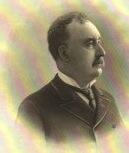
John Frederick Finerty (September 10, 1846 – June 10, 1908) was a prominent journalist, author, and U.S. Congressional Representative from Illinois. Born in Galway, Ireland, he was the son of M. J. Finerty, editor of the Galway Vindicator, and Margaret Finerty (née Flynn). After the early death of his father, he was left in the care of an uncle. He received a strong education in national schools and from private tutors, developing a particular interest in history and literature. At the age of eleven he moved to Tipperary, where he came under the influence of the noted Irish patriot Father John Kenyon. During his youth he became an Irish nationalist and joined the National Brotherhood of St. Patrick. His political activities attracted official attention, and in the midst of the American Civil War he fled to the United States to avoid arrest in Ireland.
Upon his arrival in the United States, Finerty enlisted in the Union Army and served in the Ninety-ninth Regiment of the New York State Militia. After the war he turned to journalism, a field in which he would gain national prominence. He became a war correspondent for the Chicago Times, covering the Sioux War of 1876, the Northern Indian (Sioux) War of 1879, the Ute campaign of 1879, and the Apache campaign of 1881. His dispatches from the Western frontier, based on firsthand observation of military campaigns and Native American resistance, helped establish his reputation as a vivid and daring reporter. During the sessions of the Forty-sixth Congress (1879–1881), he also served as a correspondent in Washington, D.C., reporting on national politics.
Finerty was long fascinated with Mexico, and Chicago Times editor Wilbur F. Storey twice sent him south of the border to report, where he became known as “the Reckless Hibernian.” On his first foray into Porfirian Mexico, he documented contemporary reactions to the election of President Porfirio Díaz; described the Texan city of San Antonio, the villages of Uvalde and Eagle Pass, and the Mexican town of Santa Rosa; and reported conversations with General E. O. C. Ord and Colonel William Rufus Shafter. In March 1879, attached to the American Industrial Deputation to Mexico by Storey, Finerty became the first U.S. journalist to be granted an audience with President Díaz at the National Palace. He reported on the approximately eighty delegates and their spouses, including journalist Byron Andrews of the Chicago Inter-Ocean, illustrator H. A. Ogden, Representative Peter V. Deuster of Milwaukee, engineer and inventor Coleman Sellers II, Milwaukee Mayor John Black, business leader and Republican Party co-founder Edward D. Holton, journalist Jerome J. Collins of the New York Herald, John F. Fisk of Kentucky, and industrialist Earl W. Oglebay of Oglebay, Norton & Company. His account of these events included whimsical anecdotes of unguarded moments with the delegates. When the Deputation’s itinerary concluded at Veracruz, Finerty chose to remain in Mexico rather than return immediately to the United States, continuing to travel, explore, and report from the country on his own. He extensively documented these excursions with the intention of publishing them as a book; his writings on Mexico were later independently compiled and published by the University of Texas at El Paso.
In addition to his work as a correspondent, Finerty became a newspaper proprietor. In 1882 he established the Citizen, an Irish weekly newspaper, in Chicago, which served the city’s Irish-American community and reflected his nationalist sympathies and interest in public affairs. His growing prominence in journalism and in Irish-American circles helped pave the way for his entry into electoral politics. As a member of the Independent Party representing Illinois, Finerty contributed to the legislative process during one term in office. He was elected as an Independent Democrat to the Forty-eighth Congress and served from March 4, 1883, to March 3, 1885. His service in Congress occurred during a significant period in American history, and he participated in the democratic process while representing the interests of his Illinois constituents.
After his single term in the U.S. House of Representatives, Finerty returned to Chicago and continued to be active in civic life and public service. He served as a member of the board of local improvements from 1906 to 1908, a position that involved oversight of municipal development and infrastructure in a rapidly growing city. Alongside his public duties, he pursued a substantial literary career. He authored “War-Path and Bivouac: The Conquest of the Sioux” (Chicago: Donohue & Henneberry, 1890; later editions by Dodd, Mead & Co. of New York), a detailed narrative of the Great Sioux War of 1876–1877 that came to be regarded as a classic account of that conflict. He also wrote a two-volume work, “Ireland: The People’s History of Ireland” (New York and London: The Co-operative Publication Society, 1904), reflecting both his historical interests and his enduring connection to his native country. His writings included an account of the Battle of the Rosebud, prepared in 1894, further cementing his reputation as an important chronicler of the Indian Wars.
John Frederick Finerty died in Chicago on June 10, 1908. He was interred in Calvary Cemetery, leaving behind a legacy as an Irish nationalist exile turned American soldier, frontier correspondent, newspaper editor, author, and Independent representative from Illinois who bridged the worlds of journalism, literature, and public office.
Congressional Record