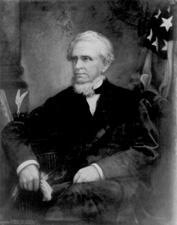
John Adams Dix (July 24, 1798 – April 21, 1879) was an American politician, lawyer, railroad executive, diplomat, and military officer who rose to national prominence in the mid‑19th century. Born in Boscawen, New Hampshire, on July 24, 1798, he was the son of Timothy Dix and Abigail Wilkins, and the brother of composer Marion Dix Sullivan. He entered military life early, joining the United States Army as an ensign in May 1813 and serving under his father until the latter’s death a few months later. Over the next decade and a half he advanced through the ranks, attaining the rank of captain in August 1825 before resigning his commission in December 1828.
Dix received his formal education at Phillips Exeter Academy in New Hampshire, an experience that prepared him for both military and civil pursuits. In 1826 he married Catherine Morgan, the adopted daughter of Congressman John J. Morgan. Through this connection he entered the world of land management and law: Morgan employed him to oversee his upstate New York land holdings in Cooperstown. Dix and his wife moved to Cooperstown in 1828, where he practiced law while managing these properties, marking his transition from a purely military career to one increasingly grounded in legal and political affairs.
Dix’s public career in New York State advanced rapidly. In 1830, Governor Enos T. Throop appointed him Adjutant General of New York, prompting a move to Albany and reestablishing his ties to military organization in a state capacity. He served as Secretary of State of New York from 1833 to 1839, a position in which he helped administer state elections, records, and various civil functions. In 1842 he was elected a member of the New York State Assembly representing Albany County, further consolidating his standing in Democratic Party politics and preparing him for national office.
Dix was elected as a Democrat to the United States Senate from New York to fill the vacancy caused by the resignation of Silas Wright Jr., and he served one full term from 1845 to 1849. A member of the Democratic Party, he contributed to the legislative process during this single term in office, participating in debates and votes at a time of mounting sectional tension over slavery and territorial expansion. His service in Congress occurred during a significant period in American history, and as a member of the Senate he took part in the democratic process and represented the interests of his New York constituents. In November 1848, he ran unsuccessfully for Governor of New York as the Barnburner/Free-Soil candidate, losing to Whig Hamilton Fish. In February 1849, again aligned with the Barnburners, he sought re‑election to the U.S. Senate, but the Whig majority in the New York State Legislature instead chose William H. Seward.
After leaving the Senate, Dix remained active in business and public life. In 1853 he served as president of the Mississippi and Missouri Railroad, an early indication of his later prominence in railroad management. He was appointed Postmaster of New York City and held that office from 1860 to 1861. In January 1861, during the final weeks of President James Buchanan’s administration, Dix was appointed United States Secretary of the Treasury, serving until March 4, 1861. At the outbreak of the Civil War, he issued a famous order in a telegram to Treasury agents in New Orleans: “If any one attempts to haul down the American flag, shoot him on the spot.” Although the telegram was intercepted by Confederates and never delivered to its intended recipients, its text reached the press, and the phrase—widely reproduced, including on Civil War tokens—made Dix one of the first Northern heroes of the conflict.
With the coming of the Civil War, Dix returned to uniformed service. Initially appointed a major general in the New York Militia, he joined the Union Army as a major general of volunteers effective May 16, 1861. His name appeared first on the promotion list, giving him seniority over all other major generals of volunteers, including Nathaniel P. Banks and Benjamin Franklin Butler. In the summer of 1861 he commanded the Department of Maryland and the Department of Pennsylvania, where his most notable early act was the arrest of six members of the pro‑Southern Maryland General Assembly, thereby preventing the legislature from meeting and forestalling Maryland’s potential secession—a step that earned President Abraham Lincoln’s gratitude. That winter he led a regional organization known as “Dix’s Command” within Major General George B. McClellan’s Department of the Potomac. He later commanded the Department of Virginia from June 1862 to July 1863, and the Department of the East from July 1863 to April 1865. On July 22, 1862, he and Confederate Major General Daniel Harvey Hill concluded the Dix–Hill Cartel, a formal agreement establishing a general system of prisoner exchange between Union and Confederate forces, including a scale of equivalents for officers and enlisted men and provisions for parole. Although some contemporaries considered him too old for field command, he played a role in the defense of Suffolk, Virginia, and is often credited with helping suppress the New York City draft riots in July 1863, though the worst of the violence had subsided by the time he replaced General John E. Wool. During the war, Secretary of the Navy Gideon Welles noted in his diary on October 10, 1862, that a “scheme for permits, special favors, Treasury agents, and improper management” had been arranged by Treasury Secretary Salmon P. Chase for Dix, apparently for political rather than financial purposes.
In the postwar years, Dix continued to serve in high civil and corporate positions. He was United States Minister to France from 1866 to 1869, representing American interests in Paris during the turbulent final years of the Second French Empire and the onset of the Third Republic. In the railroad sector, he served as president of the Union Pacific Railroad from 1863 to 1868, during the construction of the First transcontinental railroad, acting largely as a figurehead for railroad promoter Thomas C. Durant. He was also briefly president of the Erie Railroad in 1872. Returning to elective office, Dix was elected Governor of New York on the Republican ticket in November 1872 and served from 1873 to 1874, but he was defeated for re‑election by Democrat Samuel J. Tilden in November 1874. He suffered another political setback when he ran unsuccessfully for Mayor of New York City in 1876. In 1866 he had also served as temporary chairman of the National Union Convention, reflecting his continued involvement in national political realignments during Reconstruction.
John Adams Dix died in New York City on April 21, 1879, at the age of 80 and was buried in Trinity Church Cemetery in Lower Manhattan. His memoirs, in two volumes, were compiled and published in 1883 by his son, Morgan Dix, under the title “Memoirs of John Adams Dix,” and his own “Speeches and Occasional Addresses” were issued in an 1864 volume. His name has been commemorated widely: Fort Dix, a United States Army post in New Jersey, is named in his honor, as are Dix, Illinois, and Dix Township in Ford County, Illinois; several revenue cutters have also borne his name. Dix Mountain, one of the Adirondack High Peaks, and the surrounding Dix Range in New York’s Adirondacks were named for him, and a memorial to him stands in the Cathedral of All Saints in Albany, New York. The windmill at his home in Westhampton Beach, New York, was donated to the village, which has undertaken its restoration, preserving a tangible link to a figure whose career spanned the Army of 1812, the antebellum Congress, the Union high command in the Civil War, and the political and economic reconstruction of the nation.
Congressional Record