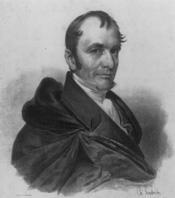
John Dean Dickinson (June 28, 1767 – January 28, 1841) was a United States Representative from New York who served in the House of Representatives from 1819 to 1831. He was born in Middletown in the Connecticut Colony, where he completed his early and preparatory studies. He pursued higher education at Yale College, graduating in 1785, a classical education that prepared him for a career in law and public affairs.
After completing his studies, Dickinson moved in 1790 to Lansingburgh, New York, then an active commercial and intellectual center along the Hudson River. He studied law, was admitted to the bar in April 1791, and commenced the practice of law in Lansingburgh. In the course of his professional advancement he relocated to nearby Troy, New York, which would remain his principal home and the base of his legal, financial, and political activities for the rest of his life.
In Troy, Dickinson became a prominent figure in the city’s developing financial and civic institutions. He served as president of the Farmers’ Bank of Troy from the bank’s foundation in 1801 until his death in 1841, a tenure of four decades that reflected both his influence and the stability of his leadership in local banking. He was also a director and founder of the Rensselaer & Saratoga Insurance Company in 1814, further extending his role in the region’s financial infrastructure. Beyond finance, he took an active interest in intellectual and scientific pursuits, serving as the first president of the Troy Lyceum of Natural History in 1818, an organization devoted to the advancement of learning and scientific inquiry.
Dickinson’s public career began in state government. He served as a member of the New York State Assembly from November 1816 to April 1817, representing his district in Albany during a period of growth and political realignment in the state. His legislative experience at the state level helped establish his reputation and prepared him for national office. At the same time, he was increasingly identified with the Federalist Party, which favored a strong national government and commercial development, positions that aligned with his professional background in law and banking.
John Dean Dickinson served as a Representative from New York in the United States Congress from 1819 to 1831, contributing to the legislative process during four terms in office. He was elected as a Federalist to the Sixteenth and Seventeenth Congresses, serving from March 4, 1819, to March 3, 1823. After a brief interval out of federal office, he returned to Congress as national politics shifted in the wake of the decline of the Federalist Party. He was elected as an Adams candidate to the Twentieth Congress, serving from March 4, 1827, to March 3, 1829, aligning himself with the supporters of John Quincy Adams and the National Republican faction. He was then reelected as an Anti-Jacksonian to the Twenty-first Congress, serving from March 4, 1829, to March 3, 1831, opposing the policies of President Andrew Jackson. Throughout these years he participated in the democratic process in the House of Representatives and represented the interests of his New York constituents during a significant period in American history marked by expanding suffrage, economic development, and intensifying party competition.
In addition to his formal legislative duties, Dickinson took part in notable public events of the era. He served as a member of the committee that received the Marquis de Lafayette during Lafayette’s celebrated visits to Troy in 1824 and 1825, reflecting his standing in the community and his connection to the Revolutionary generation’s legacy. In 1824 he was also named one of the original trustees of the Rensselaer Polytechnic Institute, an institution founded in Troy that would become one of the nation’s leading centers for scientific and technical education, underscoring his support for education and innovation.
After concluding his service in Congress in 1831, Dickinson resumed the practice of law in Troy while continuing his long-standing leadership of the Farmers’ Bank of Troy and his involvement in local civic affairs. He remained an influential figure in the city until his death in Troy on January 28, 1841. He was interred at Oakwood Cemetery in Troy. His career, spanning law, finance, education, and public office, reflected the intertwined development of New York’s political and economic life in the early decades of the United States.
Congressional Record