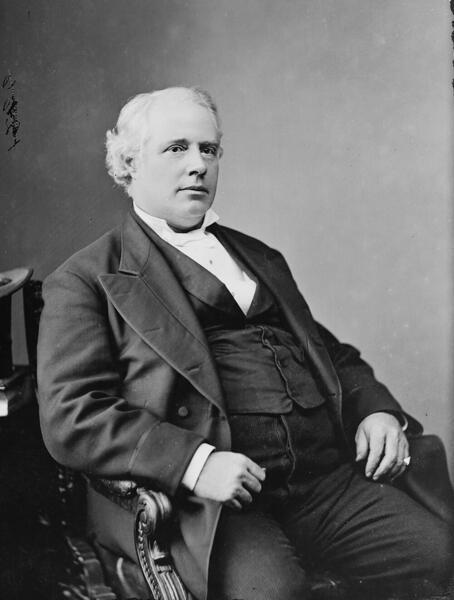
John Thomas Deweese (June 4, 1835 – July 4, 1906) was an American politician of the Republican Party who served as a U.S. Representative from North Carolina during the Reconstruction era. Born in Van Buren, Arkansas, on June 4, 1835, he was educated at home, where he undertook the study of law. He was admitted to the bar in 1856 and commenced the practice of law in Henderson, Kentucky. In the years that followed, Deweese lived for a time in Denver, Colorado, before relocating in 1860 to Pike County, Indiana, where he continued his legal and civic pursuits on the eve of the Civil War.
With the outbreak of the Civil War, Deweese entered the Union Army on July 6, 1861, as second lieutenant of Company E, Twenty-fourth Regiment, Indiana Volunteer Infantry. He served with that command until February 15, 1862, when he resigned his commission. Shortly thereafter, on August 8, 1862, he was mustered in as captain of Company F, Fourth Indiana Cavalry. Over the course of his service he was successively promoted through the ranks to colonel, reflecting his growing responsibilities and leadership in the volunteer forces. In recognition of his service, he was brevetted brigadier general of Volunteers, effective March 13, 1865. After the war, upon the reorganization of the Regular Army, he was appointed a second lieutenant in the Eighth United States Infantry on July 24, 1866. Following his military service in the West and South during Reconstruction, he moved to North Carolina, where he began to establish himself in public life.
Deweese resigned from the Regular Army on August 14, 1867, having been elected to Congress from North Carolina during the period of military Reconstruction. In 1868 he was appointed register in bankruptcy for North Carolina, a position of particular importance in the postwar South as individuals and businesses struggled to recover from the economic devastation of the conflict. Upon the readmission of North Carolina to the Union, Deweese was elected as a Republican to the Fortieth and Forty-first Congresses, representing a state undergoing profound political and social transformation. His service in Congress occurred during a significant period in American history, as the federal government sought to reconstruct the former Confederate states and to define the civil and political rights of newly freed African Americans.
Deweese served in the U.S. House of Representatives from July 6, 1868, to February 28, 1870, as a member of the Republican Party representing North Carolina. During his tenure, he contributed to the legislative process over what is generally regarded as two terms in office, participating in the democratic process and representing the interests of his constituents in a state still under the shadow of war and occupation. In the House, he held important committee assignments, serving as chairman of the Committee on Expenditures in the Department of the Interior and as chairman of the Committee on Revolutionary Pensions. These roles placed him at the center of oversight of federal spending and the administration of benefits to veterans and their families, key concerns in the immediate postwar years.
Deweese’s congressional career was abruptly curtailed by scandal. In early 1870, he became the subject of a congressional investigation into allegations that he had sold an appointment to the United States Naval Academy. Amid this inquiry, he resigned his seat on February 28, 1870. Nonetheless, the House of Representatives proceeded to act on the findings of the investigation, and on March 1, 1870, Deweese was formally censured by the House for selling an appointment to the Naval Academy. His case has since been noted in the historical record among those members of Congress who have been expelled, censured, or reprimanded, illustrating the emerging standards of congressional ethics in the Reconstruction era.
After leaving Congress, Deweese underwent a political realignment. He left the Republican Party and became affiliated with the Democratic Party, reflecting the shifting political currents of the post-Reconstruction South and the broader national realignments of the 1870s. He served as a delegate to the Democratic National Convention in 1876, participating in one of the most contentious presidential election cycles in American history. At the same time, he resumed the practice of law, drawing on his long experience as an attorney and former military officer, and continued his professional life largely outside the national spotlight.
John Thomas Deweese spent his later years in Washington, D.C., where he lived and practiced law until his death on July 4, 1906. His burial in Arlington National Cemetery reflects his recognized service as a Union officer and brevetted brigadier general during the Civil War, even as his political career remained marked by the censure he received in Congress. His life encompassed frontier upbringing, Civil War command, participation in Reconstruction politics, and a complex legacy in both military and congressional history.
Congressional Record