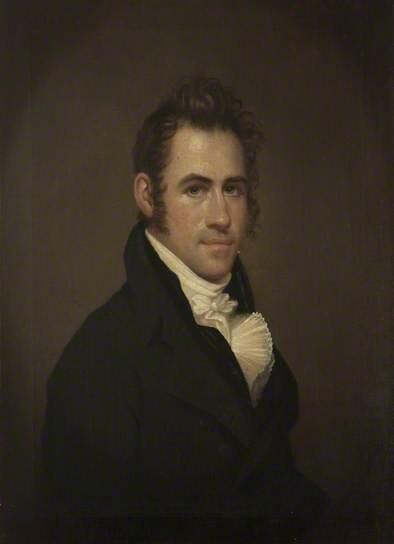
John Paine Cushman (March 8, 1784, Plainfield, Windham County, Connecticut – September 16, 1848, Troy, Rensselaer County, New York) was an American lawyer, jurist, and Federalist politician from New York. Born in rural eastern Connecticut, he spent his early years in Plainfield, where he attended the common schools before advancing to Plainfield Academy, a local institution that prepared young men for collegiate study.
Cushman pursued higher education at Yale College, from which he graduated in 1807. Intending to enter the legal profession, he continued his studies at the Litchfield Law School in Connecticut, one of the earliest formal law schools in the United States and a leading training ground for the bar in the early nineteenth century. He was admitted to the bar in 1809 and soon thereafter moved to Troy, New York, a growing commercial center on the Hudson River, where he commenced the practice of law and established himself in his profession.
During his period of legal study, Cushman met Maria Jones Tallmadge (1790–1878), whom he later married. She was the daughter of Benjamin Tallmadge, a distinguished officer of the Continental Army during the American Revolution, noted as the leader of the Culper Ring intelligence network, and later a U.S. Representative from Connecticut, and the sister of Frederick A. Tallmadge. John and Maria Cushman had several children, including Julia Paine Cushman (b. 1822), who married Amos Henry Farnsworth (b. 1825) in 1850; Tallmadge Cushman; Edward Cushman; Harriet Delafield Cushman (1825–1897), who married Colonel George Thatcher Balch (1828–1894); Mary Floyd Cushman (1827–1916), who married Edward C. Williams (1820–1913); and John Paine Cushman Jr. (1830–1901), a Presbyterian minister who married H. Caroline Maltby in 1860. Through these family connections, Cushman was linked to prominent political, military, and civic circles of his era.
As a member of the Federalist Party representing New York, Cushman entered national politics during a period of transition in the early republic. In 1817, he was elected as a Federalist to the Fifteenth United States Congress with 54.98 percent of the popular vote, defeating the incumbent Hosea Moffitt, a fellow Federalist. He served a single term in the U.S. House of Representatives from March 4, 1817, to March 3, 1819. His service in Congress occurred during a significant period in American history, as the nation adjusted to the aftermath of the War of 1812 and navigated evolving questions of federal power, economic policy, and territorial expansion. In this context, Cushman contributed to the legislative process, participating in the democratic governance of the country and representing the interests of his New York constituents. At the conclusion of his term, he did not return to Congress and instead resumed the practice of law in Troy.
In addition to his legal practice, Cushman became increasingly involved in educational and judicial affairs in New York. He was appointed a regent of the University of the State of New York in April 1830, serving in that statewide supervisory body for education until his resignation in April 1834. He also served as a trustee of Union College in Schenectady from 1833 until his death, reflecting his sustained interest in higher education and intellectual life. Within the municipal government of Troy, he held the office of Recorder from 1834 to 1838, a position that combined judicial and administrative responsibilities and placed him at the center of the city’s legal and civic affairs.
Cushman’s judicial career advanced further when he was appointed Judge of the Third Circuit of New York, a position he held from 1838 to 1844. In this capacity, he presided over a wide range of civil and criminal cases at a time when the state’s legal system was adapting to rapid economic growth, urbanization, and changes in commercial practice. His work on the bench, together with his earlier legislative service and his roles in educational governance, marked him as a figure of regional importance in early nineteenth-century New York public life.
John Paine Cushman died in Troy, Rensselaer County, New York, on September 16, 1848. He was interred at Oakwood Cemetery in Troy, a resting place for many of the city’s leading citizens. His career encompassed service as a lawyer, congressman, municipal officer, judge, and educational trustee, and he remained closely associated with the civic and institutional development of Troy and the broader state of New York throughout his adult life.
Congressional Record