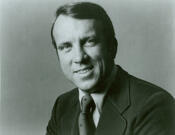
John Hervey Crozier (February 10, 1812 – October 25, 1889) was an American attorney and politician active primarily in Knoxville, Tennessee, during the mid-nineteenth century. Described by contemporaries as “an orator of uncommon brilliancy” and “one of the brainiest men ever sent by Tennessee to congress,” he represented Tennessee’s 3rd congressional district in the United States House of Representatives from 1845 to 1849. Originally a member of the Whig Party, he later aligned with the Democratic Party in the 1850s and supported the Confederacy during the Civil War. After the war, he retired from public life and devoted his remaining years to scholarly and literary pursuits.
Crozier was born in Knoxville, Tennessee, on February 10, 1812, the youngest son of Captain John Crozier and Hannah Barton Crozier. His father, an immigrant from County Fermanagh in Northern Ireland, was among the earliest settlers in Knoxville and served as the city’s postmaster from 1804 until 1838, helping to establish the community’s early civic infrastructure. The Crozier family was closely connected with other prominent East Tennessee families; one of his sisters, Peggy Barton Crozier, the eldest daughter of John and Hannah Barton Crozier, married Dr. J. G. M. Ramsey on March 1, 1823, while her parents were residing at their home known as Fruit Hill. These family ties would later shape Crozier’s political and civic activities in the region.
After attending public schools in Knoxville, Crozier enrolled at East Tennessee College (now the University of Tennessee), from which he graduated in 1829. He studied law, was admitted to the Tennessee bar, and began the practice of law in Knoxville. His legal abilities were quickly recognized, and in 1835, following the resignation of Knox County attorney-general John Nelson, Crozier was appointed to fill the unexpired term. This early prosecutorial role established him as a rising figure in the East Tennessee bar and introduced him to the broader political life of the state.
Crozier entered elective office in 1837 when he was chosen to represent Knox County in the Tennessee House of Representatives, serving until 1839. In 1839 he was elected to Knoxville’s Board of Aldermen, participating in municipal governance at a time when the city was growing as a regional commercial center. A committed Whig, he served as a presidential elector on the Whig ticket of Henry Clay and Theodore Frelinghuysen in 1844, reflecting his support for Clay’s American System and internal improvements. These roles helped propel him onto the national stage and laid the groundwork for his subsequent election to Congress.
In 1844, Crozier was elected as a Whig to the Twenty-ninth Congress and was reelected to the Thirtieth Congress, serving from March 4, 1845, to March 3, 1849, as the representative of Tennessee’s 3rd congressional district. During his two terms in the United States House of Representatives, he contributed to the legislative process at a time of significant national expansion and sectional tension. In the Thirtieth Congress he served as chairman of the Committee on Expenditures in the Department of War, overseeing financial matters related to the War Department even as he opposed the then-ongoing Mexican–American War. He also secured $50,000 in federal funding for navigational improvements to the Tennessee River, an appropriation he hoped would help connect Knoxville and Chattanooga to the nation’s inland waterways and stimulate regional commerce. His service in Congress occurred during a formative period in American history, and he participated actively in the democratic process while representing the interests of his East Tennessee constituents.
After his second term in Congress, Crozier returned to Knoxville and resumed the practice of law. Alongside his brother-in-law, Dr. J. G. M. Ramsey, he became a vigorous advocate for railroad construction in East Tennessee, recognizing the importance of improved transportation links for the region’s economic development. He remained politically active within the Whig Party and supported General Winfield Scott as the Whig presidential candidate in 1852. Following the disintegration of the Whig Party in the mid-1850s, Crozier shifted his allegiance to the Democratic Party. He supported Democratic presidential nominee James Buchanan in 1856 and campaigned in Knoxville on behalf of Southern Democratic candidate John C. Breckinridge during the presidential election of 1860, aligning himself with pro-Southern and states’ rights elements within the party.
Crozier’s defection from the Whig Party to the Democrats reignited a bitter personal and political feud with Knoxville Whig editor and clergyman William “Parson” Brownlow. During the 1860 campaign, the two men attacked one another in public speeches and continued their quarrel through newspaper editorials in 1861 as they took opposite sides on the secession question. Brownlow denounced Crozier as “a corrupt demagogue, a selfish liar, and an unmitigated coward,” while Crozier charged that Brownlow had amassed his fortune by publishing falsehoods. Crozier supported the Confederacy during the Civil War, and in December 1861 his nephew, Confederate district attorney J. C. Ramsey, had Brownlow jailed on charges of treason. When Union forces under General Ambrose Burnside occupied Knoxville in September 1863, Burnside selected Crozier’s house at the corner of Gay Street and Clinch Avenue (now the site of the Hyatt Place Knoxville/Downtown) as his headquarters, in part because of Crozier’s extensive personal library, which appealed to Burnside as an avid reader. During the final years of the war, Crozier gradually reconciled with many of the city’s Unionists. In 1865, Brownlow obtained a $25,000 (approximately $400,128 in 2024 dollars) judgment against Crozier and two other Confederate leaders, but the decision was eventually annulled.
Following the Civil War, Crozier withdrew from active political life and retired from legal practice, turning instead to what he termed “literary pursuits.” He devoted himself to reading, writing, and public lectures, reflecting the scholarly inclinations that had characterized his private life. In 1869, he delivered a lecture before the Young Men’s Literary Society entitled “What Studies Most Expand the Human Mind?”, illustrating his interest in education, intellectual development, and the liberal arts. He also maintained his longstanding interest in regional history. In 1883, he helped revive the East Tennessee Historical Society, an organization he and his brother-in-law, J. G. M. Ramsey, had originally established in 1834 to preserve the history and heritage of East Tennessee.
Crozier spent his later years in Knoxville, where he remained a respected elder statesman and man of letters. He died in Knoxville on October 25, 1889, and was interred in Old Gray Cemetery. In keeping with a family tradition, his grave was not individually marked; instead, the family plot is identified by a single monument bearing the name “Crozier.” His family continued to play a notable role in Tennessee and American life. His daughter, Lizzie Crozier French, became a leading advocate for women’s suffrage and coeducation in Tennessee, helping to advance the cause of women’s rights in the late nineteenth and early twentieth centuries. His son, John Crozier Jr., was an early aviation experimenter who began constructing a human-powered flying machine in the 1890s, but he was killed in a feud in Grainger County before he could complete his work. The Crozier family, including John Hervey Crozier, is documented in collections such as the Calvin M. McClung Historical Collection, which preserves a family photograph showing him in the back row at far left.
Congressional Record