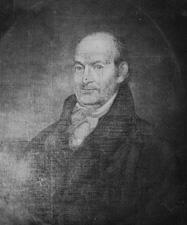
John Condit, also known as John Condict (July 8, 1755 – May 4, 1834), was a United States Representative and United States Senator from New Jersey and the father of United States Representative Silas Condit. He served as a Representative from New Jersey in the United States Congress from 1799 to 1821, during which time he was affiliated with the Republican, or Democratic-Republican, Party and contributed to the legislative process over six terms in office. His congressional service spanned a formative period in American history, and he participated actively in the democratic process, representing the interests of his New Jersey constituents in both houses of Congress.
Condit was born in Orange, in the Province of New Jersey, on July 8, 1755. He attended public schools in his native community and subsequently pursued the study of medicine. During the American Revolutionary War, he served as a surgeon, including service as surgeon in Colonel Van Cortland’s Battalion of Heard’s Brigade beginning June 29, 1776. After the war, he returned to Orange and became a prominent local figure. In 1785 he was one of the founders and a trustee of the Orange Academy, reflecting his interest in education and civic improvement in his hometown.
Condit’s political career began at the state level in New Jersey. He served as a member of the New Jersey General Assembly from 1788 to 1789, participating in the early legislative life of the state under its post-Revolutionary government. He then served in the New Jersey Legislative Council, the upper house of the state legislature, from 1790 to 1797. Through these roles he gained legislative experience and established himself as a leading Democratic-Republican figure in New Jersey politics at the close of the eighteenth century.
Building on his state legislative service, Condit was elected as a Democratic-Republican to the United States House of Representatives. He served in the Sixth and Seventh Congresses from March 4, 1799, to March 4, 1803, representing New Jersey at the federal level. His tenure in the House coincided with the administrations of John Adams and Thomas Jefferson and with the consolidation of the Democratic-Republican Party as a dominant national force. Over these years he took part in debates and votes that helped shape the early federal government and its policies.
Condit’s service in Congress extended beyond the House to the United States Senate. He was appointed as a Democratic-Republican to the Senate to fill the vacancy in the term beginning March 4, 1803, which had occurred because the New Jersey legislature failed initially to elect a senator. He took his seat on September 1, 1803, and was subsequently elected on November 3, 1803, to finish that term, serving until March 3, 1809. He was again appointed to the Senate to fill the vacancy caused by the resignation of Senator Aaron Kitchell and was elected on November 2, 1809, to complete that term. In this second period of Senate service, he served from March 21, 1809, to March 3, 1817. Across these years in the upper chamber, he represented New Jersey during the Jefferson and Madison administrations and through the War of 1812, contributing to national deliberations during a critical era of American expansion and conflict.
After leaving the Senate in 1817, Condit returned to the House of Representatives for a final period of service. He was elected to the Sixteenth Congress and served from March 4, 1819, to November 4, 1819. During this term he again represented New Jersey in the House, but resigned before its completion in order to accept a federal executive appointment. His combined service in the House and Senate, from his first election in 1799 through his final resignation in 1819, made him a long-serving Democratic-Republican legislator during the early national period.
Following his resignation from Congress in 1819, Condit entered federal administrative service. He was appointed assistant collector of the port of New York, a significant Treasury Department position, and held that office from 1819 to 1830. In this capacity he was involved in the administration of customs and revenue at one of the nation’s most important ports, continuing his public service in a non-legislative role during the later years of his career.
John Condit died in Orange Township, New Jersey, on May 4, 1834. He was interred in the Old Graveyard in Orange, Essex County, New Jersey. His life encompassed service as a Revolutionary War surgeon, educator, state legislator, United States Representative, United States Senator, and federal revenue official, and he was part of a family tradition of public service that continued through his son, Representative Silas Condit.
Congressional Record