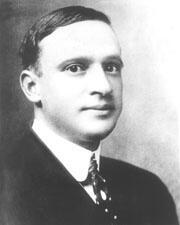
John Sanford Cohen (February 26, 1870 – May 13, 1935) was a Democratic United States senator from Georgia, a prominent newspaper editor and publisher, and a significant figure in early twentieth-century Southern politics and journalism. He served in the United States Senate from 1932 to 1933, representing Georgia during a critical transitional period in American history at the onset of the New Deal era.
Cohen was born in Augusta, Georgia, on February 26, 1870, the son of Ellen Gobert (Wright) Cohen and Philip Lawrence Cohen. His father came from a long-established Jewish family, but Cohen was raised in his mother’s Episcopalian faith. Through his mother, he was the grandson of Ambrose R. Wright, a noted Georgia politician and Confederate major general in the Civil War, a lineage that situated him within the political and social establishment of the postbellum South. Growing up in Augusta, he was exposed early to both public affairs and the world of print and politics that would later define his career.
Cohen received his early education at Richmond Academy in Augusta and later attended Shenandoah Valley Academy in Winchester, Virginia. In 1885 he entered the United States Naval Academy at Annapolis, where he studied for approximately a year before leaving in 1886. That same year he began his professional life in journalism as a newspaper reporter for the New York World, gaining experience in national reporting and political coverage that would shape his later work as an editor and publisher.
By the early 1890s, Cohen had moved into the orbit of national Democratic politics. From 1893 to 1896 he served as secretary to Secretary of the Interior Hoke Smith in Washington, D.C., a position that gave him direct exposure to federal administration and policy-making. During this period, from 1893 to 1897, he was also a member of the press galleries of the United States Congress, further deepening his familiarity with legislative processes and national political figures. His dual role as a political aide and journalist helped establish him as an influential intermediary between government and the press.
During the Spanish–American War in 1898, Cohen returned to frontline journalism as a war correspondent for the Atlanta Journal, covering the conflict and its aftermath. He subsequently enlisted in the Third Georgia Volunteer Infantry, in which he attained the rank of major. Serving with the army of occupation in Cuba, he combined military service with his background in reporting, reinforcing his public profile as both a soldier and chronicler of American military engagements. The title “Major” by which he was often known in later years derived from this period of service.
After the war, Cohen’s career became firmly anchored in Georgia journalism and business. He rose to become president of the Atlanta Journal and served as its editor from 1900 until his death in 1935, overseeing the paper’s growth into one of the South’s most influential daily newspapers. Under his leadership, the Journal played a major role in shaping public opinion in Georgia and the region on issues ranging from state politics to national elections and infrastructure development. Cohen also originated the plan for a national highway running from New York City to Jacksonville, Florida, reflecting his interest in modern transportation networks and regional economic development. His prominence in civic and business circles is further evidenced by his service on major corporate boards, including the Atlanta National Bank, where he was a member of the board of directors by 1911.
Cohen’s long involvement in Democratic Party affairs culminated in his elevation to national leadership. In 1932 he became vice chairman of the Democratic National Committee, a position he held until 1935. That same year, on April 25, 1932, he was appointed as a Democrat to the United States Senate to fill the vacancy caused by the death of Senator William J. Harris. Cohen served in the Senate from April 25, 1932, to January 11, 1933, representing Georgia during the closing months of the Hoover administration and the election of Franklin D. Roosevelt. His brief tenure coincided with a significant period in American history marked by the Great Depression and the political realignment that ushered in the New Deal. As a member of the Senate, he participated in the legislative process and represented the interests of his Georgia constituents. He did not seek election in 1932 to complete the unexpired term and returned to his newspaper and political activities after his successor was duly elected and qualified.
Following his service in Congress, Cohen continued to lead the Atlanta Journal and to play a visible role in Democratic politics and public affairs until his death. He remained vice chairman of the Democratic National Committee and continued to influence public discourse through his editorial work. Cohen died in Atlanta, Georgia, on May 13, 1935. He was buried in Westview Cemetery in Atlanta. His contributions to journalism were formally recognized posthumously when, in 1942, he was inducted into the Georgia Newspaper Hall of Fame, underscoring his lasting impact on the press and political life of Georgia and the South.
Congressional Record