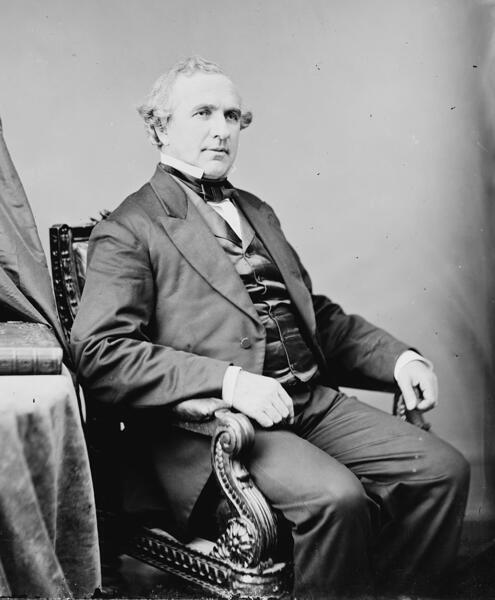
John Cessna (June 29, 1821 – December 13, 1893) was a Republican member of the U.S. House of Representatives from Pennsylvania whose two terms in Congress occurred during a significant period in American history. He participated actively in the legislative process and represented the interests of his Pennsylvania constituents amid the political realignments and national reconstruction that followed the Civil War.
Cessna was born in Bedford County, Pennsylvania, on June 29, 1821. He attended the common schools of the area and continued his education at Hall’s Military Academy in Bedford, reflecting an early exposure to disciplined study and civic-minded training. He subsequently enrolled at Marshall College in Mercersburg, Pennsylvania, from which he graduated in 1842. After completing his collegiate education, Cessna taught school for a time while studying law, preparing himself for a professional and public career.
In 1845 Cessna was admitted to the bar and commenced the practice of law in Bedford, Pennsylvania. His legal practice quickly intersected with public service, and he emerged as a prominent figure in state politics. He was elected to the Pennsylvania House of Representatives in 1850 and 1851, and again in 1862 and 1863. Demonstrating leadership among his colleagues, he was chosen speaker of the Pennsylvania House of Representatives in 1850 and again in 1863. During this early phase of his career he was aligned with the Democratic Party and served as a delegate to the Democratic National Convention at Cincinnati, Ohio, in 1856, and to the fractious conventions at Charleston, South Carolina, and Baltimore, Maryland, in 1860, which preceded the sectional crisis and the Civil War.
Amid the political upheaval of the Civil War era, Cessna changed his party affiliation and became a member of the Republican Party in 1863. He quickly assumed a leadership role within his new party. In 1865 he served as chairman of the Republican State convention and was elected chairman of the Republican State central committee, positions that placed him at the center of party organization and strategy in Pennsylvania during Reconstruction. He also gained national prominence within Republican ranks as a delegate to the Republican National Conventions in 1868, 1876, and 1880, participating in the nomination of presidential candidates and the shaping of the party platform.
Cessna’s prominence in state and national Republican politics led to his election to the U.S. House of Representatives. He was elected as a Republican to the Forty-first Congress, representing Pennsylvania in the U.S. House during a critical phase of Reconstruction. As a member of Congress, he contributed to the legislative process and the broader democratic governance of the period, working to represent the interests of his constituents in Pennsylvania. He was an unsuccessful candidate for reelection in 1870, but remained an influential figure in his party and state.
Cessna returned to Congress when he was elected as a Republican to the Forty-third Congress. His second term in the U.S. House again placed him at the federal level during ongoing debates over Reconstruction, economic development, and the postwar settlement. He chose not to be a candidate for renomination in 1874, concluding his service in the national legislature after two nonconsecutive terms. Throughout his congressional career, he was identified with the Republican Party’s efforts to shape national policy in the aftermath of the Civil War.
After leaving Congress, Cessna continued to balance legal practice with public service. He resumed the practice of law in Bedford, maintaining his status as a leading attorney in the region. His commitment to state politics endured, and he returned once more to the Pennsylvania House of Representatives in 1892, adding a further chapter to a long legislative career that had begun more than four decades earlier. He remained active in public and professional life in Bedford until his death there on December 13, 1893.
Congressional Record