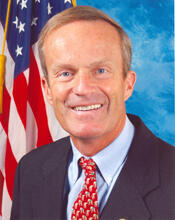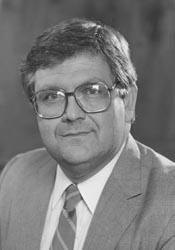
John William Buechner (June 4, 1940 – March 6, 2020) was an American lawyer and Republican politician who served as a United States Representative from Missouri from 1987 to 1991. Representing Missouri’s 2nd congressional district, he served two terms in the U.S. House of Representatives and contributed to the legislative process during a significant period in American political history. Known as “Jack” Buechner (pronounced BEEK-ner), he later held leadership roles in international democracy promotion, legal practice, and civic education organizations.
Buechner was raised in Kirkwood, Missouri, a suburb of St. Louis, where he attended parochial schools. He pursued higher education at Benedictine College in Atchison, Kansas, from which he graduated with a Bachelor of Arts degree in political science. He subsequently earned his Juris Doctor from Saint Louis University School of Law, preparing for a career that combined law, public service, and politics.
Buechner entered elective office in Missouri in the early 1970s. He was elected to the Missouri House of Representatives in 1972 and served there for a decade, remaining a member until 1982. During this period, he established himself within Republican Party circles and was selected as a delegate to the Republican National Conventions in 1964, 1980, and 1988. Building on his state legislative experience, he sought federal office in 1984, running for the U.S. House of Representatives in Missouri’s 2nd congressional district against incumbent Democrat Robert A. Young. In that first bid he narrowly lost, receiving 47.5 percent of the vote.
In 1986, Buechner again challenged Robert A. Young for the 2nd district seat and this time was successful, winning with 52.7 percent of the vote. He took office in the U.S. House of Representatives on January 3, 1987, as a member of the Republican Party and served two consecutive terms, leaving office on January 3, 1991. During his tenure in Congress, Buechner served on the House Budget Committee and the Committee on Science, Space, and Technology, participating actively in the democratic process and representing the interests of his Missouri constituents. In 1987, he was among 26 House Republicans who voted against overriding President Ronald Reagan’s veto of a clean water bill that Reagan criticized as “loaded with waste and larded with pork.” His voting record earned him conservative ratings from the American Conservative Union of 86 percent in 1987, 88 percent in 1988, 73 percent in 1989, and 67 percent in 1990, reflecting a generally conservative but occasionally more moderate profile over time.
Buechner was re-elected to Congress in 1988, but his 1990 campaign proved one of the closest House races in the country. In that election he was narrowly defeated by Democrat Joan Kelly Horn by only 54 votes. The contest occurred in a year when 102 of the 406 House members who won re-election did so with 60 percent of the vote or less, and journalist R. W. Apple Jr. of The New York Times cited “taxes and the budget battle” as contributing factors in Buechner’s loss. During his congressional service he also gained a measure of popular visibility; he was the first member of Congress to appear as a guest on Late Night with David Letterman. Around five times until 1992, he took part in weekly Thursday night poker games hosted by Senator Alfonse D’Amato in D’Amato’s Washington office, informal gatherings that brought together members of Congress and lobbyists.
After leaving Congress, Buechner embarked on a varied career in international affairs, law, and education. He became president of the International Republican Institute (IRI), a Washington-based organization that promotes democratic governance and political party development abroad. Following Senator John McCain’s assumption of the IRI chairmanship, the board dismissed Buechner, a move he later characterized as “less than gracious.” In private legal practice, he served as an associate and later partner in the Washington, D.C., office of the law firm Manatt, Phelps & Phillips and subsequently at Anderson Kill & Olick, P.C. He also remained engaged in public policy and advocacy, serving as senior counsel to The Hawthorn Group in Alexandria, Virginia, and as a member of the advisory board of Bloomberg Government. He was additionally a member of the ReFormers Caucus of Issue One, a bipartisan group of former elected officials focused on political reform.
Buechner was active in civic and educational initiatives, particularly those aimed at fostering civic understanding among young people. From 2001 until his retirement in 2005, he served as president of the Presidential Classroom program, a national civic education organization that brought high school students to Washington, D.C., to learn about government and public policy. In academia, he was a visiting professor of political thought at Webster University Vienna and an adjunct professor of political science at Saint Louis University and Stephens College, sharing his practical experience in politics and law with students in the United States and abroad.
In his personal life, Buechner married three times. His first marriage was to Marietta Caiarelli, a nurse. They had two sons, Terrence, born in 1969, and Patrick. In 1990, he married Nancy Chanitz, with whom he had another son, Charles; the family lived in McLean, Virginia, until Nancy’s death in 2006. In 2009, Buechner married Andrea Dravo, an attorney, and they resided in Washington, D.C., in his later years. John William “Jack” Buechner died on March 6, 2020, in Washington, D.C., concluding a career that spanned state and national politics, international democracy work, legal practice, and civic education.
Congressional Record