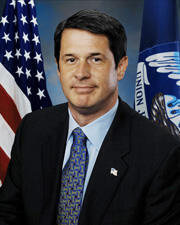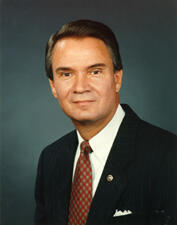
John Berlinger Breaux (born March 1, 1944) is an American lobbyist, attorney, and retired politician from Louisiana who served in the United States Congress from 1972 to 2005. A member of the Democratic Party and a prominent Southern Democrat, he served in the U.S. House of Representatives from 1972 to 1987 and as a United States senator from 1987 to 2005. Over the course of eleven terms in Congress, Breaux became known as a centrist and one of the more conservative national legislators in his party, playing a key role in major tax, welfare, health care, and trade legislation and participating actively in the democratic process on behalf of his Louisiana constituents.
Breaux was born in Crowley, Acadia Parish, Louisiana, on March 1, 1944. He attended local schools and went on to study at the University of Southwestern Louisiana (now the University of Louisiana at Lafayette), from which he graduated with a Bachelor of Arts degree in 1964. While in college, he became a member of the Lambda Chi Alpha fraternity. He then enrolled at the Louisiana State University Law Center in Baton Rouge, earning his Juris Doctor degree in 1967. After completing his legal education, Breaux was admitted to the bar and entered private practice in Louisiana, beginning a legal career that would underpin his later work in public service.
Breaux’s early political experience came through his work as an assistant to U.S. Representative Edwin Edwards, who represented Louisiana’s 7th Congressional District. When Edwards resigned his House seat after being elected governor of Louisiana, Breaux ran in the special election to fill the vacancy. On September 30, 1972, he was elected as a Democrat to the 92nd Congress, becoming, at age twenty-eight, the youngest member of the U.S. House of Representatives at that time. His campaign manager in that race was Ron Faucheux, who later served in the Louisiana House of Representatives. Breaux was re-elected with relative ease to seven succeeding Congresses, serving in the House from September 30, 1972, until January 3, 1987, and building a reputation as a pragmatic legislator attentive to the interests of his largely rural and energy-producing district in southwestern Louisiana.
In 1986, Breaux chose not to seek re-election to the House and instead ran for the United States Senate. He was elected as a Democrat and took office on January 3, 1987, beginning an 18-year Senate career that lasted until January 3, 2005. As a senator from Louisiana, he served during a significant period in American history marked by the end of the Cold War, the rise of globalization, and intense partisan polarization. Breaux was widely regarded as a centrist dealmaker in a closely divided Senate and was frequently sought out by Republican leaders to secure a handful of Democratic votes for bipartisan coalitions. Conversely, he often served as an emissary for Democratic leaders in efforts to attract moderate Republicans to support Democratic initiatives. A member of the New Democrat Coalition and a founder of the bipartisan Senate Centrist Coalition, he was also associated with the Democratic Leadership Council, for which he served as chairman.
Breaux’s Senate record reflected his moderate-to-conservative orientation within the Democratic Party. He was pro-life and a supporter of Second Amendment rights, though he gradually moderated his position on gun control over time. He was more conservative on tax policy than many of his Democratic colleagues and often challenged environmental regulations he believed were harmful to industry or energy development. He voted in favor of the North American Free Trade Agreement (NAFTA), supported welfare reform, backed a balanced budget amendment, and favored tighter bankruptcy laws. He was a key Democratic supporter of Republican efforts to abolish the federal estate tax and, in 2001, was among a minority of Democrats who supported President George W. Bush’s tax cut and opposed most attempts by Democrats to alter it. Nonetheless, Breaux had voted with the Democratic majority in favor of President Bill Clinton’s 1993 budget, and in 2003 he submitted an amendment to reduce the size of a proposed tax cut to $350 billion. In 1995, he notably voted twice with more liberal elements of his party against two widely approved lawsuit reform measures—the Common Sense Product Liability and Legal Reform Act and the Private Securities Litigation Reform Act. Both measures were vetoed by President Clinton, although the latter was eventually enacted over his veto.
Breaux played an influential role in judicial confirmations and communications policy. He opposed President Ronald Reagan’s nomination of Robert Bork to the U.S. Supreme Court and, on October 23, 1987, joined all but two Democrats and six Republicans in voting against Bork’s confirmation, which failed by a vote of 42–58. On October 15, 1991, he was one of seven Southern Democrats who voted to confirm Clarence Thomas to the Supreme Court, contributing to Thomas’s narrow 52–48 confirmation, the closest margin for a successful nominee in more than a century. In the realm of media regulation, Breaux opposed the loosening of Federal Communications Commission (FCC) rules that would have allowed cross-media ownership in the same community, and on June 22, 2004, he cast the lone Senate vote against an amendment (S.A. 3464) that would have increased the maximum fine for “obscene, indecent or profane language” by broadcasters from $27,500 to $275,000, reflecting his concern about regulatory overreach.
Within the Senate’s internal leadership and committee structure, Breaux held several key posts. In 1993, he was elected by Senate Democrats as Deputy Majority Whip, a leadership position he held until his retirement in 2005. He was a senior member of the powerful Committee on Finance, where he chaired the Subcommittee on Social Security and Family Policy. From that vantage point, he helped build the coalitions that produced major welfare reform and health insurance reform legislation in 1996. He advocated for reductions in the capital gains tax and supported tax relief for college education expenses. In 1998, Breaux was selected by the White House and congressional leaders to chair the National Bipartisan Commission on the Future of Medicare, and he also co-chaired the National Commission on Retirement Policy, which developed proposals to reform Social Security. He was widely regarded as the principal architect of the $400 billion Medicare Prescription Drug, Improvement, and Modernization Act, which created a prescription drug benefit under Medicare. During his Senate tenure, his state director and press secretary was journalist Robert “Bob” Mann, who later became the Douglas Manship Chair of Journalism at Louisiana State University.
Breaux remained deeply involved in Louisiana politics while in the Senate. In the 2003 Louisiana gubernatorial campaign, after briefly considering a candidacy of his own, he campaigned vigorously for Democrat Kathleen Babineaux Blanco of Lafayette, who was ultimately elected governor. That same year, Breaux was inducted into the Louisiana Political Museum and Hall of Fame in Winnfield, recognizing his long service to the state. In 2004 he announced that he would not run for re-election to the Senate. By most accounts, he remained sufficiently popular that he was widely expected to win a fourth term had he chosen to seek it. He endorsed Democrat Chris John, the U.S. representative from Louisiana’s 7th District, which Breaux had once represented, as his preferred successor. However, in the state’s open “jungle” primary, John finished second to Republican David Vitter of suburban New Orleans. Vitter went on to win 51 percent of the vote in the general election, avoiding a runoff and succeeding Breaux in the Senate. Despite Breaux’s enduring popularity, he was unable to determine his successor in the manner of earlier Louisiana Senate power brokers such as Russell Long and J. Bennett Johnston Jr.
After leaving Congress in January 2005, Breaux transitioned to academia and lobbying while remaining active in public policy debates. In February 2005, he accepted a position as a Distinguished Professor in the Manship School of Mass Communication at Louisiana State University in Baton Rouge. He also entered the lobbying profession, co-founding the Breaux-Lott Leadership Group with former Republican Senate Majority Leader Trent Lott. The firm specialized in federal advocacy and was later acquired by the law and lobbying firm Patton Boggs, which subsequently became part of Squire Patton Boggs. Since 2005, Breaux has worked as a lobbyist with Squire Patton Boggs in Washington, D.C., focusing on health care and energy law and representing a range of corporate and institutional clients.
Breaux has continued to engage in national policy discussions, particularly on health care and retirement issues. He spearheaded a national campaign titled “Ceasefire on Health Care: Finding Common Ground for the Uninsured,” a bipartisan initiative developed in conjunction with American University’s Center for Congressional and Presidential Studies. Through this effort, he hosted events bringing together prominent figures from both major parties to foster dialogue aimed at achieving meaningful health care reform. In corporate governance, he has served on the board of directors of CSX Transportation, reflecting his ongoing involvement in transportation and infrastructure policy. In 2021, he was reported to be involved in lobbying efforts opposing increased taxation on large inheritances, consistent with his long-standing interest in tax policy and estate taxation.
Breaux briefly reemerged as a potential candidate in Louisiana politics in 2007, when speculation mounted that he might run for governor. Widely regarded as one of the state’s most popular Democrats, he considered entering the 2007 gubernatorial race if Governor Kathleen Blanco chose not to seek re-election. After Blanco announced on March 20, 2007, that she would not run, Breaux made a public appearance in Louisiana on March 29, stating that he intended to run and would formally announce his candidacy once Louisiana Attorney General Charles Foti issued a legal opinion on his eligibility. Questions had been raised about whether Breaux met the state constitution’s requirement that a gubernatorial candidate be a “citizen” of Louisiana, as he had been registered to vote and listed his primary residence in Maryland since 2005. Attorney General Foti declined to issue an opinion, indicating that the matter should be resolved by the courts. On April 13, 2007, Breaux announced that he would not run for governor, explaining that he did not want a prolonged legal dispute over his residency to overshadow a potential campaign.
In Louisiana’s Acadiana region, Breaux’s long public service has even been commemorated in local culture: a regional Japanese restaurant chain named a sushi roll in his honor, the “John Breaux,” featuring crawfish and avocado, a nod to his Cajun roots and enduring local popularity. Throughout his career and post-congressional life, Breaux has remained a significant figure in Louisiana and national politics, known for his centrist approach, his willingness to broker bipartisan compromises, and his continued involvement in issues of health care, taxation, and retirement policy.
Congressional Record