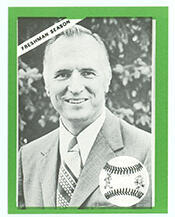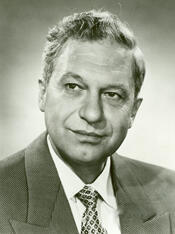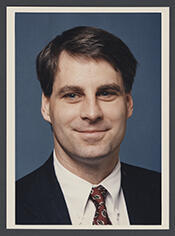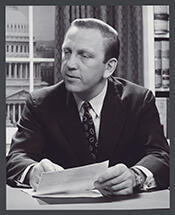
Stephen John Brademas Jr. (March 2, 1927 – July 11, 2016) was an American politician, educator, and university president who represented Indiana in the United States House of Representatives from 1959 to 1981. A member of the Democratic Party, he served eleven consecutive terms in Congress and rose to the position of House Majority Whip from 1977 to 1981, concluding a twenty‑two‑year tenure as U.S. Representative from Indiana’s 3rd congressional district. Widely recognized for his leadership on federal legislation concerning education, the arts, and the humanities, he later served as the 13th president of New York University and held prominent positions in finance, philanthropy, and cultural affairs.
The oldest of four children, Brademas was born in Mishawaka, Indiana, on March 2, 1927, to Stephen John Brademas, a Greek immigrant who operated a restaurant, and Beatrice (Goble) Brademas, an American elementary school teacher. He spent summers with his maternal grandfather, who served as state superintendent of schools in Canada and maintained a large personal library, an influence that helped shape Brademas’s lifelong commitment to education and public service. Raised in nearby South Bend, he graduated as valedictorian from Central High School in South Bend. During World War II, he served for two years in the United States Navy, stationed in Milwaukee, Wisconsin, before resuming his academic pursuits.
Brademas attended Harvard University, where he was affiliated with Adams House and graduated magna cum laude and Phi Beta Kappa with an A.B. degree. His undergraduate thesis, “The Sinarquista Movement in Mexico: Its Implications for the United States,” was published in April 1949, reflecting an early interest in international affairs and political movements. Awarded a Rhodes Scholarship, he went on to study at Brasenose College, Oxford, in England, earning a D.Phil. in Social Studies. His academic distinction and international experience laid the groundwork for his later work in Congress on education and foreign policy, as well as for his subsequent leadership in higher education.
John Brademas first won election to the U.S. House of Representatives in 1958 and took office on January 3, 1959, beginning what would become eleven terms of service through January 3, 1981. Representing Indiana’s 3rd congressional district, he became the first Greek‑American member of Congress, preceding later Greek‑American legislators such as Olympia Snowe, Paul Tsongas, and Paul Sarbanes. Serving during a significant period in American history marked by the civil rights movement, the Great Society, and the Vietnam War, he participated actively in the legislative process and represented the interests of his northern Indiana constituents. He served on the Committee on Education and Labor, where he played a leading role in shaping much of the federal legislation of the era concerning schools, colleges, and universities; services for the elderly and the handicapped; libraries and museums; and the arts and humanities.
Within the House, Brademas developed a reputation as a skilled legislator and vote‑counter, culminating in his election as House Majority Whip in 1977, a position he held until 1981. In this role, he was a key member of the Democratic leadership, responsible for marshaling support for the party’s legislative agenda. He was a cosponsor of the 1965 legislation creating the National Endowment for the Arts (NEA) and the National Endowment for the Humanities (NEH), and for ten years he chaired the congressional subcommittee with jurisdiction over those agencies. He served as chief House sponsor of the Arts, Humanities and Cultural Affairs Act; the Arts and Artifacts Indemnity Act; the Museum Services Act; the Library Services and Construction Act; the National Commission on Libraries and Information Services Act; the Education for All Handicapped Children Act; the Alcohol and Drug Abuse Education Act; and the International Education Act. He was also a major co‑author of the Elementary and Secondary Education Act of 1965; the Higher Education Acts of 1972 and 1976, which emphasized student financial aid; and the measure creating the National Institute of Education. In his home district, he was instrumental in helping the South Bend area recover from the December 1963 closure of the Studebaker Corporation’s automobile manufacturing plants, which had put more than 5,000 people out of work. Using his contacts in Washington, he helped secure an $81 million government contract in 1964 that facilitated Kaiser Jeep Corporation’s purchase of the Chippewa Avenue truck plant from Studebaker, restoring significant employment in the region and laying the groundwork for the later operations of AM General in Mishawaka. Brademas’s congressional career ended when he was defeated for reelection on November 4, 1980, by Republican John Hiler, in a race heavily influenced by the national political climate and the Ronald Reagan–Jimmy Carter presidential campaign.
After leaving Congress, Brademas moved to New York and in 1981 became the 13th president of New York University, a position he held until 1992. During his presidency, he oversaw a period of institutional growth and rising academic stature, strengthening NYU’s international profile and its connections to the arts and public policy. His prominence in cultural affairs was underscored by his friendship with film actress Paulette Goddard, who left her multimillion‑dollar estate to New York University in large part because of her relationship with Brademas. In 1990, he co‑chaired the bipartisan independent commission mandated by Congress to review the grant‑making procedures of the NEA, reflecting his continuing national role in arts policy. He was later appointed by President Bill Clinton as chairman of the President’s Committee on the Arts and the Humanities and served as chairman of the National Endowment for Democracy, as well as a member of the Consultants’ Panel to the Comptroller General of the United States.
Beyond his university leadership and federal appointments, Brademas was active on a wide range of boards and national commissions addressing the arts, higher education, foreign policy, employment and small business, historic documents and records, and the relationship between science, technology, and government. He served as chairman of the American Ditchley Foundation and co‑chaired the Center for Science, Technology and Congress at the American Association for the Advancement of Science in Washington, D.C. In the financial sector, he was a member and later chairman of the board of the Federal Reserve Bank of New York, and he served on the board of the New York Stock Exchange. He was also a trustee of the Rockefeller Foundation and served on the boards of the Alexander S. Onassis Public Benefit Foundation, the American Council for the Arts, the Center for National Policy, and the Spanish Institute. In addition, he was a member of the Central Committee of the World Council of Churches and served on several corporate boards. Brademas was elected a fellow of the American Academy of Arts and Sciences and of the Academy of Athens, and he received honorary degrees from 47 colleges and universities. Among his many honors was the annual Award for Distinguished Service to the Arts from the American Academy and Institute of Arts and Letters. At Brasenose College, Oxford, the Middle Common Room is housed in the Brademas Room, named in his honor. On October 3, 2011, the King of Spain bestowed on him the Order of Isabella the Catholic, a Spanish civil order recognizing services beneficial to Spain. In his home community, South Bend’s main post office was officially named the “John Brademas Post Office” in recognition of his service.
John Brademas died on July 11, 2016, at the age of 89. He is interred at the Congressional Cemetery in Washington, D.C. He was survived by his wife, Mary, a physician. His congressional papers are preserved and accessible through New York University, and his public career is documented in various media, including interviews and appearances on C‑SPAN and the archival television program “The Open Mind – A Congressman Looks at Education (1981).”
Congressional Record