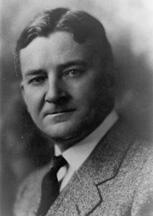
John James Blaine (May 4, 1875 – April 16, 1934) was an American lawyer and progressive Republican politician from Grant County, Wisconsin, who served as the 24th governor of Wisconsin for three consecutive terms from 1921 to 1927 and as a United States senator from Wisconsin from 1927 to 1933. Over the course of his career he also served as the 23rd attorney general of Wisconsin, a member of the Wisconsin Senate, and mayor of Boscobel, Wisconsin. A member of the Republican Party, he contributed to the legislative process during one term in the United States Senate, representing the interests of his constituents during a significant period in American history.
Blaine was born on May 4, 1875, in Wingville, Grant County, Wisconsin, the son of James Ferguson Blaine (1827–1888) and Elizabeth (Johnson) Blaine (1834–1903), who were immigrants from Scotland and Norway, respectively. He attended the common schools in Wisconsin before pursuing higher education at what is now Valparaiso University in Indiana. He enrolled in the university’s law department and graduated in 1896. Shortly thereafter he was admitted to the bar in Wisconsin and began the practice of law in Montfort, Wisconsin, before relocating to Boscobel, where he would establish his professional and political base.
In addition to his legal practice, Blaine became involved in local business and civic affairs, serving as vice president of a telephone company. He entered public life at the municipal level in Boscobel, where he was elected mayor for three one-year terms, serving in 1901–1902, 1903–1904, and 1906–1907. He also served on the Grant County Board of Supervisors, further entrenching himself in local governance. His growing reputation as a reform-minded Republican led to his election to the Wisconsin State Senate from the 16th District, where he served from 1909 to 1912. During this period he also began to participate in national party politics, serving as an alternate delegate to the Republican National Convention in 1912.
Blaine’s statewide prominence increased when he was elected attorney general of Wisconsin, serving as the 23rd attorney general from 1919 to 1921. As a progressive Republican, he aligned himself with reform elements within the party and continued to build influence in national Republican circles, serving as a delegate to the Republican National Conventions of 1916, 1920, 1924, 1928, and 1932. In 1920 he was elected governor of Wisconsin, assuming office on January 3, 1921. He was reelected twice, serving three consecutive two-year terms as the 24th governor of Wisconsin, from January 3, 1921, to January 3, 1927. His tenure as governor coincided with the post–World War I era and the early years of Prohibition, during which he was identified with progressive policies and state-level reforms.
In 1926, Blaine sought federal office and challenged incumbent Progressive Republican United States Senator Irvine Lenroot in the Republican primary. He defeated Lenroot and went on to win the general election with approximately 55 percent of the vote, prevailing over Democratic, Independent, and Socialist Party candidates. Blaine entered the United States Senate on March 4, 1927, and served one full term, leaving office on March 3, 1933. His service in Congress occurred during a period marked by the late 1920s economic boom, the onset of the Great Depression, and significant debates over foreign policy and domestic reform. As a member of the Senate, he participated in the democratic process and represented Wisconsin’s interests in national legislative deliberations.
Blaine’s Senate career was notable for several distinctive positions. He was the only senator to vote against ratification of the Kellogg–Briand Pact, which sought to renounce war as an instrument of national policy and was approved by a vote of 85–1. Blaine argued that ratifying the treaty represented an endorsement of British imperialism and was skeptical of its practical effect. In the 1928 presidential campaign he crossed party lines and endorsed Democratic nominee Alfred E. Smith for president, reflecting his independent and progressive streak within the Republican Party. He later played a key role in the movement to end national Prohibition, authoring the legislation commonly known as the Blaine Act, which became the basis for the Twenty-first Amendment to the Constitution, repealing the Eighteenth Amendment and ending Prohibition in the United States.
In 1932, amid the political realignments of the Great Depression and a strong national swing toward the Democratic Party, Blaine was defeated in the Republican primary by John B. Chapple. Chapple subsequently lost the general election to Democrat F. Ryan Duffy as part of the sweeping Democratic victories that accompanied Franklin D. Roosevelt’s election to the presidency. After leaving the Senate, Blaine returned to Boscobel and resumed the practice of law. His expertise and experience in public finance and governance led to his appointment by President Franklin D. Roosevelt as a director of the Reconstruction Finance Corporation, where he served until his death, contributing to federal efforts to address the economic crisis.
Blaine married Anna C. McSpaden (1875–1938) on August 23, 1904, and maintained his residence in Boscobel throughout his public career. He died of pneumonia in Boscobel, Wisconsin, on April 16, 1934, at the age of 58 years, 347 days. John James Blaine was interred at Boscobel Cemetery in Boscobel, Wisconsin, closing a career that spanned local, state, and national office during a transformative era in American political and social history.
Congressional Record