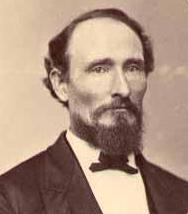
John Summerfield Bigby (February 13, 1832 – March 28, 1898) was a Republican United States Representative from Georgia who was active in state politics and the federal government during the Reconstruction era. He was born near Newnan, Coweta County, Georgia, where he attended the local common schools. Raised in the antebellum South, he came of age in a period of rapid political and social change that would later shape his legal and political career.
Bigby pursued higher education at Emory College in Oxford, Georgia, one of the leading Methodist institutions in the state, and graduated in 1853. After completing his collegiate studies, he read law and was admitted to the bar in 1856. He commenced the practice of law in Newnan, Georgia, building a professional reputation that would carry him into public life. His early legal work in Coweta County and the surrounding region provided him with experience in Georgia’s court system on the eve of the Civil War.
With the end of the Civil War and the onset of Reconstruction, Bigby became involved in the reorganization of Georgia’s civil and political institutions. He served as a member of the State constitutional conventions of 1867–1868, which were convened under the Reconstruction Acts to bring Georgia back into the Union and to revise its fundamental law. During this period he also entered public office in the judicial branch. He was appointed solicitor general of the Tallapoosa circuit in August 1867 and served in that capacity until September 22, 1868, acting as a prosecuting officer for the state in that judicial circuit. On September 22, 1868, he was elevated to the bench as judge of the superior court of the same Tallapoosa circuit, a position he held until March 3, 1871, presiding over civil and criminal matters during a contentious phase of Reconstruction.
Bigby’s judicial service led to his election to national office. A member of the Republican Party, which at that time was the party of Reconstruction in the South, he was elected to the Forty-second Congress and served from March 4, 1871, to March 3, 1873, as a Representative from Georgia. In Congress he aligned with the Republican majority on key enforcement and civil rights measures and voted for the Ku Klux Klan Act, formally known as the Enforcement Act of 1871, which was designed to curb racial violence and protect the civil and political rights of newly enfranchised African Americans in the South. Despite his active participation in Reconstruction legislation, he was an unsuccessful candidate for reelection in 1872 to the Forty-third Congress, as Democratic opposition and shifting political currents in Georgia eroded Republican strength.
After leaving Congress, Bigby returned to private life and resumed the practice of law, this time in Atlanta, Georgia, which was emerging as the state’s principal commercial and transportation center. He remained engaged in Republican Party affairs and served as a delegate to the 1876 Republican National Convention, participating in the party’s deliberations during the closely contested presidential election of that year. In addition to his legal and political work, he entered the railroad industry, becoming president of the Atlanta & West Point Railroad in 1876. In that role he was involved in the management and development of a key regional rail line that contributed to Atlanta’s growth as a transportation hub in the postwar South.
John Summerfield Bigby spent his later years in Atlanta, where he continued his professional and civic activities until his death. He died in Atlanta on March 28, 1898. He was interred in Westview Cemetery in that city, a resting place for many of Atlanta’s political, business, and civic leaders of the nineteenth century.
Congressional Record