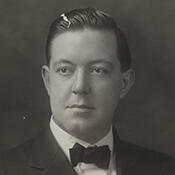
John Miller Baer (March 29, 1886 – February 18, 1970) was a U.S. Representative from North Dakota who served in the United States Congress from 1917 to 1921. A member of the Republican Party and closely associated with the Nonpartisan League, he contributed to the legislative process during two terms in office, representing the interests of his North Dakota constituents during a significant period in American history.
Baer was born at Black Creek, Outagamie County, Wisconsin, on March 29, 1886, the son of Capt. John M. Baer and Libbie Riley Baer. Through his mother he was connected to several notable American families. On the Riley side of the family he was related to the poet and humorist James Whitcomb Riley, while on the Swing side he was descended from Prof. David Swing, a well-known philosopher and preacher in Chicago. He was also a descendant of the Blair family, an old and favorably known family of southern Ohio. Baer attended the public schools in his hometown, receiving his early education in Wisconsin.
Pursuing higher education, Baer enrolled at Lawrence University in Appleton, Wisconsin. He completed his studies there and was graduated in 1909. His training prepared him for work in both technical and agricultural fields, and it also provided a foundation for the analytical and communication skills that later informed his work as a civil engineer, farmer, journalist, and political cartoonist.
In 1909 Baer moved to Golden Valley County, North Dakota, where he engaged in civil engineering and agricultural pursuits from 1909 to 1915. During this period he became part of the developing rural communities of western North Dakota and gained firsthand experience with the concerns of farmers and small-town residents. He also served as postmaster of Beach, North Dakota, a federal appointment that placed him at the center of local communications and commerce. Alongside these responsibilities, Baer began to develop his talent as a cartoonist, furnishing cartoons and articles to newspapers and using his artistic skills to comment on political and economic issues.
Baer’s work as a journalist and cartoonist deepened as he became associated with the Nonpartisan League, a powerful agrarian reform movement in the Upper Midwest. From 1909 to 1917 he worked for the Non-Partisan Leader, the League’s newspaper, contributing cartoons and written pieces that advocated for farmers’ interests and criticized corporate and political power. After resigning as postmaster, he relocated to Fargo, North Dakota, where he continued his cartooning career with the Fargo Courier-News. His prominence as a political cartoonist and spokesman for agrarian reform helped propel him into electoral politics.
Baer was elected as a member of the Nonpartisan League to the Sixty-fifth Congress by special election to fill the vacancy caused by the death of Representative Henry T. Helgesen. He took his seat on August 10, 1917, and was reelected to the succeeding Congress, serving until March 3, 1921. During his tenure in the House of Representatives, Baer served as chairman of the Committee on Expenditures in the Department of Agriculture in the Sixty-sixth Congress, a role that aligned closely with his long-standing interest in agricultural policy and rural reform. As a member of the House, he participated in the democratic process during World War I and the immediate postwar period, representing North Dakota’s farmers and rural communities and contributing to debates over economic regulation and agricultural support.
In 1920 Baer was an unsuccessful candidate for reelection to the Sixty-seventh Congress, bringing his congressional service to a close on March 3, 1921. After leaving office, he resumed his activities as a cartoonist and journalist. He became associated with Labor, the newspaper of the National Railroad Union, where he continued to use his pen and drawings to advocate for labor and agrarian interests. His post-congressional career reflected a consistent commitment to the causes that had shaped his early work in North Dakota and his service in Congress.
John Miller Baer died in Washington, D.C., on February 18, 1970. He was interred in Gate of Heaven Cemetery in Silver Spring, Maryland. His life combined public service, political advocacy, and artistic expression, linking the worlds of rural reform, organized labor, and national politics during a transformative era in American history.
Congressional Record