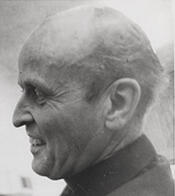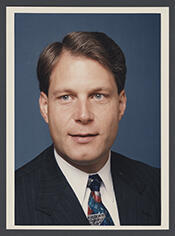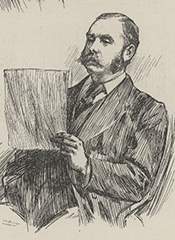
John Forrester Andrew (November 26, 1850 – May 30, 1895) was a United States Representative from Massachusetts and a prominent lawyer and Democratic politician in Boston during the late nineteenth century. He was born in Hingham, Massachusetts, on November 26, 1850, the son of John Albion Andrew, the Civil War governor of Massachusetts, and Eliza Jane (Hersey) Andrew. Raised in a family deeply involved in public affairs and reform causes, he grew up in an environment that emphasized civic duty, education, and political engagement, influences that shaped his later legal and political career.
Andrew received his early education in private schools before attending Phillips Academy in Andover, Massachusetts, one of New England’s leading preparatory institutions. He later studied at Brooks School in North Andover. He entered Harvard University and graduated in 1872, continuing immediately to Harvard Law School, from which he graduated in 1875. Shortly thereafter, he was admitted to the Suffolk County bar and commenced the practice of law in Boston. His legal work in Boston placed him within the city’s professional and political circles, where he developed a reputation as an able attorney and an active participant in Democratic Party affairs.
Andrew’s public career began in state politics. He was elected to the Massachusetts House of Representatives, where he served as a member of the lower chamber of the General Court and took part in legislative deliberations during a period of industrial growth and social change in the Commonwealth. He subsequently served in the Massachusetts State Senate, further extending his influence in state government and gaining experience in legislative procedure and public policy. In addition to his legislative service, Andrew held municipal office as Boston commissioner of parks, a position that involved oversight of the city’s developing park system and reflected the era’s growing concern with urban planning and public recreation.
By the mid-1880s, Andrew had become one of the leading Democrats in a state then largely dominated by Republicans. In 1886 he was the Democratic candidate for Governor of Massachusetts. Although he was unsuccessful in that campaign, his candidacy underscored his prominence within the party and his appeal as the son of a well-known wartime governor. His gubernatorial race helped to solidify his standing as a statewide figure and set the stage for his subsequent election to national office.
Andrew was elected as a Democrat to the Fifty-first and Fifty-second Congresses, serving in the U.S. House of Representatives from March 4, 1889, to March 3, 1893. Representing a Massachusetts district during a period marked by debates over tariffs, civil service reform, and economic policy, he aligned with the Democratic Party’s positions while also reflecting reform currents associated with his family’s legacy. During the Fifty-second Congress he served as chairman of the House Committee on Reform in the Civil Service, a role that placed him at the center of efforts to professionalize the federal workforce and reduce patronage, an important issue in post–Gilded Age politics.
In 1892 Andrew was an unsuccessful candidate for reelection to the Fifty-third Congress, bringing his formal congressional service to a close in March 1893. After leaving Congress, he resumed the practice of law in Boston, returning to the profession in which he had first established himself. He continued to be identified with public life and reform causes, drawing on both his legislative experience and his family’s long association with Massachusetts politics.
John Forrester Andrew died in Boston on May 30, 1895. He was interred in Mount Auburn Cemetery in Cambridge, Massachusetts, a resting place for many of the Commonwealth’s notable political, intellectual, and civic leaders. His career reflected the intersection of inherited public responsibility and personal achievement, spanning service in municipal, state, and national office during a transformative era in Massachusetts and American political history.
Congressional Record