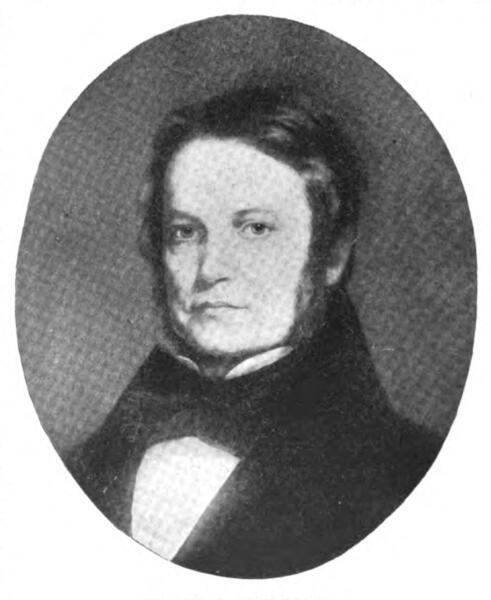
Joel Barlow Sutherland (February 26, 1792 – November 15, 1861) was an American politician, physician, lawyer, and military officer who served as the first president of the General Society of the War of 1812 from 1854 to 1861. A member of the Democratic Party and an early adherent of the Jacksonian movement, he represented Pennsylvania in the United States House of Representatives from 1827 to 1837, serving five consecutive terms during a formative period in the nation’s political development.
Sutherland was born on February 26, 1792, in Gloucester County, New Jersey. He pursued higher education in Philadelphia and graduated from the University of Pennsylvania in 1812. Trained in medicine, he entered professional life at a moment when the United States was on the brink of renewed conflict with Great Britain, and his early career combined medical practice with public service and military duty.
During the War of 1812, Sutherland served as assistant surgeon to the “Junior Artillerists of Philadelphia,” reflecting his medical training and commitment to the war effort. He later transferred from medical service to the line and, in 1814, was appointed lieutenant colonel of rifles in the Pennsylvania State militia. His wartime experience helped establish his public reputation and laid the groundwork for his later involvement in veterans’ affairs, culminating in his leadership of the General Society of the War of 1812 from 1854 until his death in 1861.
Sutherland’s political career began at the state level while he was still a young man. He served as a member of the Pennsylvania House of Representatives from 1813 to 1816, participating in state legislative affairs during and immediately after the War of 1812. He was also a founder of Jefferson Medical College in Philadelphia, reflecting his continued engagement with medical education and institutional development even as he moved more deeply into politics. From 1816 to 1817, he served in the Pennsylvania State Senate for the 2nd district. Over time, he gradually abandoned the practice of medicine in favor of the law, establishing himself as an attorney in Philadelphia.
Sutherland was elected as a Jacksonian to the Twentieth Congress and was reelected to the four succeeding Congresses, serving in the U.S. House of Representatives from March 4, 1827, to March 3, 1837. As a member of the Jackson Party representing Pennsylvania, he contributed to the legislative process during his five terms in office, participating in the democratic process and representing the interests of his constituents during a period marked by the rise of Jacksonian democracy, debates over internal improvements, banking policy, and expanding suffrage. During the Twenty-third and Twenty-fourth Congresses, he served as chairman of the United States House Committee on Commerce, a position that placed him at the center of national discussions on trade, navigation, and economic policy. While still in Congress, he also served as an associate judge of the court of common pleas of Philadelphia in 1833 and 1834, reflecting the breadth of his public responsibilities.
After a decade in Congress, Sutherland’s political fortunes shifted. He was an unsuccessful Whig candidate for reelection in 1836 to the Twenty-fifth Congress and again an unsuccessful Whig candidate for election in 1838 to the Twenty-sixth Congress, indicating a realignment of his political affiliations in the evolving party system of the 1830s. Beyond elective office, he remained active in civic affairs in Philadelphia. He was one of the originators of Lafayette Cemetery in South Philadelphia, contributing to the development of the city’s burial grounds and public spaces. His leadership of the General Society of the War of 1812 from 1854 to 1861 further underscored his enduring association with veterans of the conflict in which he had served as a young officer.
Joel Barlow Sutherland died on November 15, 1861, at the age of 69. He was buried in the churchyard of Old Pine Street Church in Philadelphia, Pennsylvania. His career spanned medicine, law, state and national politics, the judiciary, and veterans’ affairs, and his life reflected the political and social transformations of the United States in the first half of the nineteenth century.
Congressional Record