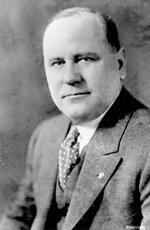
Joel Bennett Clark (January 8, 1890 – July 13, 1954), better known as Bennett Champ Clark, was a Democratic United States senator from Missouri from 1933 until 1945 and later a circuit judge of the United States Court of Appeals for the District of Columbia Circuit. A member of the Democratic Party, he served two terms in the Senate during a significant period in American history, emerging as a leading isolationist in foreign policy while also playing a key role in veterans’ legislation, including early sponsorship of the G.I. Bill. His career combined military service, party leadership, and judicial office, and he was widely regarded as an important figure in the conservative coalition that shaped congressional politics in the late 1930s.
Clark was born in Bowling Green, Pike County, Missouri, into a prominent political family. His father, Champ Clark, was a longtime Democratic leader in the House of Representatives and served as Speaker of the United States House of Representatives, and his mother was Genevieve Davis (Bennett) Clark. His sister, Genevieve Clark Thomson, was active in politics as a women’s suffrage advocate. He spent his childhood in both Bowling Green and Washington, D.C., reflecting his father’s congressional career, and was educated in the public schools of both communities. Clark graduated from Eastern High School in Washington, D.C., and went on to attend the University of Missouri in Columbia, where he received a Bachelor of Arts degree in 1912 and was elected to Phi Beta Kappa. He then enrolled at George Washington University Law School, earning a Bachelor of Laws degree in 1914. During his academic years he was affiliated with several honorary and professional societies, including Order of the Coif, Delta Sigma Rho, Delta Tau Delta, and Phi Delta Phi.
Even before completing law school, Clark began his professional life in national politics. In 1913 he was appointed parliamentarian of the United States House of Representatives, a position he held until 1917. In 1916 he also served as parliamentarian of the Democratic National Convention, underscoring his early prominence within the party’s procedural and organizational ranks. He resigned his House post in 1917 to enter military service during World War I. After leaving active duty, Clark returned to civilian life and the practice of law, but he remained closely connected to veterans’ organizations and Democratic Party affairs, building a base of support that would later underpin his Senate career.
Clark joined the United States Army in 1917, attended the First Officers’ Training Camp at Fort Myer, Virginia, and was commissioned a captain. He was then elected lieutenant colonel and second in command of the 6th Missouri Infantry Regiment of the Missouri National Guard, which was federalized as the 140th Infantry Regiment of the 35th Division. After deployment to France, he served on the headquarters staffs of both the 35th and 88th Divisions. In March 1919, while serving with the postwar Army of Occupation in Germany, he was promoted to colonel. He left active service in May 1919, but rejoined the Missouri National Guard in 1921 as a major on the staff of the adjutant general, serving until 1928. Clark helped organize the first American Legion convention in Paris and was elected the Legion’s first national commander. From 1919 to 1922 he served as president of the National Guard Association of the United States. Throughout his life he maintained an active interest in the 35th Division Veterans Association, the American Legion, and the Veterans of Foreign Wars, associations that later informed his legislative work on behalf of veterans.
After the war, in 1919, Clark established a law practice in St. Louis, Missouri. During the 1920s he combined legal work with historical and political pursuits, including researching and writing a biography of President John Quincy Adams. He became a frequent campaign speaker for Democratic candidates in Missouri and considered, but ultimately declined, a race for the United States Senate in 1928 for the seat of retiring Senator James A. Reed. That year he served as a delegate to the Democratic National Convention, a role he would reprise in 1936, 1940, and 1944. At the 1944 convention he delivered the nominating speech for fellow Missourian Harry S. Truman as the party’s candidate for vice president, reflecting his stature within the national Democratic Party.
In the 1932 election, Clark sought the United States Senate seat held by retiring Senator Harry B. Hawes. Drawing heavily on his strong support among veterans, he secured the Democratic nomination against two opponents and went on to defeat Republican Henry Kiel in the general election for the term beginning March 4, 1933. When Hawes resigned on February 3, 1933, a month before his term expired, Clark was appointed to fill the vacancy, giving him seniority over other senators elected that year. He was reelected in 1938 and served in the Senate from February 3, 1933, to January 3, 1945. In 1944 he was an unsuccessful candidate for renomination, losing the Democratic primary to Missouri Attorney General Roy McKittrick, who in turn lost the general election to Republican Governor Forrest C. Donnell. During his Senate tenure, Clark chaired the Senate Committee on Interoceanic Canals from 1937 to 1945 and served as a member of the Board of Regents of the Smithsonian Institution from 1940 to 1944.
Clark’s Senate career unfolded during the New Deal and World War II, and his positions reflected a complex blend of conservatism and liberalism. During the 1930s he opposed several key New Deal measures, including certain tax reforms, the National Recovery Administration (NRA), and the Agricultural Adjustment Administration (AAA). By 1937 he had become, in the words of one historian, “one of the organizers of the conservative coalition in Congress.” Nonetheless, he continued to identify himself as a liberal and publicly supported New Deal initiatives aimed at providing social security, encouraging homebuilding, and improving working conditions. On foreign policy he emerged as a prominent isolationist. In April 1943, British scholar Isaiah Berlin, in a confidential analysis for the British Foreign Office, described Clark as “a rabid isolationist and member of the American First Committee” who had “steadily voted against all the foreign policies and war measures of the Administration with the exception of the reciprocal trade agreements,” and characterized him as a member of the Wheeler–Nye–Robert A. Taft coterie and an “avowed Anglophobe.” Yet Clark could also be sharply interventionist in his rhetoric against America’s wartime enemies; on January 29, 1944, he declared on the Senate floor that Emperor Hirohito should be hanged as a war criminal at the war’s end.
Clark was also active on civil rights and veterans’ issues. In the fall of 1937 he displayed in the Senate chamber a poster bearing photographs of the bodies of Roosevelt Townes and Robert McDaniels, African American victims of a lynching in Duck Hill, Mississippi, earlier that year. The poster stated: “These blow torch lynchings occurred while the Wagner–Van Nuys Anti-Lynching Bill was pending before Congress. There have been NO arrests, NO indictments, NO convictions, of any one of the lynchers. This was NOT a rape case.” In 1944 he became the first senator to introduce the G.I. Bill proposal in Congress, drawing on his long association with veterans’ organizations. During hearings on the bill, he strongly opposed efforts to deny benefits to veterans who had received “blue discharges” (now termed “Other Than Honorable” discharges). Responding to testimony by Rear Admiral Randall Jacobs, who argued that including such veterans would undermine discipline, Clark dismissed these objections as “some of the most stupid, short-sighted objections which could be raised,” insisting that men discharged without honor solely for lack of aptitude for military service should not be deprived of benefits “to which soldiers are generally entitled.”
After his Senate service ended in January 1945, Clark returned briefly to private life before being nominated to the federal bench. On September 12, 1945, President Harry S. Truman nominated him to be an Associate Justice of the United States Court of Appeals for the District of Columbia (later styled United States Circuit Judge of the United States Court of Appeals for the District of Columbia Circuit), filling the vacancy created by the departure of Associate Justice Thurman Arnold. The Senate confirmed his nomination on September 24, 1945, and he received his commission on September 28, 1945. He served on the court until his death on July 13, 1954. During these years he also received honorary Doctor of Laws (LL.D.) degrees from several institutions, including the University of Missouri, Marshall College, Bethany College, and Washington and Lee University, in recognition of his contributions to public life.
Clark’s personal life reflected both his Missouri roots and his national prominence. In 1922 he married Miriam Marsh, daughter of Wilbur W. Marsh. The couple had three children: Champ, Marsh, and Kimball. Miriam Clark died in 1943. In 1945 he married British actress Violet Heming in a ceremony held at the Berryville, Virginia, home of his sister; President Truman served as best man, underscoring Clark’s close ties to the president. Clark’s political reputation as an isolationist was such that he, along with other senators of similar views, was referenced in Woody Guthrie’s 1943 song “Mister Charlie Lindbergh,” which criticized pre–World War II isolationism and called for leaders committed to defeating fascism.
Clark’s health declined during the last year of his life, and he died in Gloucester, Massachusetts, on July 13, 1954, while still serving on the federal bench. He was interred at Arlington National Cemetery, reflecting both his military service and his long tenure in national office.
Congressional Record