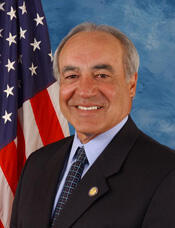
Joseph Natalio Baca Sr. (born January 23, 1947) is an American Democratic politician who served as a U.S. Representative from California from 1999 to 2013. A member of the Democratic Party for most of his career, he represented a district in southwestern San Bernardino County that included Fontana, Rialto, Ontario, and parts of the city of San Bernardino. Over seven terms in the House of Representatives, Baca participated actively in the legislative process and represented the interests of his constituents during a significant period in American political history.
Baca was born in Belen, New Mexico, the youngest of 15 children in a primarily Spanish-speaking household. His father worked as a railroad laborer, and when Baca was young the family moved to Barstow, California. Growing up in a working-class environment, he shined shoes at age 10, delivered newspapers, and later worked as a laborer for the Santa Fe Railroad. In 1966 he was drafted into the United States Army and served until 1968; he did not serve in Vietnam. Following his military service, Baca attended Barstow Community College and went on to earn a bachelor’s degree in sociology from California State University, Los Angeles.
After completing his education, Baca worked for 15 years in community relations with General Telephone and Electric, gaining experience in public outreach and corporate-community relations. His involvement in local education and governance began in 1979, when he became the first Latino elected to the board of trustees for the San Bernardino Valley College District. This early electoral success marked the beginning of a long career in public service and helped establish his profile as a representative of the growing Latino community in the Inland Empire region of Southern California. In 1989, Baca and his wife, Barbara, founded their own business, Interstate World Travel, in San Bernardino, further rooting the family in the local community.
Baca entered state-level politics in the early 1990s. He was elected to the California State Assembly in 1992 and served there until 1998, representing his district in Sacramento and focusing on issues affecting working families and local communities. In 1998 he was elected to the California State Senate, where he served until 1999. His tenure in the State Senate was brief, as a vacancy arose in the U.S. House of Representatives following the death of Congressman George Brown Jr. after a long illness. Baca ran in the special election to fill the seat, finishing first in a seven-way primary but falling short of a majority due to the presence of two minor Democratic candidates. In the special general election he defeated Republican Elia Pirozzi with 50.4 percent of the vote, securing his entry into Congress.
In the U.S. House of Representatives, Baca served from 1999 to 2013. He won a full term in 2000 with 59 percent of the vote. After the 2000 census, his district was renumbered as the 43rd and reconfigured as a majority-Hispanic district, in which he was handily reelected in 2002 and did not face another close contest until 2012. During his congressional service, Baca served on the House Financial Services Committee, where he was a member of the Subcommittee on Capital Markets, Insurance, and Government Sponsored Enterprises, and the Subcommittee on Financial Institutions and Consumer Credit. He also served on the House Agriculture Committee, where he was the ranking member of the Subcommittee on Departmental Operations, Oversight, Nutrition and Forestry, and participated in the Subcommittee on Department Operations, Oversight, and Credit, the Subcommittee on Livestock, Dairy, and Poultry, and the Subcommittee on Nutrition and Horticulture, at one point serving as ranking member of the latter. His committee work reflected interests in financial regulation, agriculture, nutrition, and consumer protection.
Baca was an active member of numerous caucuses. He served as chairman of the Congressional Hispanic Caucus (CHC) and chaired the CHC Corporate America, Technology, Communications and the Arts Task Force, which aimed to increase Hispanic representation in corporate America. He created and co-chaired the Congressional Sex and Violence in the Media Caucus, and he belonged to the Blue Dog Coalition, the Congressional Diabetes Caucus, the Military/Veterans Caucus, the Native American Caucus, and the U.S.-Mexico Caucus. His legislative record included co-sponsorship in 2011 of H.R. 3261, the Stop Online Piracy Act (SOPA). That same year he voted for the National Defense Authorization Act for Fiscal Year 2012, which contained a controversial provision allowing the government and the military to detain American citizens and others indefinitely without trial. In March 2012, Baca and Representative Frank Wolf of Virginia introduced H.R. 4204, the Violence in Video Games Labeling Act, which would have required video game companies to place the warning “WARNING: Exposure to violent video games has been linked to aggressive behavior” on their products.
Baca’s tenure in Congress was also marked by internal caucus disputes and ethics-related criticism. According to the Los Angeles Times, while serving as chairman of the Congressional Hispanic Caucus, he directed funds from the CHC’s political action committee, BOLDPAC (Building Our Leadership Diversity), to the unsuccessful California campaigns of his sons, Joe Baca Jr. and Jeremy Baca. Representative Loretta Sanchez and five other members withdrew from the PAC in protest, arguing that funds intended to elect Hispanic candidates should not have been used to support Baca’s sons in races against other Hispanic candidates, and noting that in a previous PAC-funded race Joe Jr. had also run against Hispanic opponents. Citizens for Responsibility and Ethics in Washington (CREW) released a report stating that Baca had paid his daughter $27,000 from campaign funds and donated more than $20,000 from his own campaign committee to his sons’ political campaigns. CREW also reported accusations from former members of Baca’s Washington staff that they were sent to California in 2004 for a staff retreat and pressured to work on Joe Baca Jr.’s state Assembly campaign while on paid time for the senior Baca.
In January 2007, several members of the Congressional Hispanic Caucus, including Loretta Sanchez, Nydia Velázquez, Hilda Solis, and Linda Sánchez, wrote a letter to Baca requesting a new election for CHC chair by secret ballot, asserting that he had been elected in a public vote contrary to caucus rules requiring a secret ballot. On January 31, Politico reported that Baca had referred to Loretta Sanchez as a “whore,” a characterization he denied. Loretta Sanchez and Solis alleged that Baca had made the remark in the summer of 2006. Citing the alleged insult, concerns over the propriety of his election as CHC chairman, and what they described as his treatment of Latina members within the caucus, Loretta Sanchez resigned from the CHC along with her sister Linda Sánchez, three other female California members, and one female member from Arizona. The Sanchez sisters said they learned of the remark from unnamed sources; Politico identified California State Assembly Speaker Fabian Núñez as one person who heard the insult firsthand and relayed it to Loretta Sanchez, and she stated that Baca confirmed the comments to Linda Sánchez the day before Loretta confronted him. In a February 2014 interview with The Hill, Baca, reflecting on his 2012 defeat, referred to Representative Gloria Negrete McLeod, who had unseated him, as “some bimbo”; minutes later he apologized, explaining that he was upset because he believed it was a disservice to voters that she had announced she would not seek reelection after serving only one term.
Following the 2010 United States census, California’s Citizens Redistricting Commission significantly redrew the state’s congressional map. Much of Baca’s former territory became the 35th District, while his home in Rialto was placed in the 31st District. Baca chose to run in the new 35th District and finished first in the all-party primary with 46.7 percent of the vote, ahead of State Senator Gloria Negrete McLeod, who received 34 percent; under California’s “top two” primary system, both advanced to the general election. In the closing weeks of the campaign, Negrete McLeod benefited from $3.2 million in independent expenditures from the federal super PAC of New York City Mayor Michael Bloomberg. The super PAC funded negative advertisements in newspapers, on radio, and on television accusing Baca of being soft on crime and of causing perchlorate contamination in drinking water. Bloomberg was reported to be displeased with Baca for not supporting stronger federal gun control laws and federal gun registration. Negrete McLeod defeated Baca in the general election, winning 56 percent of the vote to his 44 percent, ending his congressional service in January 2013.
After leaving Congress, Baca sought a return to federal office and pursued other electoral opportunities. In 2014 he ran for Congress in California’s 31st District but finished fifth in the primary with 11.2 percent of the vote. That same year he ran for mayor of Fontana, California, but lost by a wide margin and subsequently announced his retirement from politics. Nonetheless, he remained a recognizable figure in Inland Empire politics and continued to be associated with Democratic and Latino political networks. In June 2015, Baca switched his party affiliation to the Republican Party, citing his “core Christian” and pro-business beliefs as the basis for the change. In January 2018, he returned to the Democratic Party, stating that “in my heart, I’ve always been a Democrat with a 100 percent voting record for labor.”
After an eight-year retirement from elective office, Baca reentered politics at the local level. In 2022 he was elected to the Rialto City Council, marking a political comeback in the city where he resided. Building on that success, he ran for mayor of Rialto in 2024. In the 2024 Rialto mayoral election, Baca defeated incumbent Mayor Deborah Robertson and two other candidates, winning a four-year term as mayor. He received 6,226 votes (40.76 percent) to Robertson’s 4,668 votes (30.56 percent); the other candidates, Rafael Trujillo and Ché Rose Wright, received 22.55 percent and 6.13 percent of the vote, respectively. He thus assumed the mayoralty of Rialto, extending a political career that had spanned local, state, and national office.
Baca and his wife, Barbara, have four children: Joe Jr., Jeremy, Natalie, and Jennifer. Their son Joe Baca Jr. served one term as a state assemblyman for California’s 62nd District. The Baca family is associated with the broader Baca family of New Mexico, a historically significant Hispanic family in the American Southwest. Throughout his career, Joe Baca’s trajectory from a large, working-class family in New Mexico and California to the halls of Congress and local executive office in Rialto has reflected both the opportunities and controversies that have accompanied the rise of Latino political leadership in the United States.
Congressional Record